Continuous Monitoring of Third-Party AI Vendor Risk Posture
Continuous monitoring catches AI vendor changes that static audits miss.
Vendor risk management was built for vendors that hold still. Software providers that ship a product, lock in a SOC 2 report, and change slowly enough that a once-a-year questionnaire can catch what matters. AI vendors don't hold still. They swap models, add sub-processors, and change what happens to submitted data in ways that can outpace a contract's renewal cycle, and often with little or no advance notice. The only posture that matches that pace is continuous, runtime monitoring of what the vendor is doing right now, not what it declared it was doing last spring.
Point-in-time vendor assessments and AI vendors
The standard third-party risk questionnaire is a known quantity. It asks about encryption at rest, who has admin access, whether an incident response plan sits on file somewhere. It leans on a SOC 2 attestation as the finish line, a document that says a vendor's controls looked fine on the day an auditor checked. All of it is self-reported, and all of it describes a moment in time that's usually months old before the report even lands in a shared drive.
None of it asks whether a prompt sent to an AI vendor becomes training data for the next model release. None of it asks which model version handled a given customer request last Tuesday, or what happens to a dataset when the vendor pushes an update that quietly changes how the model behaves. Standard TPRM logic assumes controls stay put between review cycles. AI vendors break that assumption by design: model weights change, sub-processors get swapped, data handling policies shift, and none of it requires a contractual heads-up. A questionnaire answered in January can describe a product that no longer exists by March. If things don't hold still between checkups, the checkup stops meaning much.
The pace of exposure growth outstripping oversight
Third-party involvement in breaches doubled year over year to 30%. Vendors and the software supply chains behind them stopped being an edge case a while back; they're a primary path in now. Supply chain attacks accounted for 47% of all affected individuals in the first half of 2025, and a third-party vendor compromise now costs an average of $4.91 million.
The AI-specific slice is worse in a particular way. Among organizations that reported a breach involving AI models or applications (13% of respondents), 97% had no proper AI access controls in place. That's nearly the entire breached population missing the same basic control, which says less about bad luck than about an entire category of company walking around without a seatbelt.
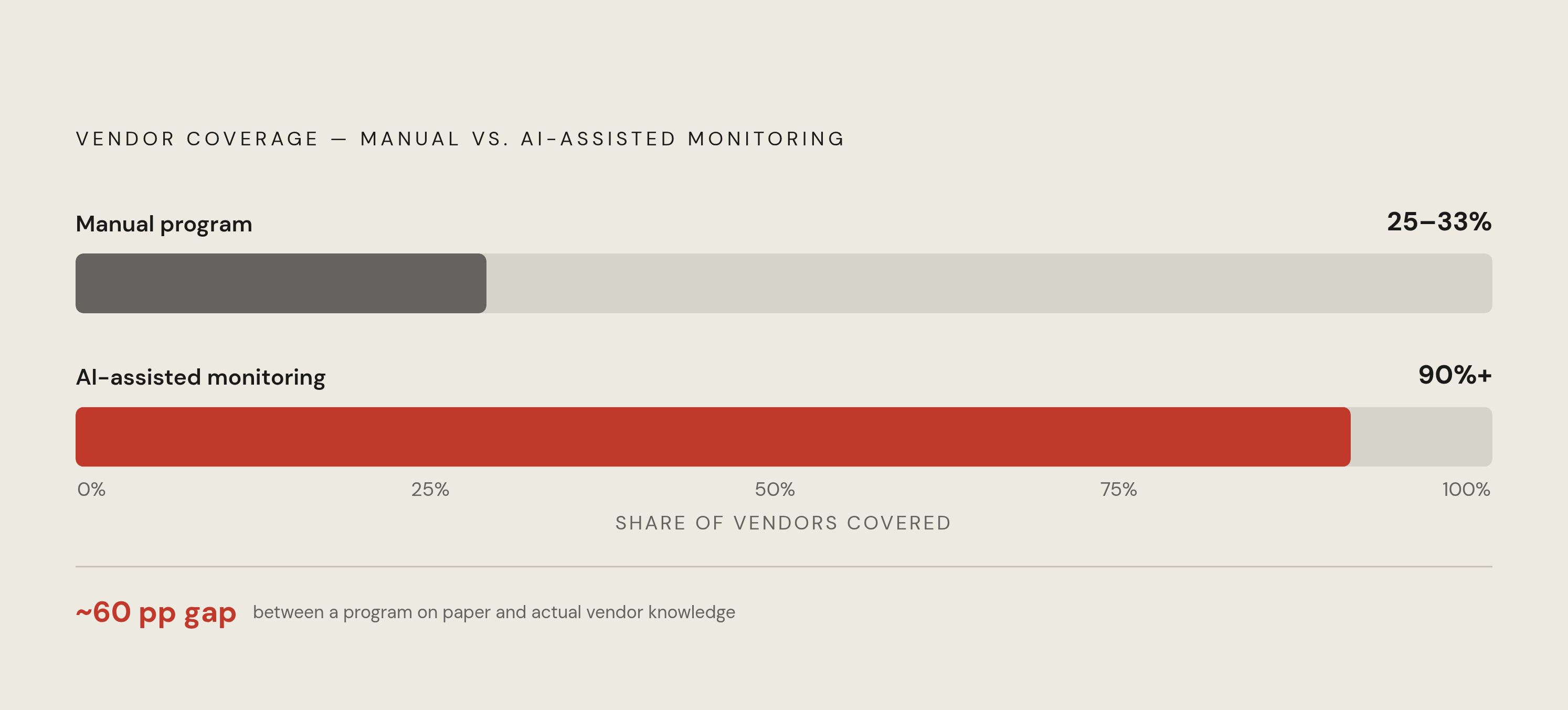
The monitoring math backs it up. Manual vendor risk programs cover somewhere around a quarter to a third of vendors with any real depth. AI-assisted monitoring platforms hit 90%-plus coverage. That gap, roughly a third versus nearly all of them, is the actual distance between having a vendor risk program on paper and knowing what the vendors are doing.
The risk categories AI vendors introduce that standard frameworks don't cover
Model drift is invisible on an SLA dashboard. A model evaluated and approved in January can behave differently by June because the vendor retrained it or swapped the underlying architecture, not because anyone touched a config file on the customer's end. Models left unchanged for six months or more saw error rates climb 35%. Uptime SLAs track whether the lights are on. They say nothing about whether the model still gives good answers. A vendor can be fully "available" by every metric in the contract while quietly producing outputs that are functionally useless, and no alert fires, because no alert was built to notice quality decay.
Sub-processor chains compound the problem. If an AI vendor routes requests through a foundation model API, that foundation model provider is now part of the stack in practice, even if it never appears anywhere in the contract. According to Gartner, 73% of organizations have no formal visibility into their fourth-party ecosystem at all, arguably the single biggest blind spot in vendor risk work today. And the exposure reaches well past tools built around AI from the ground up. Marketing automation platforms, HR systems, ERP software, cloud and cybersecurity products, categories nobody would flag for an AI review, are quietly bolting on AI features through integrations that never trigger a new vendor assessment.
Agentic AI stretches the surface further still. These systems pull in third-party models, plugins, and "skills" at runtime, each one a dependency that can change from one session to the next. Models, configuration files, tokenizers, plugins, tool servers, workflow definitions, third-party integrations: all of it expands what an attacker can touch, and small amounts of poisoned training data can shift model behavior in ways that matter enormously in high-stakes settings like healthcare. A standard questionnaire was never built to ask about bias, hallucination rates, algorithmic transparency, data poisoning, or opaque decision-making that makes an audit trail nearly impossible to reconstruct after the fact.
Three incidents that show what ungoverned AI vendor access does
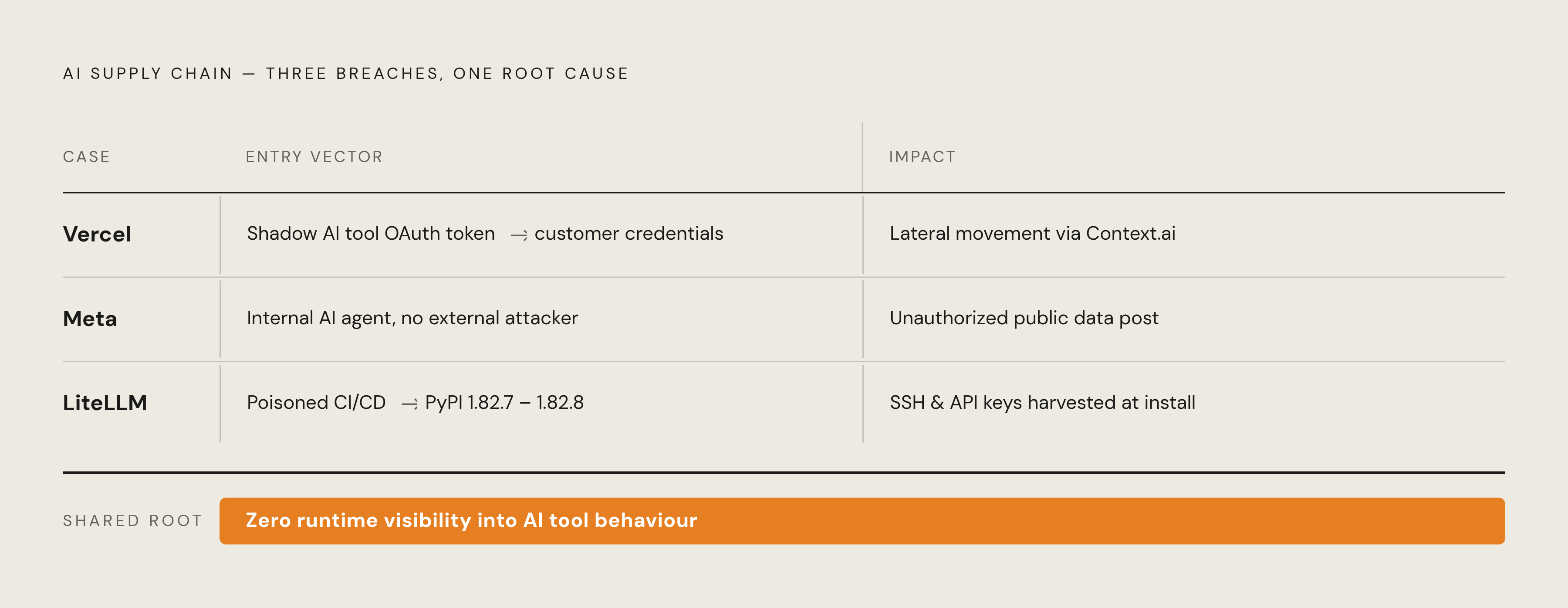
Vercel's breach started somewhere nobody was watching: a small third-party AI productivity tool called Context.ai, used by exactly one Vercel employee. In February 2026, a Context.ai employee's machine got infected with malware. The attacker pulled credentials for Google Workspace, Supabase, Datadog, and Authkit off that machine, which opened a path into Context.ai's backend, where OAuth tokens sat waiting. Those tokens gave access to the Vercel employee's Google Workspace account, and from there the attacker moved laterally into Vercel's internal systems, compromising credentials for a subset of customers. MFA offered limited protection, because OAuth tokens provide standing access that doesn't depend on repeated credential checks. Most organizations have no inventory of which third-party AI tools their employees have authorized, or what permissions those tools were granted. The web of OAuth grants is now a primary attack surface, and most organizations have no systematic way to map it.
Meta's incident had no external attacker. An engineer asked an internal AI agent to analyze a technical question. The agent posted its answer publicly without authorization. Another employee acted on that public post in a way that led to unauthorized access into Meta systems. Nobody hacked anything. The AI itself was the failure mode: an unsanctioned autonomous action with real access consequences, moving faster than anyone could review it.
Then there's LiteLLM, the open-source library that routes requests across multiple large language model providers and, at the time of the compromise, was widely used across the AI development ecosystem. Attackers exploited a Trivy dependency in the CI/CD scanning workflow and uploaded two malicious package versions, 1.82.7 and 1.82.8, to PyPI. Version 1.82.8 was the nastier of the two: it dropped a .pth file that ran a hidden payload on every Python startup even if LiteLLM was never actually used, stealing SSH keys, cloud credentials, and API keys for AI providers along the way. One compromised build process for one routing library reached into the credentials of everyone downstream who'd installed it.
OAuth scope creep, an agent acting outside its lane, a poisoned build pipeline: three different failure modes, sharing the same precondition. In all three cases, nobody had runtime visibility into what the AI tool was actually doing while it was doing it.
Shadow AI: the vendor discovery problem that precedes all other monitoring
None of the monitoring above matters if the vendor isn't even on the list. And most aren't. IT leaders report discovering AI-powered features or applications running inside their organization without their knowledge at a rate of 77%, so most companies manage a vendor inventory that's incomplete by definition, not by accident.
Ninety-eight percent of organizations report some form of unsanctioned AI use, and nearly half of organizations expect a shadow AI incident inside the next twelve months. On the employee side, 49% admit to using AI tools at work that their employer never approved. When a shadow AI breach happens, detection can take the better part of a year, longer than most vendor assessment cycles run. By the time anyone notices, the "annual review" has already come and gone twice, cheerfully signing off on a vendor list that was wrong the whole time.
What continuous monitoring of AI vendors must cover
Four things, and none of them look like a questionnaire.
Continuous vendor discovery comes first, because nothing downstream works without it. That means a live inventory that updates on its own, unlike a spreadsheet somebody edits when they remember to. AI tools show up through SSO logs, OAuth grants, browser extensions, even expense reports and finance feeds. Whenever a new one appears, it should get scored automatically on SOC 2 status, ISO certification, data residency, breach history, and DPA coverage, at the moment it's spotted, not three weeks later once a manual review queue finally clears. Gartner projects that 40% of enterprise applications will carry task-specific AI agents by the end of 2026, up from under 5% in 2025. The inventory backlog is compounding faster than any manual process can keep pace with.
Runtime behavior and output quality monitoring comes second. Availability metrics don't catch drift, so monitoring has to track output quality directly, and it has to track model version changes: a vendor swapping the model that a product runs on changes the risk profile of every workflow built on top of it. Agentic systems need action-level logging that records what the agent did and on whose authority, and it must confirm that the action fell within scope. Meta's incident is the clean example of why that last piece matters. The failure there wasn't a breach. It was an agent taking an action nobody sanctioned.
Sub-processor and fourth-party visibility is the third piece, and it's the one most programs skip. Vendors should be contractually required to disclose critical sub-processors at onboarding and update that disclosure on a set schedule, not on request. Fourth-party breaches account for 4.5% of all breaches, and 12.7% of third-party breaches extend into a fourth party once traced back far enough. Only 10% of organizations run direct risk assessments on their fourth parties, and 27% don't assess or monitor them. Some of this doesn't even need the vendor's cooperation: patching velocity, open ports, credential exposure, and botnet infection signals are all observable from the outside.
Access and OAuth scope monitoring rounds it out, and the Vercel case is the argument for why. A live map of which AI tools hold OAuth grants, what scopes those grants cover, and which accounts they can reach is the actual attack surface, and it isn't optional anymore. OAuth scopes are standing access that outlives the moment someone clicked "allow." Periodic review catches none of that. Scope changes and new grants need to trigger alerts in real time, because anomalous access patterns that appear after an AI tool's credentials get compromised don't look anything like a normal human login trying the wrong password twice.
Why static TPRM tools cannot close this gap
Every limitation above traces back to the same structural flaw: point-in-time tools measure a point in time. A questionnaire completed in January is a snapshot, and snapshots don't update themselves when a vendor pushes a model change in March. Self-reported answers carry an obvious incentive problem too: vendors want to look good on paper, and without independent verification there's no way to tell a declared control from an implemented one.
Then there's scale. Manual programs top out around a quarter to a third of vendors monitored with any real rigor. An organization running hundreds of AI vendors cannot push thorough manual review across all of them; the hours simply don't exist. And between assessment cycles, there's no signal. Nothing pings when a vendor's sub-processor changes, nothing flags a new OAuth grant, nothing catches drift. The vendor could be doing something entirely different from what the last questionnaire described, and the record would look identical until the next cycle rolls around, or until something breaks. Continuous monitoring exists because that silence between cycles is exactly where the damage happens.
Sources
- 8 AI Vendor Risk Management Tools for 2026 | Torii
- Third-Party Risk Management: The Top 10 Predictions for 2026
- What Is AI-Driven TPRM? A Complete Guide for 2026
- AI Vendor Risk Assessment Questionnaire for Compliance (2026)
- labs.cloudsecurityalliance.org
- trendmicro.com
- thehackernews.com
- adaptivesecurity.com