Productivity vs. Control Tradeoffs in Shadow AI Policy
Employees use unauthorized AI faster than IT can govern it safely.
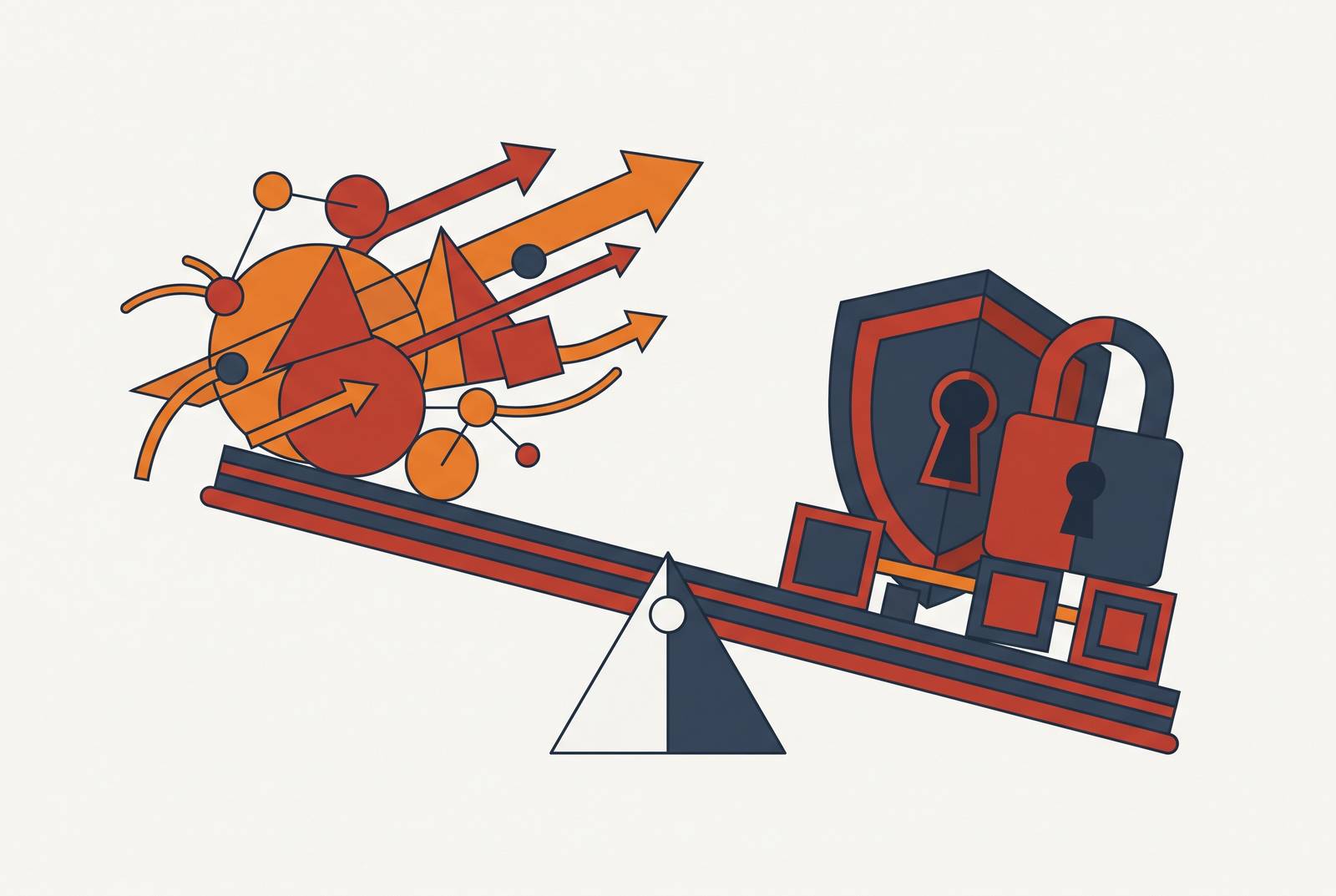
Shadow AI is a rational response to a productivity gap that official channels have failed to close. The behavior is widespread and routine rather than occasional: employees lean on AI most for generating ideas, analyzing data, summarizing meetings, conducting research, and drafting written material, the daily bread of knowledge work rather than some fringe shortcut. The Teramind Shadow AI Behavior Report 2025-2026 found that most knowledge workers who use their own AI tools do so because they prefer the independence, and a third say IT simply doesn't offer what they need. It is closer to an employee buying their own stapler because the supply closet is locked than to sabotage.
The supply side explains the gap. The Lenovo Work Reborn Research Series 2026, whose fifth report surveyed full-time employees at enterprise organizations, found that roughly a fifth of organizations provide no AI tools for workplace use at all, and nearly a third offer no training on how to use AI at work. Meanwhile demand keeps climbing: the same survey found that a large majority of employees expect their AI use to increase over the next year, with a large share expecting that increase to be significant. Supply is flat or absent in a fifth of organizations while demand accelerates, and the difference gets filled by whatever tool an employee can open in a new browser tab.
The most striking detail is where this behavior concentrates. The Trusted Tech Team 2026 Shadow AI Research Report found that senior decision-makers are more than twice as likely as their own teams to use unapproved AI tools. Shadow AI is not an entry-level habit that leadership is stamping out. It runs top-down. The people writing the policies are often the same people breaking them before lunch. And the floor beneath all of this is firm: the Teramind report found that roughly half of workers would refuse to give up their personal AI tools even if their employer banned them. These tools have already been folded into how employees judge their own adequate performance at work, which is a difficult thing to legislate away with a memo.
What is at risk when AI use escapes governance
The exposure shadow AI creates is harder to reverse and harder to detect than the unauthorized SaaS adoption organizations learned to manage in the previous decade. An unauthorized Dropbox folder can be deleted. An AI model that has ingested a company's source code cannot be asked to forget it, since the tool may retain or train on what it was given, turning a single careless prompt into a permanent exposure rather than a recoverable one. The Teramind report found that 70 to 75 percent of employees using unapproved AI admit to sharing potentially sensitive information, customer data, employee records, or internal documents, and a large share upload files including PDFs, slide decks, spreadsheets, logs, and code repositories. Browser extensions and SaaS connectors compound the problem by moving data between corporate systems and consumer AI services without security review, creating integration risk that mimics the classic shadow-IT pattern.
The record already contains the cautionary tales. In late March 2023, Samsung semiconductor engineers pasted proprietary source code, including internal database code and defect-detection algorithms, along with confidential meeting transcripts into ChatGPT on three separate occasions within a few weeks. Samsung banned generative AI company-wide within a month, reversed that ban later, leaned on internal tools in the interim, and by 2026 had re-adopted external services including ChatGPT, Gemini, and Claude; the reversal shows the reactive ban addressed optics rather than the underlying demand. Supply-chain risk appeared again in February 2025, when the AI chatbot aggregator OmniGPT suffered a breach that exposed tens of millions of lines of AI conversations, tens of thousands of user emails and phone numbers, and sensitive data including API keys and credentials buried inside user-uploaded files, a risk employees had no way to evaluate before they ever signed up.
Regulatory exposure compounds the technical exposure. Unauthorized AI use can violate GDPR, the EU AI Act, HIPAA, PCI DSS, and SOC 2 even when the organization never formally sanctioned the tool in question. As of January 2026, the Insurance Services Office filed new generative AI exclusions, including CG 40 47, that broadly exclude claims tied to generative AI outputs: defamation, intellectual property infringement, and physical damages traceable to AI errors. A breach caused by shadow AI may simply be uninsurable. IBM's research, cited in the Teramind report, found that shadow AI added substantially to the average cost of a breach, and a significant share of organizations reported breaches caused specifically by shadow AI.
Why existing controls fail to contain shadow AI
Most organizations that believe they have shadow AI under control do not, because the tools built to govern shadow IT were not built for how AI traffic actually moves. AI traffic runs encrypted, through the browser, which makes a simple URL block both too blunt and too easily sidestepped: it snags ordinary employees doing ordinary work while missing anyone determined enough to find a workaround. A binary allow-or-deny policy for AI tools also ignores context entirely. User role, data classification, and business justification carry no weight in a coarse network rule, so the system treats a marketing intern drafting ad copy the same as an engineer pasting proprietary code.
Scale makes the problem worse. The Teramind report found a substantial majority of workers using unapproved AI tools, with a large share doing so weekly, scattered across dozens of apps, browser plugins, and personal accounts, a surface area no single block-list can realistically cover. Teramind's research also quantifies the resulting blind spot directly: a large majority of organizations report no visibility into their AI data flows at all. On average, unsanctioned applications operate inside the enterprise for more than 400 days before anyone notices them, long enough for entire departments to build core workflows around a model that doesn't appear anywhere on the company's asset inventory.
The most common form of shadow AI is AI functionality embedded inside tools the company already approved and pays for, Notion AI, Microsoft 365 Copilot, Slack AI, Salesforce Einstein, GitHub Copilot. The approved-app catalog, in other words, offers no protection, since the shadow AI is living inside the sanctioned software. As of 2026, auditors have started showing up asking for a complete AI tool inventory that accounts for these embedded features, not just standalone applications. Organizations have been retreating from outright bans, as the Lenovo 2026 survey and related research show, but the Cisco 2026 Data and Privacy Benchmark Study found that this retreat has not been matched by a parallel rise in the technical controls that would make loosening the ban safe. Employees have been documented reinstalling AI tools the moment after IT revoked their access, a behavioral persistence that means even a well-written policy needs enforcement machinery most organizations haven't built yet. A CSIRO empirical study of 27 Australian critical infrastructure organizations identified three specific mechanisms behind this security erosion: data flows that bypass established perimeters entirely, embedded AI features that expand an organization's attack surface without ever being formally assessed, and a loss of observability that undermines forensic auditing and least-privilege enforcement alike. None of these three mechanisms is solved by a firewall rule.
Why prohibition alone makes the problem worse
Banning unsanctioned AI tools outright does not make shadow AI disappear. It pushes the behavior underground, eliminates whatever oversight the organization had, and throws away the productivity gains that made employees reach for these tools in the first place. The Teramind report found that roughly half of workers would keep using AI tools even after an explicit ban. The ban doesn't eliminate the risk so much as convince the organization that it has, a compliance fiction dressed up as a policy win. During 2023, JPMorgan Chase, Citigroup, Goldman Sachs, Bank of America, Deutsche Bank, and Wells Fargo all banned or restricted employee use of ChatGPT. The bans made headlines without curbing the underlying demand, and the broader financial industry has since drifted toward governed access instead of prohibition. Samsung's own ban followed the identical arc: reversed, replaced by an internal AI tool, and eventually supplemented by the exact external services it had once outlawed, evidence that the organization had to supply a sanctioned alternative before the underlying problem actually went away.
Caution carries its own price tag. An organization that plays it too safe on AI will likely miss out on the efficiency, productivity, and innovation gains the technology offers, and will fall behind competitors willing to take a more permissive, pro-innovation stance. That tradeoff isn't theoretical: the Lenovo 2026 survey found that a large majority of employees say AI makes them more productive, so prohibition asks an organization to give up a real, employee-confirmed advantage in exchange for a security posture that half its workforce is already quietly ignoring. The strongest counterargument holds that the productivity case gets overstated and that a temporary ban is worth the inconvenience while real controls get built. But unsanctioned applications run inside the enterprise for more than 400 days on average before anyone discovers them, so any "temporary" prohibition is likely to expire long after shadow AI has already burrowed into daily workflows, making the pause largely symbolic.
What workers will comply with
Greer Consulting Inc. states the dynamic directly: "Shadow AI isn't a technology problem, it's a trust problem. What we're seeing across workplaces right now is employees quietly turning to AI tools that leadership hasn't approved, not because they're trying to be rebellious, but because they're trying to survive the pace of work". Employees keep their AI use quiet mainly out of fear of judgment or pushback, and because no clear policy exists telling them what is actually permitted. That's an employee filling a vacuum the organization left open, not hiding something they know to be wrong.
The numbers back up the vacuum. The Teramind report found that in many organizations, fewer than half of employees can even describe the company's AI usage policy, and a policy nobody can describe is not a policy that governs anyone's behavior. Roughly half of employees say they've received conflicting guidance on AI use, and nearly a quarter say they received no training whatsoever. Mixed signals don't produce compliance. They produce improvisation, each employee inventing their own rules because the organization never settled on one. Even where training exists, it rarely sticks: among employees who received it, a majority say it wasn't regular or ongoing, and a large share call it ineffective outright. A single training session delivered once, at onboarding, and never repeated does not change behavior that gets tested daily. The appetite for something better is sitting right there in the data: the Lenovo survey found that half of employees say better training would help them get more value out of AI at work.
A healthcare system offers the clearest evidence of what fixing this actually looks like. After providing employees with approved tools and setting clear boundaries around their use, the organization achieved a large reduction in unauthorized AI use alongside meaningful daily time savings for clinicians. The intervention worked because it closed the control gap and the productivity gap at the same time, rather than attacking one while ignoring the other. The design principle here is that a policy earns compliance when the employee under deadline pressure finds the sanctioned path easier to take than the workaround. A policy that only removes the unsanctioned option, without replacing it with something as fast and as useful, will be quietly routed around by the next deadline.
The governance framework that earns compliance without sacrificing control
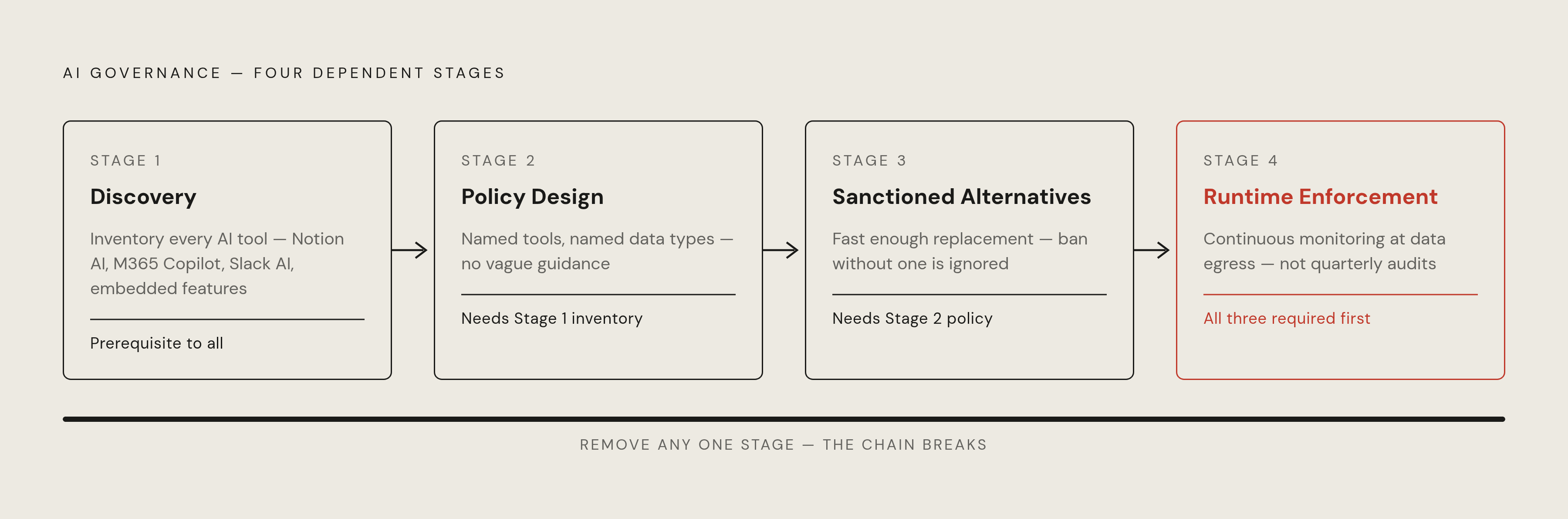
Shadow AI governance holds together on four parts working at once: discovery, policy design, sanctioned alternatives, and runtime enforcement. Each of the four depends on the other three; without one, the rest cannot hold. Organizations that bolt on a single fix, a block-list here, a training deck there, keep finding themselves back at square one.
Discovery comes first, on the simple logic that nothing ungoverned can be governed. A complete AI tool inventory has to include the embedded AI features riding inside sanctioned SaaS platforms (Notion AI, Microsoft 365 Copilot, Slack AI, Salesforce Einstein, GitHub Copilot) and not just the standalone, easier-to-spot rogue applications, since auditors are now arriving with exactly this request as of 2026. Standard DLP, CASB, and EDR tools weren't built to answer the questions that matter here: which users are sending data to public AI tools, what kind of data they're sending, and whether outputs are ending up inside a codebase without review. Answering those questions takes purpose-built monitoring operating at the user and session level, since most legacy tools still operate at the network level.
Policy design comes next, and the earlier sections already supplied the blueprint for what fails: vague guidance, conflicting signals, and training that happens once and is never repeated. A policy that employees can actually describe back, with specific tools named as approved or prohibited and specific data types flagged as off-limits, succeeds where a vague "use AI responsibly" memo does not.
Sanctioned alternatives matter just as much as the rule itself. The healthcare case and Samsung's own reversal both point to the same conclusion: banning a tool only works if the organization hands employees a replacement that is fast enough and capable enough to compete with the thing being taken away. Without that substitute, the ban is a suggestion, and roughly half of employees have already said they'll ignore it.
Runtime enforcement closes the loop. Visibility and good intentions don't stop an employee from reinstalling a blocked tool the same afternoon IT revokes it, a pattern that has been documented happening. Enforcement has to operate continuously, at the moment data is about to leave the building, rather than as a quarterly audit; unsanctioned applications on average operate within the enterprise for more than 400 days before discovery, by which point entire departments may have built core workflows around an AI model absent from the company's asset inventory. Putting the four pieces together stops the tradeoff between productivity and control from being a tradeoff at all. Employees get a tool fast enough to keep up with the pace of their work, and the organization gets a line of sight into how that tool is actually being used, which is the only version of this arrangement that holds up under an audit, a breach, or a bad news cycle.