Shadow AI Discovery in Large Enterprises
Unapproved AI tools at work leak data on a schedule, not just once.
Shadow AI means any AI tool, model, or agent employees use without IT knowing, approving, or governing it. That sounds like shadow IT with a new coat of paint, and plenty of security teams treat it that way. That is the mistake. Shadow IT moved data to an unapproved place: a personal file-storage account, a rogue team-messaging workspace, some contractor's shared spreadsheet. Bad, but bounded. The data sat somewhere. You could find it, delete it, and move on with your week.
Shadow AI doesn't sit still. Paste a contract into an unapproved chatbot and the text doesn't just land somewhere unauthorized, it can get retained, learned from, or surfaced later through someone else's query on the same platform. The data stops behaving like a file and starts behaving like an input, and most enterprise security programs built for shadow IT haven't caught up to what that means.
The blast radius makes the point sharper. An unapproved chatbot exposes whatever a person types into it, which is bad enough. An unapproved agent can query a database, call an API, send an email, and take five more actions after that without anyone checking its work. A chatbot leaks once. An agent leaks on a schedule, and it sets its own schedule.
The definition of "AI tool" has also expanded past the chat window everyone pictures. It covers browser extensions and AI features baked into SaaS products nobody thought to audit, model APIs called directly from a script sitting in a production repo, IDE assistants a developer installed on a Tuesday afternoon, agents running in containers or as local processes or as MCP servers, and copilots embedded inside applications IT approved years ago, back when "approved" still meant something. The attack surface didn't grow. The attack surface multiplied instead of merely growing.
How fast shadow AI is spreading inside large enterprises
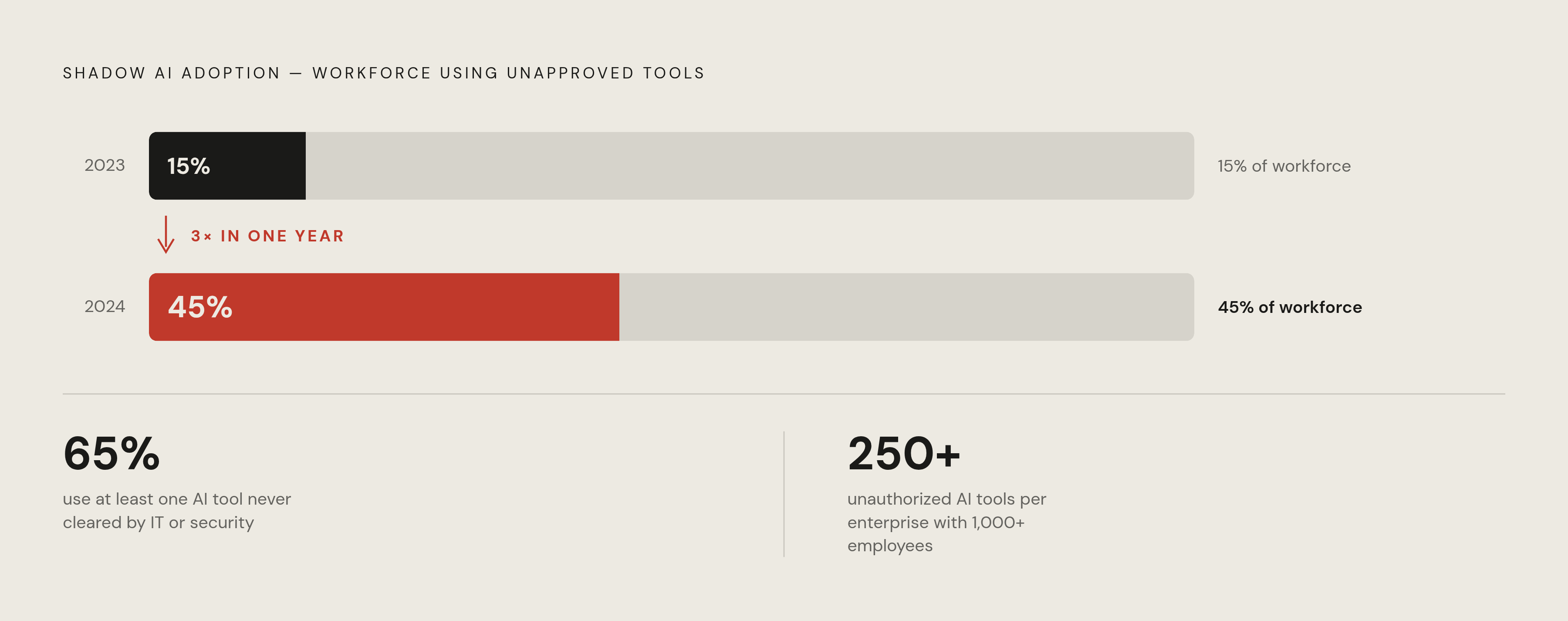
Employees aren't going to raise their hands about this, so the adoption numbers have to come from somewhere else. Seventy-eight percent of AI users at work bring their own AI tools outside IT approval, and 65% of employees use at least one AI tool that was never cleared by IT or security. That's the majority of the workforce, doing its job with software the security team has never seen.
One in three employees regularly logs into AI tools using personal accounts on corporate devices, which routes straight around whatever access controls the organization built. Corporate identity governs the laptop. It doesn't govern the login screen.
Unapproved AI use on corporate devices tripled in a single year, climbing from 15% to 45% of the workforce. That's not a trend line worth a footnote; it's a phase change, a jump that turns "something to monitor" into "something to fix this quarter.""
The enterprise picture gets worse, not better, with scale. Companies with more than 1,000 employees manage an average of 250-plus unauthorized AI tools running somewhere in their environment. The 2025 State of Shadow AI Report puts the average enterprise's total unauthorized application count, AI and otherwise, at 1,200. Somewhere in that pile sits every category of exposure a security team is paid to prevent, and nobody's counted them yet.
What sensitive data leaves the organization through shadow AI
Four things walk out the door: intellectual property (customer lists, contracts, trade secrets), passwords and API keys (usually pasted by accident inside a chunk of code someone was debugging), regulated data (PII, health records, financial records), and confidential operational data, the internal stuff that never had a name until it ended up somewhere it shouldn't.
The Samsung case gets cited constantly, and it earns the reputation. Three engineers at Samsung's semiconductor division, working independently, each pasted something sensitive into ChatGPT: proprietary source code, manufacturing equipment software, and a transcript from a confidential meeting. Three people, three incidents, one team, zero coordination between them. Nobody conspired. Nobody needed to.
The DeepSeek breach makes a different point. Misconfigured infrastructure at the AI chatbot platform exposed more than a million records, including chat logs and API keys, and no employee made a mistake here. The lesson sits in what happens after data lands on an ungoverned AI platform: it doesn't stay put, and it doesn't stay private just because nobody meant any harm. The exposure triggered regulatory scrutiny, which is usually how these stories end up on a compliance officer's desk instead of a security blog.
The trend line backs up both stories. Shadow AI-linked security incidents rose from 20% to 43% of all AI-related breaches year over year, and the average cost of a breach involving shadow AI hit $5.39 million. Somewhere between the ChatGPT paste and the invoice from the incident response firm, the abstraction disappears and the number gets real.
Five surfaces where shadow AI hides and the detection method each one requires
Single-layer audits miss somewhere between half and two-thirds of actual exposure. That is a polite way of saying most audits fail before they start, because the teams that get burned ran one scan on one layer and called the problem solved.
Network traffic shows which AI services employees connect to by domain: ChatGPT, Gemini, Claude endpoints, and whatever else is resolving through corporate DNS. Detection here runs through DNS security, cloud secure web gateways like Zscaler or Netskope, and CASB traffic inspection. The gap is structural: DNS sees the destination, not the prompt or the file getting uploaded, and SWG enforcement only works on-device if traffic actually routes through the vendor's cloud point of presence for decryption. This layer never registers local agents, and it's chasing a moving target: Netskope now tracks more than 1,550 distinct generative AI SaaS applications, up from 317 in an earlier baseline, expanding faster than any static blocklist can keep pace with.
Browser activity reveals AI websites visited, extensions installed, prompts typed into web tools, and whether someone's using a personal account instead of a corporate one. Enterprise browsers and browser security extensions like LayerX handle detection here, inspecting at the prompt level. But the browser boundary is a hard wall: desktop AI apps, IDE assistants, and locally running agents are invisible from this vantage point, and unmanaged devices don't show up. Personal-account use bites hardest right here. Forty-seven percent of workplace generative AI users are on personal accounts, and those sessions look exactly like ordinary personal browsing to any control anchored to corporate identity.
Endpoint telemetry catches locally installed AI software: IDE extensions like GitHub Copilot, Cursor, and Claude Code, local LLMs, and MCP servers running as local processes. EDR/XDR platforms, endpoint agents, and software inventory scans do the detecting, but the gap is coverage: unmanaged laptops and contractor machines stay dark, and even a clean endpoint scan tells you what's installed without telling you what data the tool actually touched or sent somewhere else. Both are tools developers install themselves, often without ever appearing in IT's official SaaS registry. That's the scale of what sits on developer laptops alone, unlogged and unreviewed.
The agentic AI tier changes the discovery problem qualitatively, not just quantitatively
A passive AI tool waits for someone to type something. An agent doesn't wait for anything. It queries a database, calls an API, sends an email, and holds onto credentials to do it all again tomorrow, with no human checkpoint anywhere in the loop. Same name, but a different animal.
MCP adoption grew more than 400% in 2025, and most of those deployments happened outside any formal security review. Worse, MCP servers don't respect the tidy five-layer framework above: they can run as local processes, live inside SaaS products, or operate as infrastructure-level agents, and a single deployment can span network, browser, endpoint, and code all at once. Trying to catch it with one detection layer is like trying to net smoke.
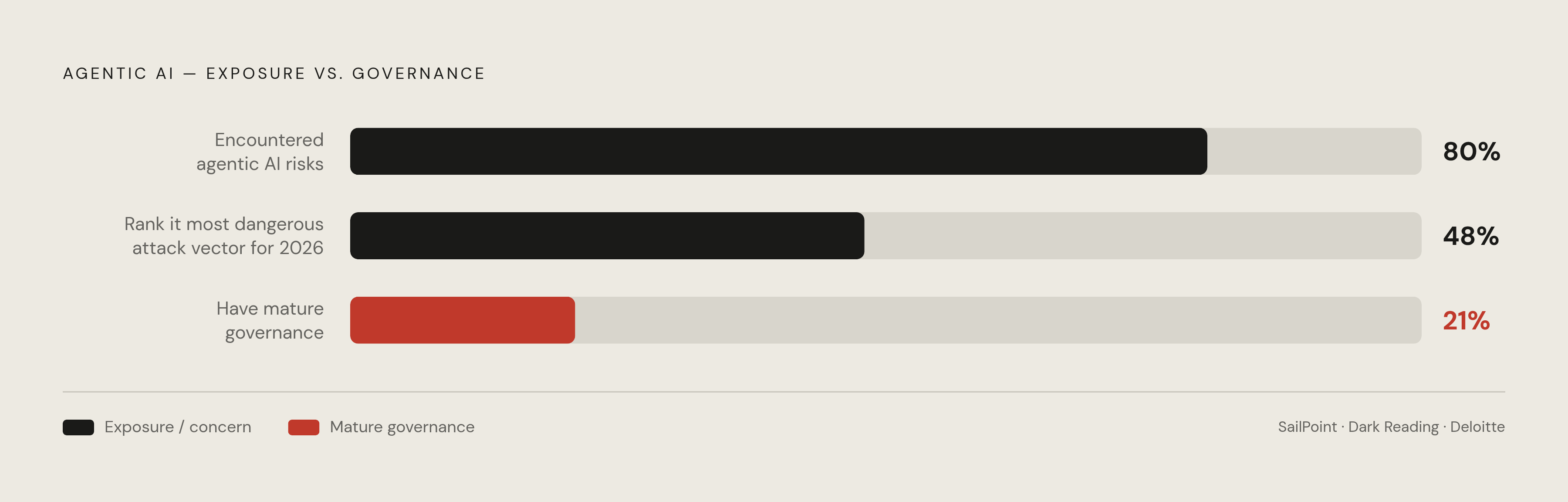
Inside the Microsoft 365 ecosystem, active agents grew 15 times year over year, a growth rate badly outrunning the governance frameworks built for the previous generation of supervised AI tools. Security professionals have noticed, and the numbers line up into an uncomfortable shape: Dark Reading reports that 48% rank agentic AI as the most dangerous attack vector heading into 2026, SailPoint reports that 80% of organizations have already run into agentic AI risks, and Deloitte reports that only 21% of IT leaders say they have a mature governance program for any of it. Adoption is outrunning oversight by a wide enough margin that "governance gap" undersells it.
The discovery tool landscape and the gaps each approach leaves
No single vendor covers all five surfaces. Treating any one tool as a complete answer keeps gaps open, and the vendors selling single-pane dashboards know it even when their marketing doesn't say so. The only approach that holds up is matching tool to layer, then stitching the signals together by hand.
On the network and SSE side, Netskope extends its Security Service Edge platform with GenAI-specific detection, tracking those 1,550-plus generative AI SaaS applications and adding endpoint discovery for locally running AI agents, LLMs, MCP servers, and extensions. It holds Leader status in the 2026 Gartner Magic Quadrant for both SASE Platforms and Security Service Edge, but it delivers the most value to organizations that already run it as part of their stack, since enforcement still depends on traffic routing through the vendor's cloud PoP. Cloudflare's CASB offering covers similar ground on network and SaaS discovery, most useful where Cloudflare's broader stack is already the standard, and bound by the same traffic-visibility limits as any other network-layer tool.
Inside Microsoft-centric environments, Microsoft Defender for Cloud Apps provides visibility into more than 1,000 generative AI applications alongside its general SaaS discovery. Microsoft Global Secure Access extends that discovery into AI applications, model-provider APIs, and SaaS-based MCP servers, though local AI agent discovery requires separate endpoint-level tooling. Outside the Microsoft ecosystem, that network visibility hits a wall fast. Most enterprises follow a recognizable maturity curve: discover the AI apps in use, block access to the unsanctioned ones, prevent sensitive data from reaching even the sanctioned ones, and govern whatever data does flow through audit and investigation controls.
At the endpoint layer, EDR/XDR platforms with data protection capabilities can extend endpoint-based security to detect unauthorized AI uploads, often without requiring additional agents for organizations already running those tools. That makes existing endpoint deployments a practical starting point rather than a reason to build from zero.
None of this adds up to one dashboard that solves shadow AI, and anyone promising that dashboard is selling something. What it adds up to is a layered stack where each piece covers a blind spot the others can't see, because the thing being searched for was never confined to one place to begin with. Discovery was never going to be solved with a single tool. It never had a one-surface problem to begin with.