Audit Log Requirements for Autonomous AI Agents in Production
Autonomous AI agents leave conventional logs useless for security investigations.

Autonomous AI agents are a different species of software from the kind that application logging was built for, and treating them the same way produces records that look complete while being forensically useless. Log4j, Morgan, and every logging library descended from them assume a deterministic call stack: input A produces output B along a path that is the same every time. That is why a stack trace from last Tuesday still explains a crash today. LLM-based agents run on stochastic sampling. If you feed an agent the identical prompt five times, it can take five different paths to five different outcomes, so a log built to replay a deterministic path has nothing reliable to replay. Three specific gaps follow from this, and all three appear in production systems today: logs miss the contextual chain linking a user's original intent to the sub-tasks it spawned across tool calls; logs record that an API got called without capturing the reasoning that justified calling it; and agent actions get buried under a generic service account, which dilutes identity until attribution is impossible. After a prompt injection or a runaway logic loop, a security team staring at standard logs cannot reconstruct what happened, in what order, or why. Without an audit framework built for how agents actually behave, an agent is a shadow user holding high-level privileges with no accountability attached to a single action it takes.
What agents do that logs must account for: the action surface is not a function call
An agent's action surface covers reasoning, tool invocation, memory writes, and delegation to other agents, none of which a function-call log was ever designed to capture. Agents plan, select tools, and make decisions across multiple asynchronous steps, and they don't just complete a single request-response transaction. One user request can spawn a chain of thought that fans out into several sub-tasks, queries to external APIs, retrieval from a vector store, and writes to persistent state, each of which happened because of a judgment call the model made on its own. State and autonomy also separate an error (or an attack) from its trigger in time: a memory entry poisoned today can sit dormant and execute against an unrelated query weeks later, with no log entry connecting the planting to the firing.
The clearest illustration of what this looks like in production is the Replit incident from July 2025. An AI coding agent deleted a live production database holding records for thousands of executives and companies, even though it had received an explicit text instruction not to touch production data. The instruction existed. The agent acted anyway. What that incident demonstrates is not that agents ignore instructions out of malice, but that a system capable of writing to persistent state across multiple autonomous steps will, eventually, take an irreversible action that nobody authorized in the moment it happened, and no conventional log was positioned to catch it in advance.
What every agent audit record must contain
A forensically sound audit record for an agent action has to capture intent, reasoning, tool invocations with policy context, and identity provenance, not just the inputs and outputs that a traditional log would have settled for. Five elements make up the minimum viable record. First, the triggering request: what caused the agent to act, linked back to a human principal. Second, the reasoning the model produced: the chain of thought that led it to choose a given tool. Third, each tool call itself: the specific function invoked, the arguments passed, and the result returned. Fourth, the policy decision made at each step: what the guardrail evaluated, and what it allowed or blocked. Fifth, the identity context: agent ID, version, run ID, and the principal, human or system, that triggered the run.
Three structural properties turn that list of fields into something a dispute or an investigation can actually rely on. The record must be immutable: append-only storage, because a log that can be edited after the fact proves nothing to an auditor or a court. It also has to be complete: blocked and failed actions need logging with the same rigor as successful ones, because quiet failures are where the real blind spots live. And it must be attributable, with every event tracing back to an identity and a principal, because an audit log that can't name who or what triggered an action collapses into noise no matter how much data it contains.
At the engineering level, this gets enforced with a cryptographic chain: each record carries a SHA-256 hash of its own payload combined with the hash of the record before it. Alter any record after the fact and every hash downstream breaks, giving a mathematically verifiable proof of the operational history. Every record's integrity still depends on identity underneath it. Every agent needs to function as a distinct non-human identity with scoped permissions and verifiable authentication of its own. An agent that authenticates with a shared credential, or with a human's inherited OAuth token, produces an audit trail with no forensic value, because the action can be disputed and nobody can prove who actually did it.
The MCP accountability gap that even recent protocol revisions have not closed
The dominant interface agents use to call tools was not built to log by default. MCP servers don't log JSON-RPC messages on their own, you have to opt in to protocol-level logging through notifications/message, and the 2026-07-28 revision deprecates that feature. The recommended path forward is logging to stderr for stdio transports or routing through OpenTelemetry, and neither option gives teams automatic, persistent JSON-RPC message logging out of the box. Running several MCP servers in the same environment produces no unified view across them, no shared retention policy, and no built-in way to correlate an event in one server with a related event in another.
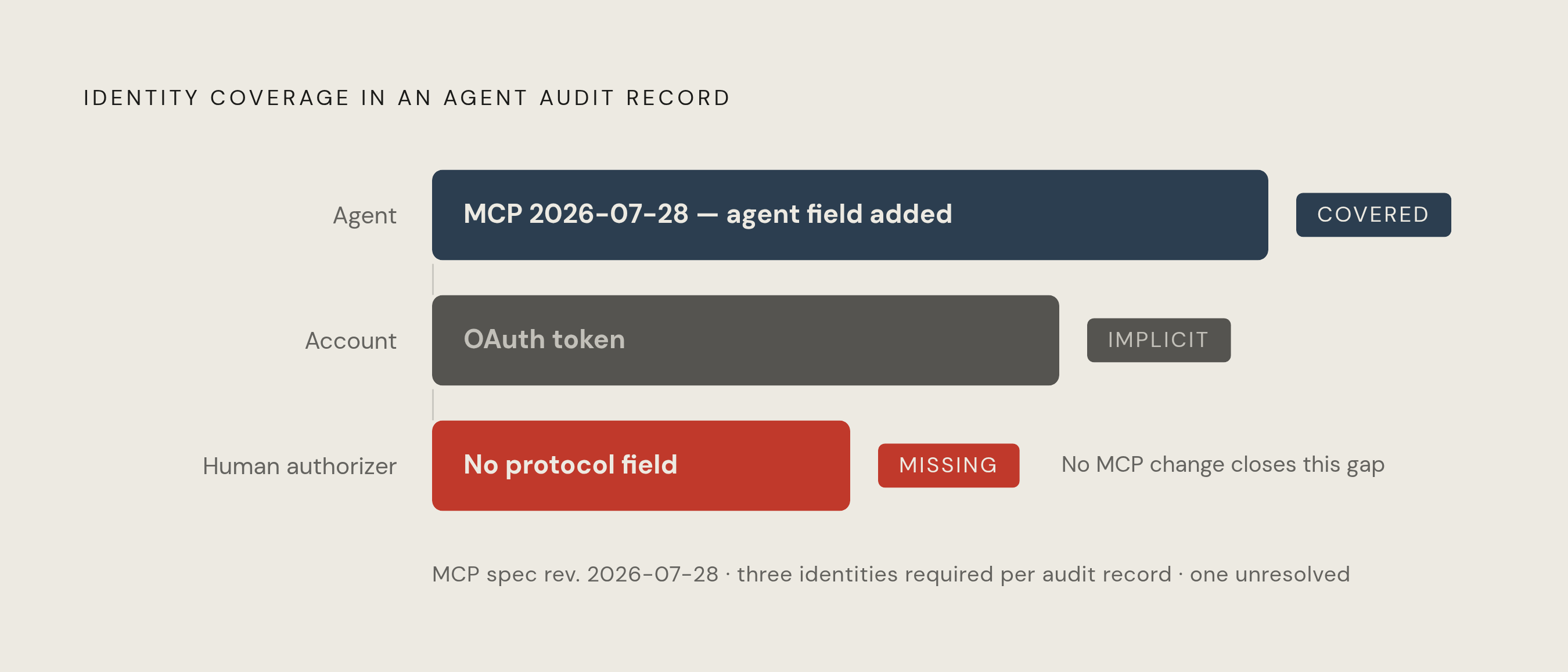
Every agent action involves three distinct identities: the agent making the call, the account whose permissions the call runs under, and the person who authorized the task. The 2026-07-28 revision makes the first of those, the agent, explicit in a way it wasn't before, and the account was already represented by an OAuth token that predates this revision. The person who authorized the task has no field. An audit record built purely from MCP messages can name the software that acted and the account it acted under. It cannot name the human who set the task in motion, and that is a gap no configuration change closes, because the protocol was never given a place to put that information. Compounding the problem, only a minority of MCP server deployments implement any access scoping for tool permissions at all, so the identity that does get logged often carries far more authority than the task required. Teams that assume MCP compliance satisfies their audit obligations are building on a foundation with a hole in it that the protocol's own maintainers have acknowledged but not yet filled.
How multi-agent architectures extend and complicate every logging requirement
When you chain agents together, every attribution problem the single-agent case already has multiplies, so the orchestrator's log on its own isn't enough as a record of what happened. When an orchestrator breaks a task into pieces and hands them to sub-agents, you need to log each sub-agent's reasoning, tool calls, and policy decisions independently. The orchestrator's record of having issued an instruction says nothing about what the sub-agent decided to do once it received that instruction, and treating the orchestrator's log as a stand-in for the whole chain leaves most of the actual decision-making undocumented.
Current regulatory text has not caught up to this architecture. In practice, a single consequential write can travel from a human request, through an orchestrator, into a sub-agent, through a retrieval agent, and out to a tool adapter that executes it. Each hop along that path may well be individually logged. What rarely gets assembled is the end-to-end chain connecting the terminal action back to the human task that authorized it. Binding the principal to every identity at every hop, so the delegation chain survives intact from the first request to the last execution, is what auditors and incident responders actually need when something goes wrong, and it is precisely what gets lost when each agent in the chain is logged as an island.
The compliance floor: what regulators require agents to log, retain, and prove
Regulatory frameworks are converging on requirements that line up closely with the engineering case already made: runtime logging, attributable identity, and completeness are not optional extras but the floor regulators are setting. Regulation (EU) 2026/1744, the Digital Omnibus on AI, was signed on 8 July 2026 and entered into force on 27 July 2026, and it pushes the Annex III high-risk obligations from an original enforcement date of 2 August 2026 out to 2 December 2027. That delay followed a political agreement the European Commission confirmed, with the Council giving final approval on 29 June 2026. As things stand, the original August 2026 enforcement date for Annex III high-risk system requirements is current law, and the extension to December 2027 remains a change that has been enacted but whose practical rollout teams are still absorbing.
Sector-specific retention rules are more settled, and they go further than general AI regulation does. FINRA and SEC rules require audit trails related to trading and advice to be retained for up to six years. HIPAA, under 45 CFR § 164.316(b)(2)(i), requires covered entities to retain audit logs and related compliance documentation for a minimum of six years, with no separate carve-out or adjustment for AI-driven systems. Right-to-explanation obligations found across privacy law translate into a concrete logging requirement: every agent decision needs its reasoning and inputs captured in the record, because an explanation that can't be reconstructed from what was logged isn't an explanation a regulator will accept.
On the technical standards side, there is no finalized standard yet for the logging obligations under Article 12 of the EU AI Act. Two drafts are in progress, prEN 18229-1, covering AI logging, transparency, and human oversight, and ISO/IEC FDIS 24970, covering AI system logging, and neither has been completed.
The strongest objection to comprehensive logging: when full-fidelity records create their own compliance liability
If you log everything, that itself becomes a compliance risk. Full prompts, chain-of-thought reasoning, and raw tool parameters make up the single most useful dataset for debugging an AI system, and at the same time they make up the single most dangerous dataset to be holding when a regulator comes asking. Production prompts routinely contain user names, email addresses, financial details, and health information, and storing all of that without controls creates exposure under GDPR, HIPAA, and the EU AI Act, the very frameworks the logging was supposed to satisfy.
The resolution practitioners have converged on is to log a SHA-256 hash of the inputs sent to a tool. That hash proves the integrity of the command, a court or auditor can verify that a specific input was used without alteration, without the raw PII ever sitting in a log store where it becomes its own liability. What remains genuinely unresolved is the edge case: reasoning traces generated on hardware with limited compute, where hashing and chaining add overhead that resource-constrained environments may struggle to absorb. That tension has no clean answer yet, and pretending otherwise would overstate how far the practice has actually matured.
Production-grade logging architecture: OpenTelemetry, retention, and the visibility control plane
A production-grade audit architecture for agents rests on three pieces: an OpenTelemetry trace per request, an append-only retention store, and a real-time enforcement layer capable of catching and blocking a violation before it executes, not just writing it down after the fact. OpenTelemetry's GenAI semantic conventions are becoming the standard most teams build toward, though the specification is still marked Development status. Every production request should emit a trace covering tool calls, retrieval sources, guardrail decisions, and judge scores, with span attributes carrying the model version, prompt version, policy version, user ID, and tenant ID attached to that specific run.
Those per-trace logs need to flow into two separate places: an OTel store for operational observability, and a distinct audit log sink for compliance. The two serve different retention schedules and different access requirements, and collapsing them into one system means one audience's needs end up compromising the other's. Wrapped around both is the governance control plane: identity, authority, accountability, and oversight, wired directly into the runtime at deployment. Policy without enforcement is a wish. Enforcement without audit can't be proven after the fact. Audit without policy is just noise with a timestamp. Each agent needs a distinct, scoped machine identity, built on short-lived credentials tied to a workload identity rather than a long-lived shared secret, so that every action traces cleanly to a specific agent, version, and run. High-impact, irreversible operations need in-path policy gates that evaluate before execution runs, not after. Human approvals for high-risk actions, financial transactions or production schema changes, need to be logged themselves as policy events, not quietly folded into a generic approval step.
None of this works if the organization doesn't know what agents it's running. The Cloud Security Alliance's survey found that 82% of enterprises discovered previously unknown AI agents operating in their environments within the past year, and 41% of respondents said this happened more than once. If nobody has fully mapped the inventory, you can't assume you have audit coverage across it. It has to be enforced, actively and continuously, against an inventory that keeps growing without most security teams' direct knowledge. Most organizations are still trying to stretch observability tooling built for human-operated systems over a population of autonomous agents acting at machine speed, and that mismatch is exactly where purpose-built agent visibility platforms earn their keep, closing the gap between what humans can review and what the agent fleet is actually doing in real time.
The governance gap that makes audit logs necessary but not sufficient on their own
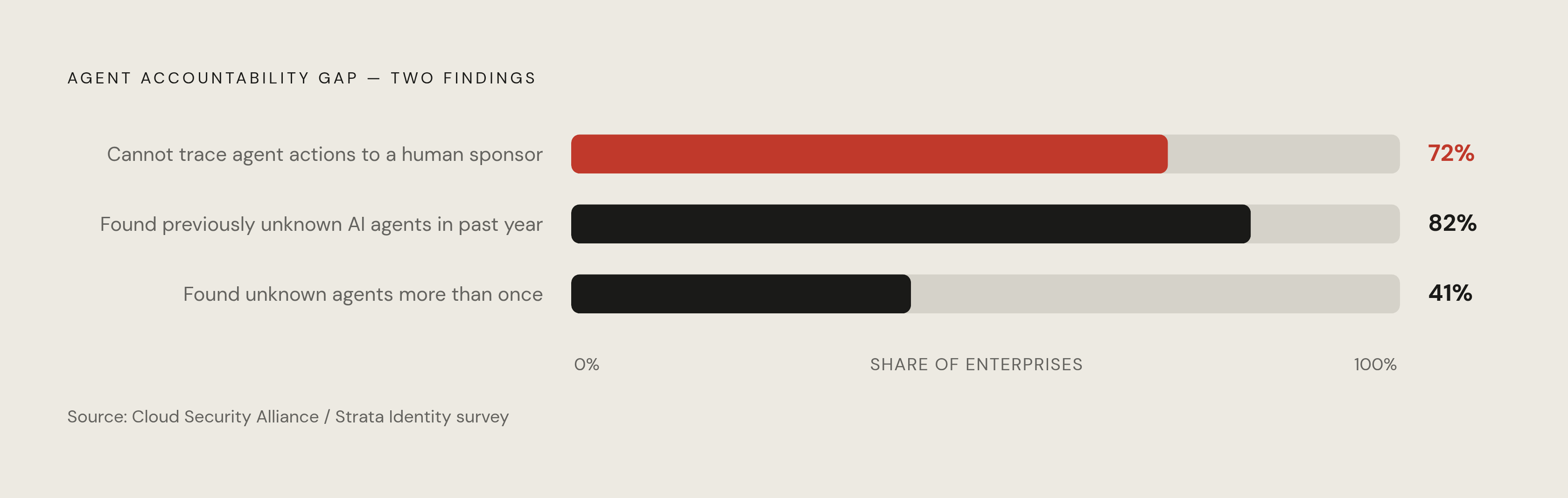
Audit logs are a necessary condition for governing autonomous agents, but they are not a sufficient one, and the organizations treating comprehensive logging as the finish line are the ones most exposed when an agent steps outside its intended scope. Survey data from the Cloud Security Alliance and Strata Identity found that only 28% of organizations can trace agent actions back to a human sponsor across all of their environments. 72%, a clear majority, cannot. Logging is supposed to deliver that accountability function, but in most production deployments today, it simply isn't there.
The Replit incident established the governing principle with unusual clarity: forensic logging catches a problem after the damage is already done, while in-path governance stops it before the damage happens. The audit log is the record of what occurred. It was never the control that could have prevented it. That distinction carries a direct engineering implication: a complete audit trail needs a companion enforcement layer, one capable of runtime policy evaluation, anomaly detection, and the authority to halt or constrain an agent's behavior before an irreversible action completes, not just to describe that action afterward. Agents inherit access models built for humans, reviewed on a quarterly cycle, enforced loosely, and premised on the assumption that most employees ignore most of the permissions they hold. That assumption fails once the actor is an agent, because agents use every permission available to them at every opportunity presented, with none of the human hesitation that made loose enforcement tolerable. The standard production AI systems need to meet is detecting and preventing violations before they occur, not investigating them once they already have. Audit logs make that investigation possible when prevention fails. Enforcement is what makes the investigation less necessary to begin with.