EU AI Act High-Risk Classification for Enterprise Deployments
Classification depends on how you deploy the system, not what technology powers it underneath.

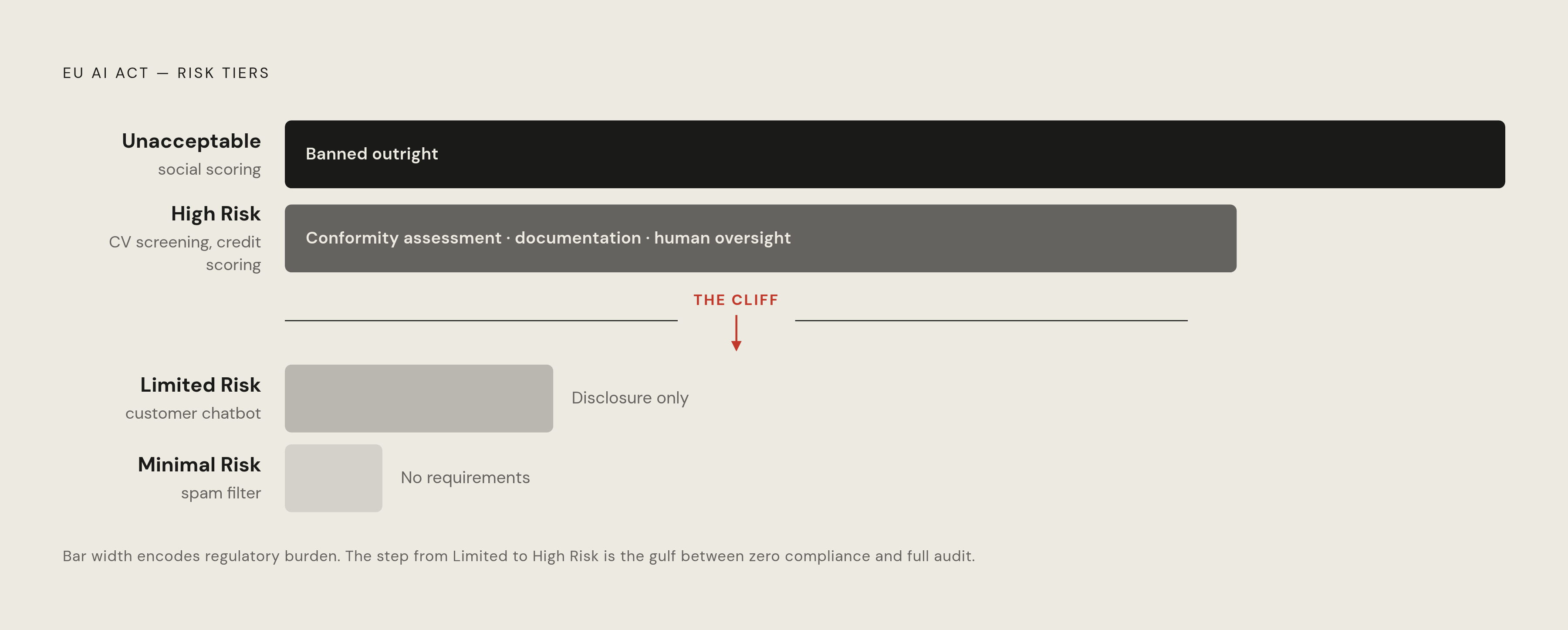
High-risk classification is where the EU AI Act does almost all of its work. Most of the regulation's obligations, the conformity assessments, the documentation mandates, the human oversight rules, only attach once a system crosses into that one tier, so getting the classification right is the first task of any enterprise compliance program, and the Act sorts systems into four bands: unacceptable risk, which is banned outright; high risk, which carries the full regulatory weight; limited risk, which asks only for a disclosure; and minimal risk, which asks for nothing in particular. Social scoring sits in the banned category. A CV-screening tool or a credit-scoring algorithm, for example, lands in high-risk. A customer-facing chatbot usually sits in limited risk, unless it's making medical, financial, or otherwise high-stakes calls, in which case it jumps the line. A spam filter sits in minimal risk and stays there. The distance between high-risk and the tier just below it is the distance between an audited, documented, continuously monitored system and one that needs no special treatment whatsoever.
The two Article 6 gates that determine whether a system is high-risk
Article 6 of the AI Act gives exactly two routes into high-risk territory, and a system only needs to clear one. The first route runs through Annex I: a system counts as high-risk if it functions as a safety component of a product already governed by EU product safety law, and that product already requires third-party conformity assessment. The second route runs through Annex III: a system counts as high-risk if it falls into one of eight named use-case categories, independent of whatever hardware it might or might not be attached to.
These two gates don't stack. An enterprise doesn't need to fail both tests to trigger obligations; failing either one is sufficient on its own. Annex I is about physical products regulated for safety: medical devices, machinery, aviation systems, lifts, toys, vehicles, recreational craft, radio equipment, pressure equipment, cableway installations, personal protective equipment, gas appliances, in vitro diagnostic devices, marine equipment, rail systems, and more. What triggers this gate isn't the AI itself; it's the role that AI plays inside a product that already sits inside the EU's safety regime. Annex III works differently. It catches standalone software deployments across eight sectors, whether or not a physical product is anywhere in the picture.
That split determines which questions an enterprise actually needs to ask. A company running an HR platform, a lending tool, or a case management system is almost certainly working the Annex III side of the analysis. A company building AI into manufactured goods, medical devices, or safety-critical infrastructure starts with Annex I instead. Either way, the test turns on what the system is used for and in what context it's deployed, rather than on what model architecture sits underneath it. Two companies can run the same large language model and land in entirely different risk tiers depending on how that model gets put to work. This is the conceptual move that everything downstream of Article 6 depends on: classification follows use, not technology.
The eight Annex III categories and where enterprise tools land
The eight Annex III sectors read, on paper, like a specialized list aimed at government and public-sector systems. In practice, they sweep in a wide range of ordinary enterprise software that most organizations buy, deploy, and never think to flag as regulated AI.
Critical infrastructure covers AI systems used as safety components in managing digital infrastructure, road traffic, or the supply of water, gas, heating, or electricity, with "critical infrastructure" defined by reference to an existing EU directive on the resilience of critical entities. Education and training covers systems you use in admissions, applicant ranking, evaluating learning outcomes, and detecting cheating on exams.
Employment is the category most enterprise buyers will recognize immediately, because it covers the tools HR departments already run every day: CV screening, task allocation, performance monitoring tied to promotion decisions, and broader workforce management software. Any AI used for recruitment or selection, for decisions on employment terms, promotion, or termination, for allocating tasks, or for monitoring performance falls inside this category, subject to a narrow Article 6(3) exception for systems that don't pose a meaningful risk of harm. Essential private and public services is the other category that will land directly on most enterprise desks: credit scoring, creditworthiness evaluation, and pricing or risk assessment for life and health insurance all sit here. The Act frames this category around services "necessary for people to fully participate in society," which pulls in housing, basic financial services, and utilities, but not every financial product qualifies just because money changes hands.
The remaining three categories, law enforcement, migration and border control, and the administration of justice, matter enormously to the public bodies that use them but touch a much smaller slice of ordinary enterprise software. Law enforcement covers recidivism risk assessments, polygraph systems, and tools that evaluate how reliable evidence is. Migration and border control covers systems examining asylum and visa applications. Administration of justice covers AI that helps judicial authorities research facts and law and apply the law to a specific case. Most enterprise technology buyers will never touch these three, but the first two categories, employment and essential services, are exactly where off-the-shelf enterprise software quietly becomes regulated AI.
The May 2026 Commission guidelines' practical expansion of Annex III's reach
On 19 May 2026, the European Commission released draft guidelines that set out how to classify high-risk AI systems. They are not binding law, but regulators will use them to decide enforcement priorities, which makes them the most concrete, usable interpretation of Annex III available to enterprises right now. The consultation period on the draft ran until 23 June 2026, and the guidelines should be treated as a working standard even while still formally in draft, because waiting for a final version before acting leaves a compliance program with no interpretive guidance at all in the meantime.
Three expansions in the guidelines matter more than the rest. The first concerns recruitment tools. The Commission reads "recruitment or selection" broadly enough to include AI that drafts job descriptions or produces a suitability score from a CV, even when a human recruiter makes the final call. "Work-related decisions" stretches to cover pay, performance reviews, promotions, and task allocation built on historical performance data, though decisions too trivial to matter, who gets which office, who picks the lunch slot, stay outside scope. The second expansion concerns behavioral biometrics: systems that authenticate users or flag fraud using keystroke rhythm, click patterns, or similar behavioral signals can fall into the biometrics category even when the vendor describes the product as something other than biometric.
The third expansion is the one enterprises are most likely to get wrong, because it concerns agentic and multi-step AI systems. A component that performs a narrow, procedural, preparatory task can still be classified as high-risk if it feeds into an output that materially shapes an Annex III decision as part of a larger agentic workflow. Wrapping a high-risk function inside a multi-step pipeline doesn't quarantine that function from classification; the guidelines treat the component's contribution to the final output as what counts, not its position in the chain. The guidelines also shut down a tempting workaround on intended use: a contract clause stating a system must not be used for high-risk purposes doesn't protect a provider if the product's marketing, technical documentation, or plain capabilities suggest high-risk use is intended or reasonably foreseeable anyway.
The Annex III exemption and the provider's burden of claiming it
Landing inside an Annex III category doesn't automatically make a system high-risk. The Act carves out an exemption for systems that don't present a significant risk of harm to health, safety, or fundamental rights. That exemption is narrow, and it has to be actively claimed and documented rather than assumed by default.
The conditions for using it are limited to a short list, read strictly: the system performs a narrow procedural or preparatory task; it supports a human activity that's already been completed rather than replacing that activity; or it detects deviation from existing decision-making patterns without doing any profiling of its own. None of these conditions survives contact with a system that materially influences the outcome of an Annex III decision. If the output moves the needle on who gets hired, who gets a loan, or who gets flagged for review, the exemption is off the table regardless of how procedural the system looks on the inside.
This creates a genuine headache for general-purpose AI platforms sold across many enterprise contexts at once. If a vendor hasn't expressly and consistently excluded high-risk uses, and those uses are reasonably foreseeable given what the platform can do, the platform can't lean on the exemption no matter how the sales deck describes it. This setup puts an open-ended documentation burden on tools that are, in practice, low-risk day to day. The Act's answer is unsentimental. The documentation burden is the toll for operating inside Annex III territory without carrying the full high-risk compliance load, and the exemption was built to prevent over-regulation, but only for systems that can show, on paper, they stay inside its narrow limits. Claiming the exemption is a planning decision a provider has to earn, not a default status a provider gets to assume.
The Digital Omnibus restructured the compliance timeline without eliminating near-term obligations
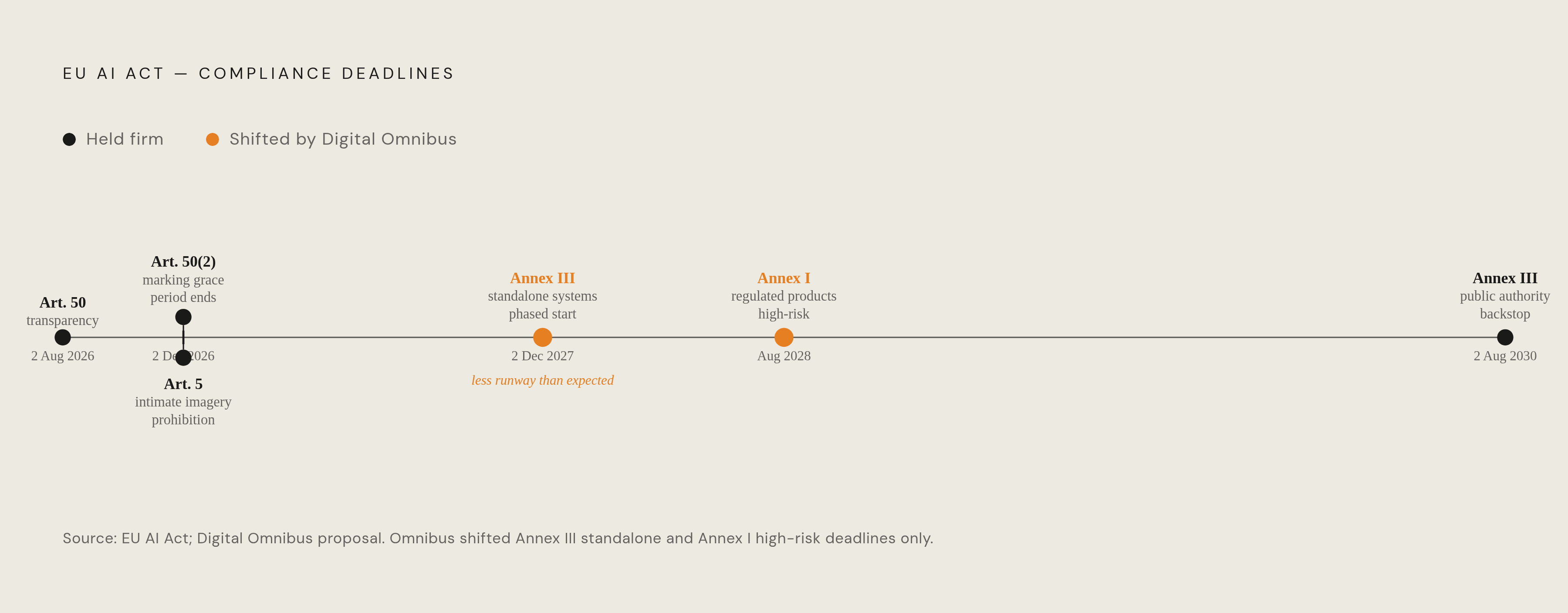
The Digital Omnibus on AI, adopted in June and July 2026, rearranged several compliance deadlines because the technical standards needed to operationalize high-risk obligations weren't finished yet. The rearrangement was targeted at specific deadlines, not a blanket delay across the whole Act, and several obligations stayed exactly where they were.
Three deadlines moved. Standalone Annex III high-risk systems now face phased compliance beginning 2 December 2027. High-risk systems embedded in Annex I regulated products are expected to come under obligation starting August 2028. High-risk systems meant for use by public authorities keep a backstop of 2 August 2030 for Chapter III obligations, and that deadline was already written into Article 111(2) of the original AI Act, so the Omnibus didn't introduce it.
Two obligations did not move. Article 50 transparency requirements, telling people when they're interacting with an AI system and labeling AI-generated content, largely stayed on the original 2 August 2026 timeline, though the Omnibus added a four-month grace period running to 2 December 2026 for the machine-readable marking rules under Article 50(2), specifically for systems already on the market before 2 August 2026. Separately, a new Article 5 prohibition on AI systems that generate non-consensual intimate imagery, including content that is a "reasonably foreseeable and reproducible outcome" of a system's ordinary operation, carries its own compliance date of 2 December 2026.
The Omnibus is not a general pause. Organizations that put off classification work until 2027 will have less runway to finish the documentation-heavy preparation the high-risk regime demands, and design history and data lineage records are hard to reconstruct after the fact once the development work is done.
What high-risk classification requires enterprises to build and maintain
Once a system is classified high-risk, a specific set of legal obligations attaches to it. Article 9 requires a risk management process that runs continuously across the system's entire lifecycle: risks get identified, estimated, evaluated, and mitigated, then reassessed every time the system, its data, or its context of use changes. This isn't a document signed off before launch and filed away.
Annex IV requires technical documentation that covers design decisions, data lineage, and testing methodology in detail. Agile development teams that produce minimal paper trails run into a real structural problem here, because this kind of documentation is difficult to reconstruct once the building is already finished. Article 12 requires automatic logging of events relevant to spotting risks, monitoring the system after launch, and tracing how the system actually behaved. Article 14 requires human oversight built into the system's design, so a person can monitor what it's doing, understand its outputs, step in or override it, and shut it down when necessary. Full automation of high-stakes decisions, with no human in the loop at all, is the configuration the Act trusts least.
Deployers carry their own set of duties, separate from what providers owe, and these apply even to organizations that simply bought a system off the shelf rather than building one. A deployer has to use the system strictly according to the provider's instructions, assign trained staff to oversee it, and put organizational measures in place to support that oversight. Where the deployer supplies the input data, it has to make sure that data is relevant and representative. The deployer has to monitor performance on an ongoing basis and report serious incidents without delay, retain system logs, and, where applicable, run data protection impact assessments or Fundamental Rights Impact Assessments before deployment, a step particularly required for creditworthiness assessments, insurance pricing, and public-sector decisions.
Extraterritorial scope for non-EU enterprises
The Act reaches providers who place systems on the EU market, deployers established in the EU or serving EU users, and providers and deployers based in third countries whenever someone uses the system's output inside the EU. Where a company is headquartered offers no protection.
If a US-based credit scoring vendor's models score loan applications for borrowers in Germany, it falls inside the Act's scope, even if every server the models run on sits outside Europe. Non-EU providers of high-risk systems have to appoint an authorized representative inside the EU before putting the system on the market, and that's a structural requirement, not paperwork to file and forget. A non-EU enterprise that hasn't run a classification analysis on its EU-facing AI deployments is unprepared for an enforcement action it's already exposed to.
Shadow AI and missing design history create the largest compliance gaps
Shadow AI is the most common gap by far. When individual business units procure AI tools on their own, without routing the purchase through any central registration process, no one in the organization ends up with a full picture of which AI systems are actually running. Classification analysis can't start until someone knows what needs to be classified, and shadow AI guarantees that inventory is incomplete from day one. Missing design history compounds the problem. The documentation Annex IV demands, design decisions, data lineage, testing methodology, assumes records that agile development teams frequently never generate in the first place, which leaves enterprises trying to document systems after the fact using evidence that was never written down to begin with.
Sources
- High-level summary of the AI Act
- AI Act Update
- High-risk AI in the European Union - AI Laws of the World
- Draft EU Guidelines Clarify When AI Systems Are High-Risk Under the AI Act
- EU AI Act High-Risk Deadline Pushed to December 2027
- EU AI Act Omnibus Agreement — Postponed High-Risk Deadlines and Other Key Changes - Gibson Dunn
- EU AI Act Annex III: The 8 High-Risk Categories — CASRAI
- Article 6 - Classification rules for high-risk AI systems - CMS DigitalLaws