Behavioral Anomaly Detection for AI Agent Traffic
Static rules can't catch AI agents behaving differently than before.
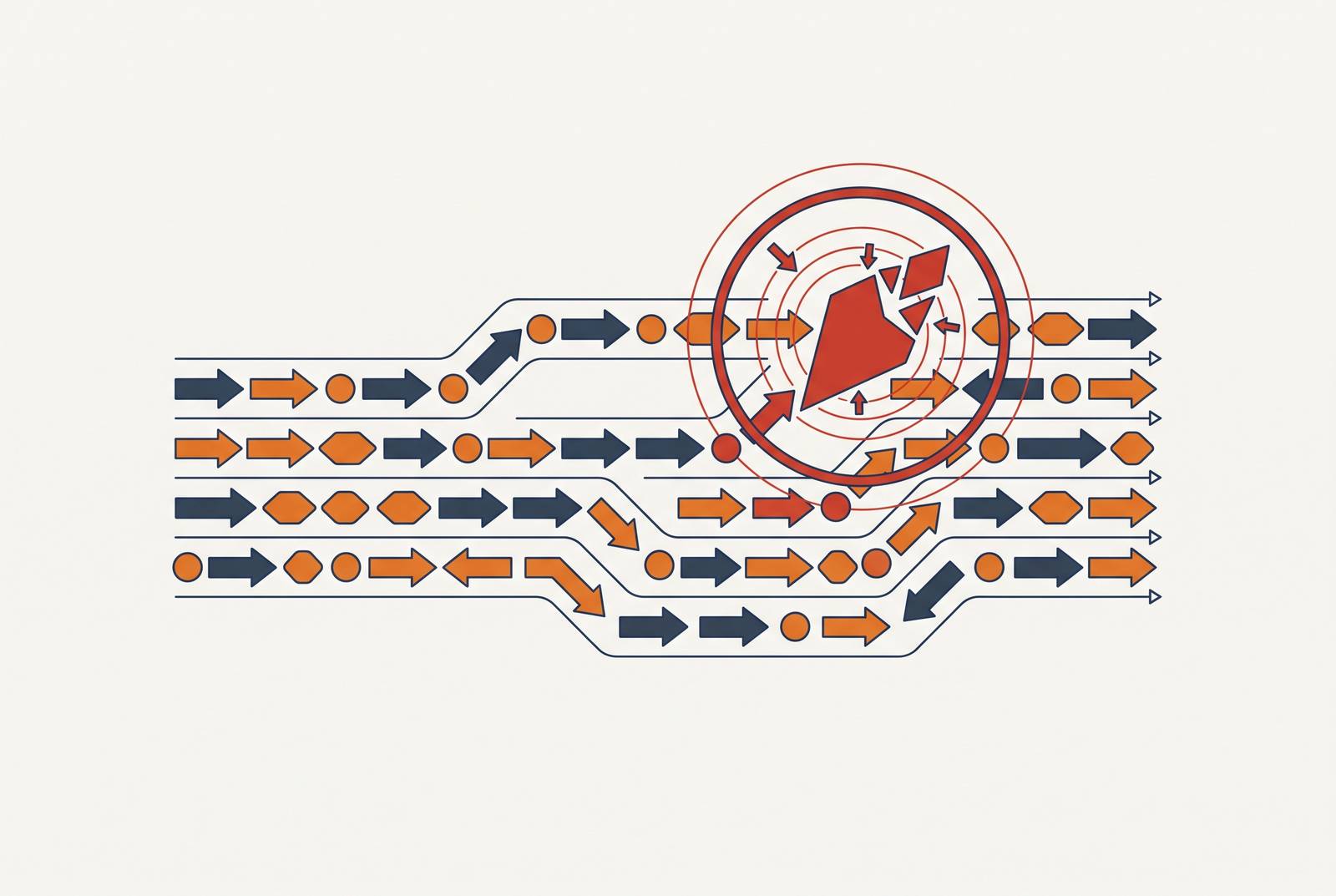
AI agents break the oldest assumption in security tooling: that a fixed input produces a fixed, inspectable output. They run on learned probability distributions instead of deterministic logic, and they carry real credentials, OAuth tokens, API keys, service account permissions, while doing it. Static rules are built to recognize known-bad patterns, but they have no foothold when a system can legitimately do something different every time it runs. Behavioral anomaly detection exists because it measures something rules cannot: what an agent's activity looks like over time, compared to itself. That shift, from inspecting requests to profiling behavior, is what this piece is about.
Why static rules fail against AI agents specifically
A rule engine works because it checks an incoming request against a catalog of patterns it already knows are good or bad. A rule engine's failure here is a mismatch between what rule engines assume about the systems they're protecting and what agents actually are.
Agent credentials carry real privileges without the identity signals that would reveal misuse, which makes the mismatch worse. A compromised or manipulated agent doesn't present as an intruder probing a perimeter. The only observable difference between an agent doing its job and an agent doing someone else's bidding is behavioral: what it's doing, how often, and whether that pattern fits what it's done before.
Static defenses also share a structural blind spot: they only catch what they've already been told to look for. Every scaling event or redeployment legitimately changes what normal traffic looks like, and distinguishing that operational churn from an actual security incident requires context no static rule carries.
What behavioral anomaly detection measures for agents
Behavioral anomaly detection doesn't inspect the content of any single request. Exabeam's Agent Behavior Analytics applies this directly, building unified behavior profiles that cover both the humans and the agents acting on their behalf, modeling request volumes, token usage, API activity, tool invocation, and outbound communication patterns together.
Practitioners tend to converge on five measurement dimensions. Permission escalation attempts flag calls to resources or APIs outside an agent's normal operational envelope. Input-output semantic coherence checks whether what an agent produced is actually consistent with what it was asked to do.
For systems with multiple agents working together, detection has to operate on the whole execution, not just individual steps. Research published under the name Skynet makes the case directly: agentic task failures often start at a single step, an injected prompt or a flawed plan, and then propagate through downstream dependencies as that corrupted step gets amplified across subsequent agents and tool calls. Agents that generate user interfaces introduce a payload layer that session-level behavioral monitoring doesn't reach on its own, a problem covered in full later in this piece.
How baselines are built
A behavioral baseline isn't something you configure before deployment. It has to be learned from how an agent actually behaves in production. There's an unavoidable window at the start of any deployment where the detection layer has no established normal to compare against. AWS CloudWatch Anomaly Detection follows a similar logic at the infrastructure level, analyzing up to two weeks of historical metric data to build expected value bands that identify trends, seasonality, and pattern shifts, triggering alarms when live metrics fall outside those bands.
These baselines draw on statistical methods and machine learning, and which one you use depends on the kind of deviation you're watching for. A research institute focused on software engineering has shown that statistical process control, using exponentially weighted moving averages, catches subtle network shifts that pure threshold-based methods miss entirely, including the slow, low-volume reconnaissance patterns an attacker uses specifically to avoid tripping a hard limit.
Coverage improves further with three-dimensional profiling: an individual baseline for each agent, a peer group baseline comparing it to similar agents, and a temporal baseline capturing time-of-day and day-of-week patterns. Microsoft Sentinel's UEBA implementation uses exactly this structure, comparing current behavior against both individual and peer baselines with unsupervised machine learning, and the same architecture maps cleanly onto agent monitoring. None of this is a one-time setup. A Lambda function suddenly calling an API from a new AWS region could be a credential compromise, or it could be ordinary autoscaling, and the behavioral model needs enough accumulated context to tell the difference. That context only exists after the system has been watching for a while, which is the whole reason production time isn't optional.
The detection tradeoffs security teams face in production
Behavioral detection doesn't eliminate risk so much as redistribute it, and that redistribution appears in two structural tradeoffs that architecture has to account for directly. The first is latency. Google runs analysis asynchronously, out of band from the live request path, so agent response times stay fast, and that's why it built Agent Anomaly Detection this way on purpose. The harm done inside that gap is the price of not slowing every agent down to wait on a verdict.
The second tradeoff is false-positive load. The fix is giving the model richer context: peer group baselines, temporal profiles, and awareness of an agent's full lifecycle, including creation events, permission changes, and invocation trends over time, all of which help separate an operational change from an actual threat.
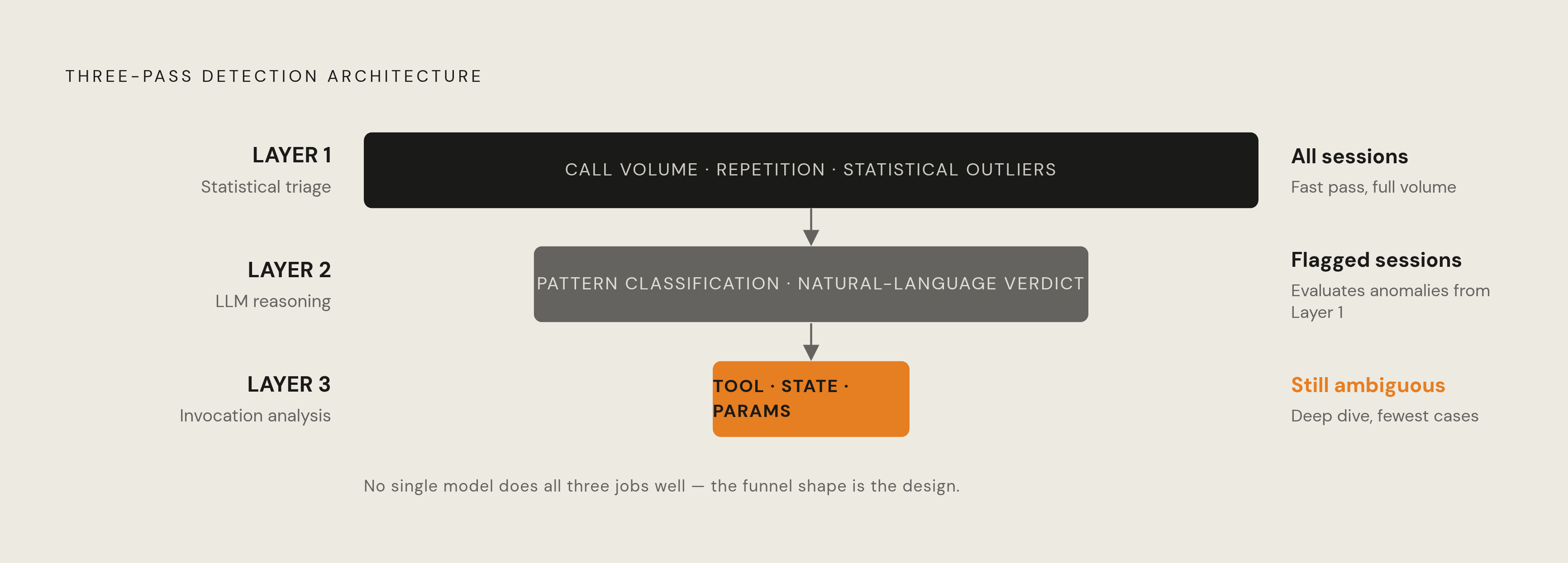
A third tradeoff gets less attention but matters just as much: a baseline that's known can be gamed. The practical answer to all three tradeoffs is the same: a layered architecture, with fast statistical passes triaging volume, LLM-based reasoning evaluating the sessions that get flagged, and deep invocation-level analysis reserved for the cases that stay ambiguous after the first two passes. No single model is being asked to do all three jobs at once, because no single model does all three jobs well.
The UI payload blind spot in behavioral detection
Behavioral detection, as typically built, watches session-level traffic statistics: call volumes, token patterns, request sequences. That leaves an entire category of attack invisible, because the deception lives inside a payload that is syntactically clean and semantically false, one layer below where most behavioral monitors look. Research on this gap, published under the name AegisUI, lays out three scenarios that show what the problem looks like. None of them would move a session-level behavioral baseline even slightly, because nothing about the request volume or token pattern looks unusual.
The gap is structural. Schema validation checks that a payload is well-formed, not that a button labeled "Continue safely" doesn't quietly trigger an account deletion. The authors behind AegisUI are direct about where the field stood before their work: no benchmark, no labeled dataset, and no end-to-end experimental pipeline existed for structured agent-generated UI protocols. Their framework builds toward one, producing 4,000 labeled payloads, 3,000 benign and 1,000 malicious, across five attack families: phishing interfaces, data leakage, layout abuse, manipulative UI, and workflow anomalies.
You can learn a lot about where the hard problems sit from the detectors tested against that dataset. Across all of them, manipulative UI payloads, interfaces designed to mislead a user about what an action actually does, proved the hardest attack family to catch. This work is early: a synthetic dataset, not yet tested against production traffic, by the authors' own account. What it establishes is the shape of the gap and a credible starting framework for closing it, the same lesson Skynet's execution-graph approach offers for multi-agent systems: deception invisible at one layer of abstraction becomes visible once the analysis spans binding targets, action semantics, and session context together.
Google's Agent Anomaly Detection in production
Google's Agent Anomaly Detection is a reasoning-based oversight and audit layer for autonomous agents deployed on the Gemini Enterprise Agent Platform. It works from telemetry agents already produce: it reads OpenTelemetry traces and logs to check whether an agent is operating inside its intended boundaries. Turning it on requires OpenTelemetry tracing and logging enabled through the ADK, Python 1.2 or later, with Google recommending ADK 2.1.0 or later, logging and observability buckets kept in the same US multi-region, and raw telemetry that captures both prompt inputs and response outputs. Agents show up as "monitored agents" before anyone explicitly enables analysis on them; their logs and traces sit unanalyzed and no costs accrue until monitoring is turned on, letting an organization inventory its agents before committing to the expense of watching them.
The detection architecture runs in three layers. The system's own documentation gives a concrete example: an Inventory Agent retrieving a full catalog through repeated offset-jumping API calls generates no errors and violates no explicit policy, yet Layer 1 flags the call volume and repetition as a statistical outlier, and Layer 2 identifies the pattern as systematic scraping, returning a verdict in natural language. The third layer looks at individual tool executions, execution states, and parameter histories within the conversation trace, for the cases that still need closer inspection after the first two passes.
The detectors ship mapped to the OWASP Agentic Top 10: tool misuse (ASI02), identity and privilege abuse (ASI03), cascading failures (ASI08), and rogue agents (ASI10), along with resource exhaustion and token usage escalation. Every finding carries a severity level, a plain-language explanation, and recommended actions, and it gets published to Security Command Center for triage alongside other security findings. As of September 2026, the product is in Private Preview.
Exabeam's Agent Behavior Analytics extends UEBA to the agentic enterprise
One vendor's approach to agent behavior comes from the security analytics side of the problem rather than the agent platform side, and it starts from a specific reframing: an AI agent is a new category of insider threat, an authenticated entity with real privileges operating inside the perimeter. Traditional insider threat work assumes a person is misusing access they were granted. Exabeam's April 2026 announcement names four specific risks that follow from treating an agent as a new category of insider threat: data exfiltration at machine speed, triggering high-impact workflows without appropriate oversight, accessing systems outside intended scope, and blending activity into routine traffic in a way that makes human behavior and machine behavior hard to tell apart.
Agent Behavior Analytics, inside Exabeam's New-Scale Analytics, builds unified behavior profiles that cover both users and the agents acting on their behalf, modeling request volumes, token usage, API activity, tool invocation, web interactions, and outbound communication together as one data stream. Three examples illustrate what that unification catches in practice: a user who typically sends short prompts suddenly uploading a large dataset to an AI assistant, an agent known for generating summaries that starts issuing a high volume of external API calls, and a development agent accessing repositories it has never touched before. None of those would necessarily trip a rule written in advance, but each one is a visible deviation once there's a profile to deviate from.
Agent lifecycle monitoring addresses a problem static inventories miss entirely: many organizations don't actually know how many agents exist in their environment, who created them, or what permissions they carry. Platform-level visibility extends across ChatGPT, Google Gemini, Microsoft Copilot, and Anthropic Claude, the productivity platforms where most human-agent collaboration is currently concentrated, giving security teams context for how users and agents interact with enterprise data across each of them.
What organizations need before behavioral detection can work
Behavioral detection is only as good as the inventory of agents feeding it. An agent nobody knows about cannot be baselined, monitored, or flagged, and most organizations running agents in production don't yet have a complete picture of what's actually deployed. Google's architecture reflects the same split: agents appear as "discovered" before anyone enrolls them for monitoring, and their logs sit unanalyzed until that enrollment happens, treating discovery and monitoring as two distinct phases.
Non-human identity management adds a layer of complexity that human-focused identity systems weren't built for. CISA's ICAM Reference Architecture tackles this directly: it defines non-person entities as automated technologies deployed to execute tasks on behalf of persons or other entities, so agents sit formally inside identity governance frameworks that were historically built around human users.
None of this closes the loop without the ability to act on what's detected. Blocking a subsequent tool call, halting a later turn, and revoking a credential automatically when behavior deviates past a threshold turn detection into a control. If a detection system only logs anomalies, you get an audit trail of damage that's already been done. The recommended posture is automatic credential revocation on deviation, not passive logging that waits for a human to review it later.
Behavioral detection and the broader compliance and regulatory picture
Behavioral monitoring for agent traffic is moving from a recommended security practice toward a formal compliance requirement, driven by federal zero-trust mandates and the extension of identity governance to non-human entities. NIST SP 1800-35, published in June 2025, gives comprehensive guidance on implementing zero trust architecture with continuous authentication required for all workload identities, not just human users, with civilian federal agencies facing an FY2024 deadline and the Department of Defense targeting FY2027.
The OWASP Agentic Top 10, published in December 2025 for the 2026 cycle, gives the field a shared taxonomy, and it's becoming the reference point for agent security controls generally. Google building its Agent Anomaly Detection detectors around that exact taxonomy signals that the framework is being operationalized in production tooling, not just cited in advisory papers.
The case for acting sooner rather than later is reinforced by what's happening on the offensive side. A behavioral baseline is a posture that has to stay continuous to remain worth anything, not a one-time investment that holds steady once it's built.
For security and compliance teams, the practical upshot is that runtime monitoring, with enforceable controls and complete audit logs, is what demonstrates compliance with identity and access requirements that now extend to agents. Logging after the fact doesn't satisfy a continuous authentication mandate. The organizations still treating agent behavioral monitoring as optional are the ones that will spend their first 7 to 30 days of mandatory coverage with no baseline at all, which is the one window this entire discipline exists to close.