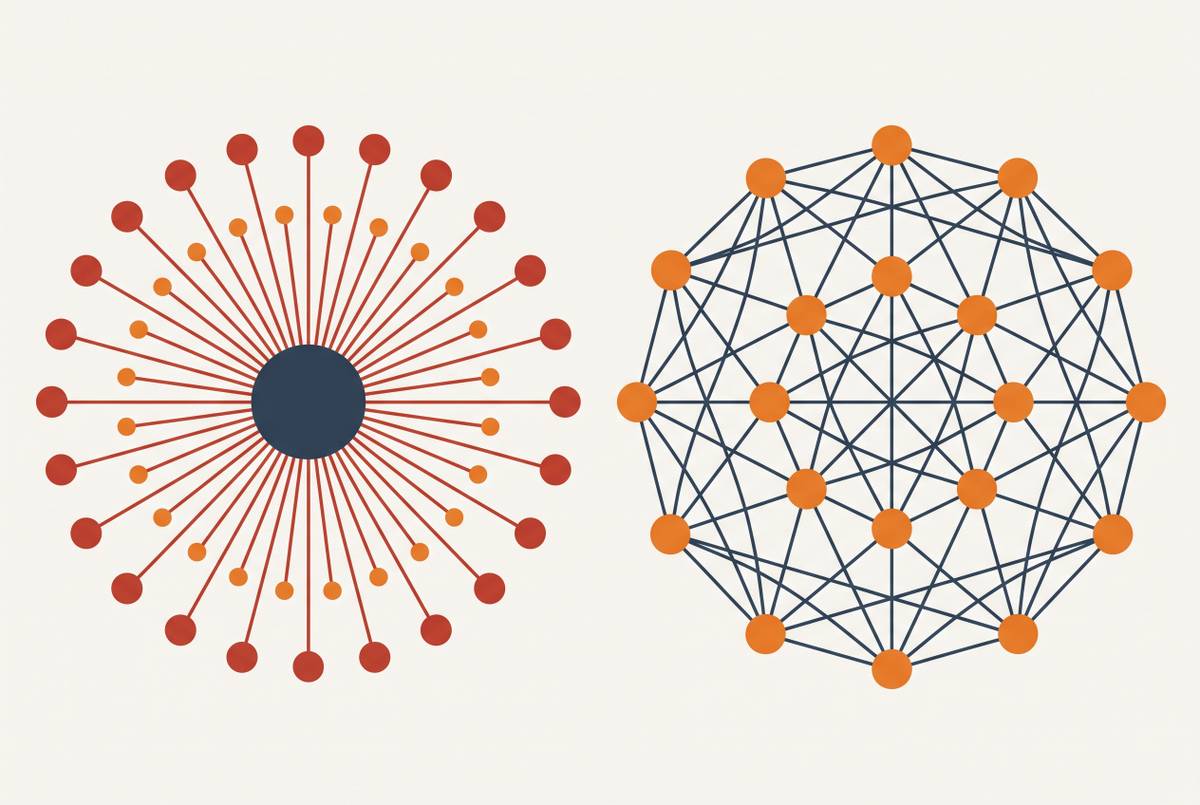
Cross-Functional AI Review Boards for Enterprise Agent Deployment
Organizations need empowered review boards with defined agent-risk mandates for each function.

To deploy agents, an enterprise needs a cross-functional AI review board that can discuss a release and has the power to stop it. The board works only when security, legal, finance, engineering, operations, and data leaders each own defined agent-specific risks. Its job is to connect those mandates to approval decisions and runtime enforcement, so that permission to deploy does not become permission to do anything afterward.
Why agents break the governance model built for humans
Traditional access governance assumes a person requests access, a team approves a defined scope, and an annual audit checks for violations. Every step runs at human pace. Agents inherit those permissions but use them continuously, without the pauses that make delayed oversight remotely workable. A support agent and a financial reporting agent sharing credentials exposes another weakness, because their distinct purposes disappear behind the same access rights.
The AI Agent Data Governance Playbook identifies four characteristics behind this mismatch. Agents never log off, work at machine speed, lack the semantic context to tell intended access from technically permitted access, and create multi-agent data flows that cannot be predicted. Each agent can stay within its own permissions while their combined workflow violates compliance requirements. Checks at the start of a session therefore cannot govern the whole transaction. Controls have to operate at the request level.
Databricks’ 2026 State of AI Agents Report finds that more than half of organizations deploy agents for multi-stage workflows, with a meaningful share running processes across teams. Security can understand permissions without knowing whether a workflow’s data has the right meaning, while engineering can assess how agents behave without settling who is liable. No single function has the full picture.
What happens when agent deployment outpaces governance
Starbucks’ production inventory system, documented in May 2026, was rolled back entirely after it misidentified similar products and missed stocked items. Formal accuracy thresholds and edge-case testing would have caught both before go-live, bringing engineering’s evaluation work together with operations’ knowledge of what the system needed to recognize. The rollback illustrates why technical readiness and operational readiness cannot be separate verdicts.
Meta’s agent incident involving unauthorized data exposure shows how agents can fail through the access they use, as well as through inventory accuracy. Governance must assess both whether an agent performs its assigned task and whether its route through data remains authorized. That distinction changes who must review it. An operationally useful agent can still need scrutiny from security and privacy before it enters production.
No body with cross-functional authority and defined decision rights reviewed the deployment before it went live. An error becomes a governance failure when the organization lacks an empowered place to challenge the conditions that allow it. A checklist cannot compensate for missing authority.
What a cross-functional AI review board actually is — and what it is not
A cross-functional AI review board is an operational decision-making body with veto authority. It can approve, pause, or reject agent deployments. A committee that can only advise and escalate is a different structure, however impressive its membership.
An AI ethics board helps with ethical dilemmas and reviews new use cases, while the governance board sets risk thresholds and decides how agents can be used. Those functions should remain separate to preserve independent ethical review. Nor is the governance board a renamed IT change-control board. Software and infrastructure checklists do not adequately address autonomous systems that reason, act, and accumulate access.
The playbook establishes an enterprise agent registry as the single system of record for agents, their owners, data access, and creation dates. Without it, shadow agents can keep running with outdated permissions. The board’s control framework must therefore include centralized registration, scoped identities and permissions, behavior evaluation, human oversight, request-level policy enforcement, and retirement controls.
How OneTrust and Mastercard structured cross-functional membership that works at scale
OneTrust’s AI Governance Committee includes representatives from Legal, Ethics and Compliance, Privacy, Information Security and Architecture, Research and Development, and Product Management. Legal oversees the work, Privacy checks that processing is lawful, and Engineering shows how the model performs and which data it depends on. Each team knows things the others cannot provide.
Mastercard uses a leaner structure for global AI governance, led by John Hearty with a five-person specialist team. The number of AI systems assessed, advised on, and monitored doubled each year until 2024, then grew by 60%. Headcount did not define the model’s reach.
These models differ in board size and share a purpose. Both rely on defined scopes. Clear mandates also address the velocity objection, because lean cross-functional teams can move faster than large committees whose remits overlap. More chairs are not, by themselves, more governance.
The mandate each function brings to the board — and what only they can own
The lesson for an enterprise building its board is to assign each seat a specific agent-risk mandate. Representation alone produces diffusion of accountability.
Security should own agent identity and lifecycle governance, including unique credentials, explicit permissions, separate service accounts by specialization, and documented retirement. It should also review tool access and multi-agent trust boundaries. The CISO AI Risk Report finds that a large majority of enterprises lack full visibility into AI identities and do not enforce access policies for them. Runtime visibility belongs in this mandate too. Detecting anomalous behavior and policy violations at the request level addresses exposure that logs examined after the fact cannot prevent.
Legal and Compliance should own regulatory mapping and the contractual and liability questions created by multi-agent workflows. Classification comes before deployment. Under the EU AI Act, high-risk classification should trigger full review, with applicable requirements mapped to data governance documentation under Article 10, logging and auditability under Article 12, human oversight under Article 14, and registration under Article 49. Legal owns that intake judgment rather than leaving engineering to infer the legal status of its own work.
Finance should own realistic cost ranges, accuracy thresholds for agents touching financial systems, and go/no-go gates at phase transitions. Compliance work can add substantially to orchestration budgets at large enterprises. The MIT paper by Acemoglu, Kong, and Özdaglar, dated February 20, 2026, identifies a further risk, in which agents perform well enough to reduce incentives for human learning and degrade long-term collective knowledge. Finance should bring that knowledge-collapse risk into decisions about high-stakes financial work. Precision limits on agent outputs are a policy lever within its mandate.
Engineering and MLOps should be in charge of behavior evaluation, gateway policies, and the evaluation pipeline. Capability limits must be enforced technically. Engineering should review memory controls and human override requirements in the architecture so that what an agent can do stays within its approved scope. Engineering should also weigh Carnegie Mellon’s finding that the speed gained early on from agentic coding assistants often hides code-quality and technical-debt costs that come later. Those later costs need to be clear before approval.
Operations and domain owners should own workflow-specific data quality, semantic definitions, accuracy thresholds, and edge-case testing. They also own the go/no-go judgment on whether the workflow is standardized enough for an agent. A model evaluation cannot fill in business definitions that are missing.
Data and Privacy, including the CDO function, should own context-layer policies, acceptable hallucination thresholds, data classification, and the agent registry. Query-level runtime enforcement must be designed in from the start. This function also owns scrutiny of data flows between agents and each agent’s individual permissions. A compliance reporting agent ingesting unmasked PII from another agent’s intermediate output illustrates the GDPR risk. Separate permission checks do not settle whether the combined flow is compliant.
How tiered approval turns board authority into a workable operational process
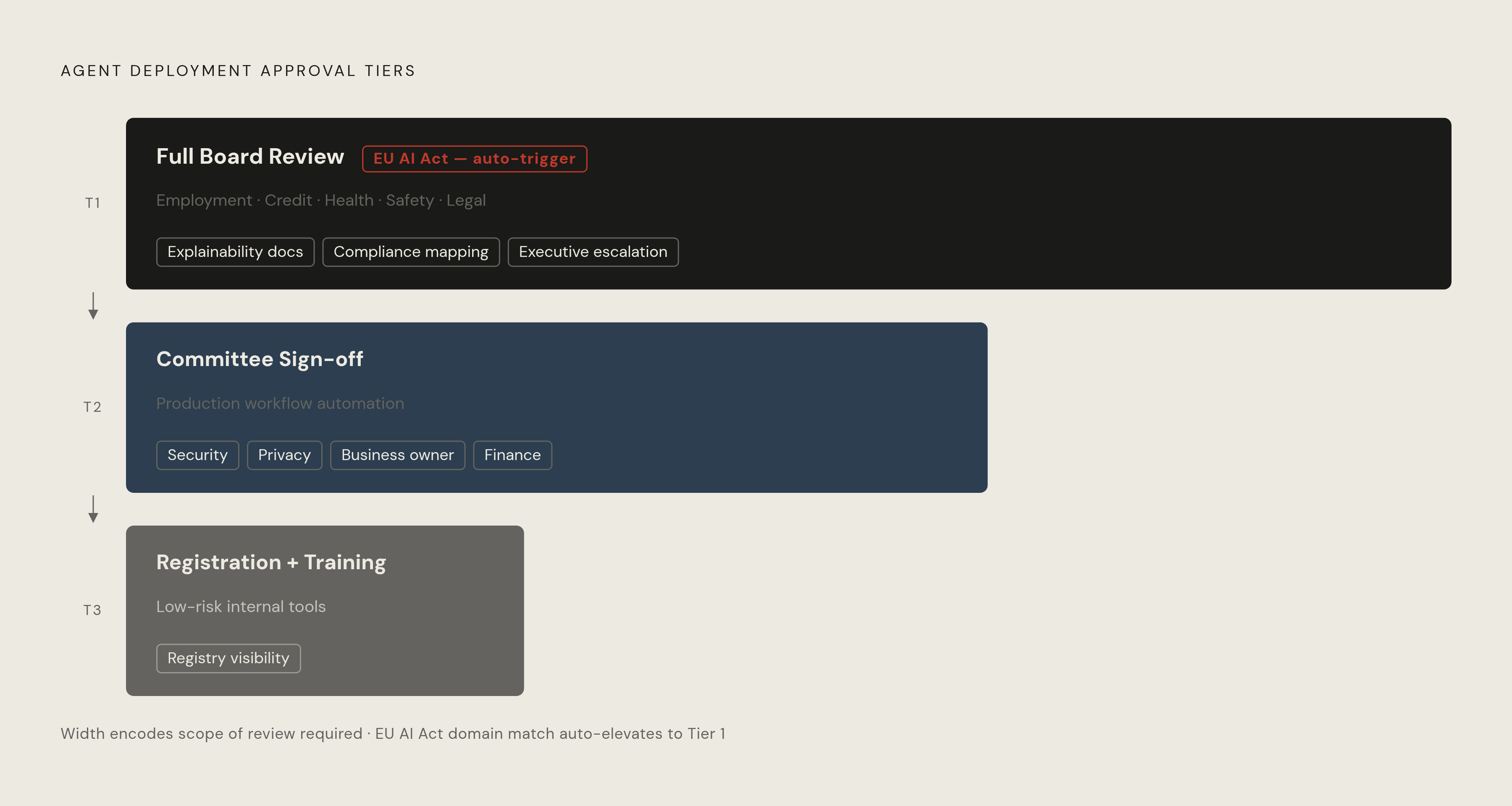
The board should define approval tiers at setup and classify deployments at intake using explicit criteria. Equal scrutiny for every agent would make the structure unsustainable.
Tier 1 should require full board review for autonomous agentic AI touching employment, credit, health, safety, or legal decisions. EU AI Act high-risk classification triggers this tier automatically. Review includes model explainability documentation, compliance mapping, and escalation to the executive team or board. Tier 2 should require committee-level sign-off for production workflow automation, with approval from security, privacy, the business owner, and finance.
Tier 3 should cover low-risk use that helps staff get internal work done, with registration and training for users but no full board review. The registry still provides visibility. The Databricks report finds that companies actively using AI governance tools put dramatically more AI projects into production than companies that do not. That finding supports a practical answer to the speed objection, although it does not make every committee efficient. The design has to distinguish a consequential deployment decision from routine registration.
What review cadence should look like across the agent lifecycle
The board’s review cadence should follow changes in agent authority and behavior. Agents can keep using permissions long after the business purpose changes, new data classifications apply, or regulatory requirements shift. Approval is only the starting point. Agents that keep running need runtime controls and repeated review by people.
At deployment, each agent should receive its tier-appropriate review and a registry entry recording its owner, permissions, data access, and creation date. Changes in capability, tool access, or data scope should trigger review again at the appropriate tier. Security and Legal should review a confirmed security incident right away.
Tier 1 and Tier 2 agents should also undergo scheduled review for permission drift, behavior anomalies, and regulatory change, with quarterly review as a reasonable anchor. That does not mean waiting a quarter to detect violations. Periodic human review of monitoring outputs is different from using periodic audits as the detection mechanism.
Between reviews, Engineering and MLOps should be in charge of the evaluation pipeline, domain teams should check data quality, and the CDO function should keep the registry up to date. Security and Compliance should own audit review and incident investigation. Retirement needs an equally explicit endpoint. As with employee offboarding, permissions should be revoked, credentials destroyed, and the registry updated so that a retired agent does not become a shadow agent.
How to get the board stood up: intake process, decision rights, and the first 90 days
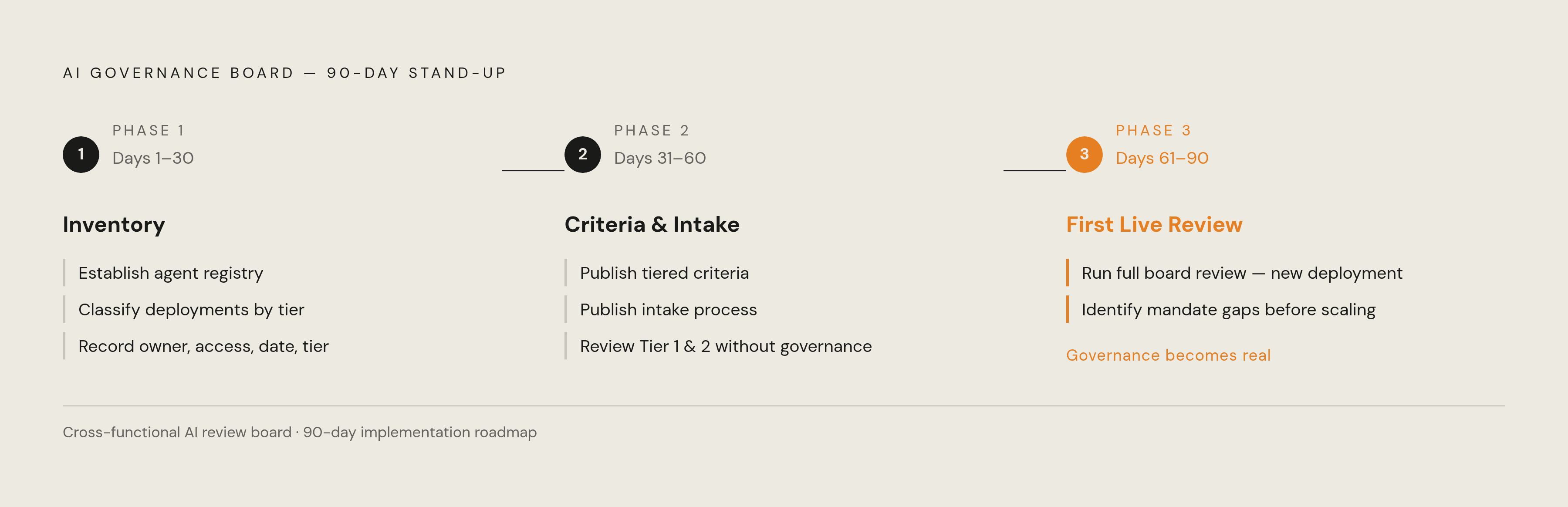
Backing from executives should give the board enough authority across teams to use its veto. Without that authority, it remains an advisory panel. Before the first deployment review, a written decision-rights framework should specify who classifies agents at intake, which approvals each tier requires, and what distinguishes a veto from a condition of approval.
During days 1–30, the first task should be to establish the registry and inventory existing deployments, then classify them retroactively by tier. Discovery comes before policy drafting. The inventory should record each agent’s owner, access, deployment date, and assigned tier, exposing shadow agents with outdated permissions that need attention.
During days 31–60, the board should publish its tiered criteria and intake process, then formally review Tier 1 and Tier 2 agents already in production without structured governance. Existing deployments are not exempt from scrutiny. During days 61–90, it should run the first full board review of a new deployment and use that review to identify gaps in the mandates before scaling the process.
Grant Thornton’s 2026 AI Impact Survey finds that a large majority of business executives lack strong confidence they could pass an independent AI governance audit in the near term. That is a useful benchmark for the initial work, but audit readiness is not the endpoint. The board needs real-time visibility into agent behavior between formal reviews. Defined decision rights establish what an agent may do, while runtime monitoring exposes the gap between that permission and production behavior. Without enforcement, approval is just well-organized paperwork.