Centralized vs. Federated AI Governance Models
Choosing between centralized and federated AI governance depends on your risk and scale.
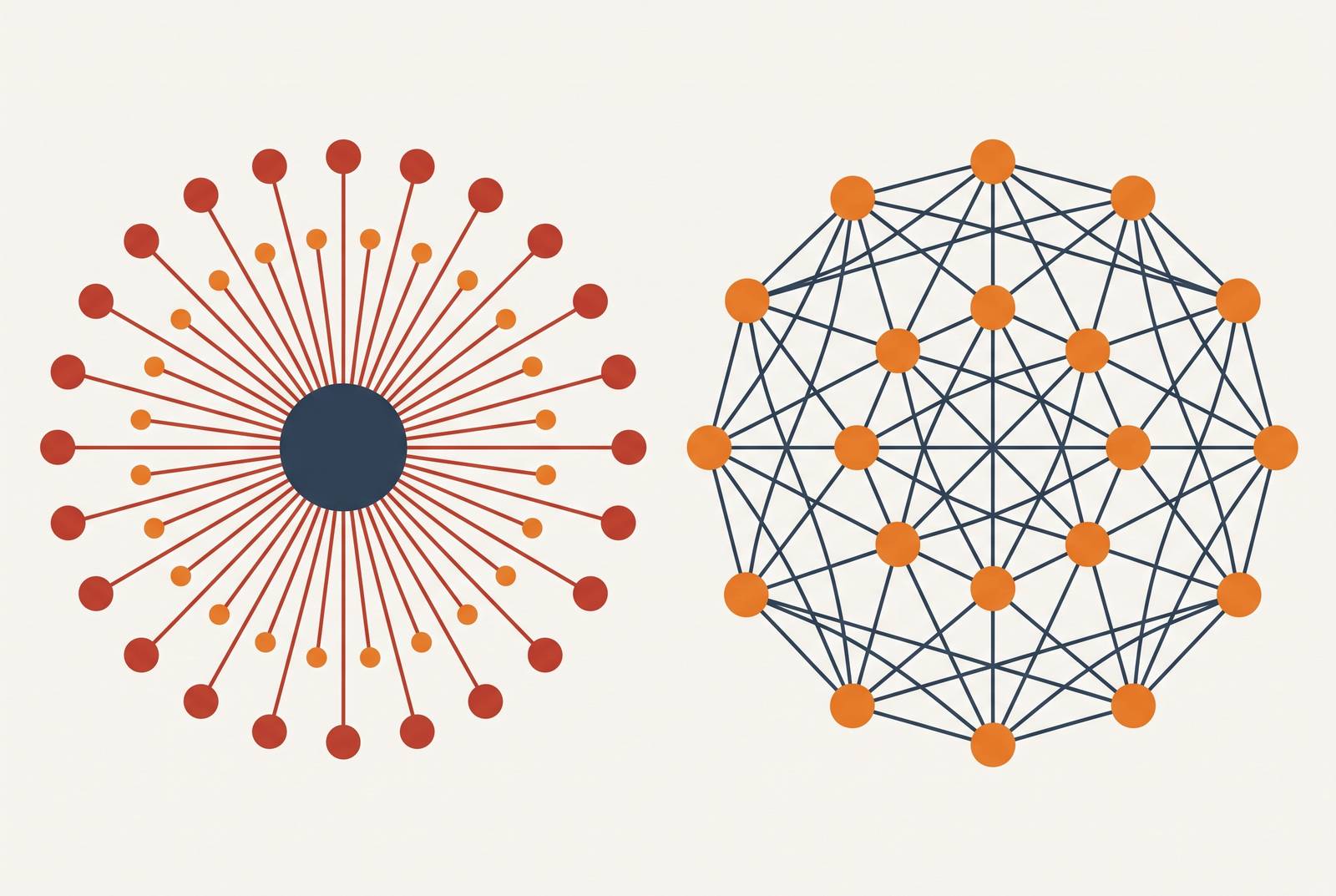
Centralized and federated AI governance solve different problems, namely consistency and speed. The right structure depends on risk, regulatory exposure, and whether teams can own their decisions. But neither structure is complete without runtime controls for AI agents. Oso provides that enforcement layer, while the organization still has to decide who has authority and who answers when something goes wrong.
Why governance structure matters more than governance policy for AI at scale
Organizations are deploying AI without the structural foundations to make it accountable. The consequences appear as inconsistent validation, fragmented ownership, and audit failures, even where written policies look sound. Deloitte's 2026 State of AI in the Enterprise report found that companies already deploying AI are less ready for governance than they are for technical infrastructure and data management. That gap concerns how organizations operate as well as which technology they buy.
The useful distinction is between a framework, a governance model, and governance tooling. A framework supplies the rules, the model assigns ownership and decision rights, and tooling puts those decisions into practice. Confusing them encourages organizations to produce more policy when they lack someone with the authority to apply it. Structure therefore shapes validation timelines, audit readiness, and whether domain expertise reaches the decision. Centralized and federated models arrange that authority differently, and agents raise the stakes because access designed for deliberate human action can be exercised at machine speed.
What centralized governance actually centralizes — and what that buys in regulated environments
Centralized governance puts one authority in charge of the AI governance lifecycle across the organization. Business units submit models, and a central team handles validation requests, controls monitoring and risk decisions, and approves or escalates deployments. Documentation standards, validation templates, and reporting formats are uniform. The advantage is traceability, with a consistent process and an identifiable owner for each decision.
That arrangement earns its place in banks, insurers, and healthcare organizations, where uniform audit artifacts and a single model inventory matter. It makes it easier to keep work in line with SR 26-2, EU AI Act, and similar frameworks. When agents join the portfolio, the same authority can set the same access-control policies for all deployments. Fine-grained authorization enforcement, including the controls Oso provides, can make those permissions as uniform and auditable as the approval process.
Centralization also makes sense before an organization has much AI experience. Scarce talent, emerging tool sprawl, and limited leadership visibility favor concentrating expertise. McKinsey research found that more than half of businesses have adopted a centrally-led organization for generative AI even when their usual data and analytics setup is relatively decentralized.
Where centralized control breaks — the bottleneck problem and the one-size-fits-all review trap
The same routing that produces consistency can become a bottleneck as model volumes grow. Every additional request competes for the capacity of one validation team, so deployment speed becomes tied to that team's headcount. A structure that serves a small portfolio well can throttle a larger one without any change in policy. This is centralization's strength operating beyond its useful scale.
The problem deepens when every request receives the same review regardless of risk. Low-risk experiments wait behind the hardest cases, while reviewers with too much work may have too little time for deployments that truly are high-risk. Agents spread across engineering, product, finance, and sales faster than a central queue can accommodate, creating pressure for shadow deployments. The queue becomes an incentive to avoid the queue.
Slow approvals can also push teams to grant broader permissions up front so they can avoid coming back for another review. That leaves agents with more capability than governance intended. By enforcing permissions at runtime, Oso can help separate deployment speed from access scope, allowing iteration without treating broader access as the price of avoiding another approval cycle.
What federated governance actually federates — and why domain context is the core argument for it
Federated governance gives business units or product teams the work to carry out under enterprise-wide guardrails. Each team is in charge of its own model validation, monitoring, documentation, and decisions about risk. The central function sets high-level policy and leaves each team in charge of how it carries out the work. Authority moves closer to the people who understand the model's purpose and the consequences of failure.
That proximity is the strongest argument for federation. A fraud model at a payments company has different risk dimensions from a recommendation engine in retail. Teams with deep domain knowledge can make validation more appropriate to those differences while reducing dependence on a central reviewer. The case grows stronger when divisions operate in different markets, regulatory environments, and technology contexts.
Federated learning differs from federated governance, but it shows why work sometimes has to stay local. Participating hospitals can train models on their own data and share only model updates with a central aggregator. Raw data stays where it came from, which helps meet privacy and data-residency obligations like GDPR and HIPAA. That arrangement can avoid legal and ethical barriers to centralized data pooling, but it does not itself settle who owns governance decisions.
Where federated governance breaks — the coordination overhead and accountability atrophy risks
Distributing authority does not eliminate coordination work. Without a shared coordination layer, validation standards diverge, documentation fragments, and no one has a reliable view of the full model inventory. Decisions can make sense within a unit even when they overlook what happens to the rest of the enterprise. The organization then struggles to present a coherent compliance posture, even if individual teams believe their own work is in order.
Federation also depends on accountability maturity that cannot be assumed. Where teams lack the capacity to maintain documentation and validation discipline, governance can atrophy over time. Teams may miss the problem during development and see it only when an examination calls for a complete inventory, lineage, or validation history across units. Local ownership is not the same as collective audit readiness.
Agents add a more immediate visibility gap. A business unit may own an agent without having the tooling to monitor its inherited access or actions in real time. Peer units and the central function may be equally unable to see the activity. In that situation, a distributed governance model assigns responsibility but leaves the responsible people discovering violations after they have occurred.
The hub-and-spoke hybrid as the most commonly adopted middle path — and what it actually requires to work
A central AI function is in charge of governance, infrastructure, tooling standards, and shared platforms. Business units own use-case prioritization and day-to-day work, supported by embedded AI talent connected to the center. Among enterprises beyond the earliest deployment stages, it is the most commonly adopted middle path.
Shared infrastructure and governance can support institutional learning without requiring the center to make every domain-specific decision. The model manages the continuing tension between consistency and speed.
That management requires explicit decision rights. The structure must say which decisions belong to the center, which belong to units, and how disagreements escalate. Otherwise, a nominal hybrid can drift into shadow federation, where local practices escape oversight, or re-centralization, where every decision returns to the hub. A hub-and-spoke diagram is easy to draw. The difficult work is deciding what happens when the hub and a spoke disagree.
How risk tier, regulatory exposure, and AI maturity determine which structure actually fits
Which structure fits depends on three things: risk exposure, regulatory environment, and AI maturity. Risk exposure asks what happens when a model fails. Regulatory exposure asks which obligations apply and whether they are uniform across units. Maturity asks whether teams have the expertise and accountability infrastructure to govern without central review of every decision. These conditions matter more than a general preference for control or autonomy.
A single-jurisdiction bank with uniform obligations has a stronger case for centralization than a multi-market conglomerate. High, consistent risk supports common validation and ownership, particularly when talent is scarce or leadership lacks visibility into deployments. By contrast, domain-diverse portfolios favor federation when local teams can maintain their own compliance records. Different regulatory regimes also weaken the case for imposing one validation workflow everywhere.
In healthcare, strong oversight may favor centralized governance, while restrictions on pooling hospital data may favor federated learning. Neither choice automatically determines the other. Similarly, a naturally decentralized company may fit federated governance, but only if its units can carry the responsibility. Autonomy without that capacity is delegation on paper.
Why neither model, as typically implemented, can govern AI agents at runtime
Both governance models usually operate before deployment and through later review. They establish responsibilities and approved behavior but do not, by themselves, supply enforcement machinery. The NIST AI Risk Management Framework, ISO/IEC 42001, and the EU AI Act define obligations at the policy level. None is itself a mechanism for detecting or stopping an agent's action.
That distinction becomes critical when agents inherit production access and use it immediately. An action a human might take days to execute can be completed by an agent in seconds. A central approval team cannot know what happens after go-live unless runtime monitoring is separately instrumented. A local team can have the same blind spot and also miss patterns across units.
The failure is structural: asking reviewers to pay closer attention does not give them a control that operates at machine speed. Runtime governance needs continuous visibility into which agents are running, what data they access, what actions they take, and whether those actions match approved policy. An audit log can explain what happened, but that alone cannot stop it.
What runtime agent monitoring and enforcement look like in practice — and where Oso fits
Oso addresses this operational gap through agent discovery, real-time monitoring, anomaly detection, and enforcement. It discovers agents running inside an organization and monitors approved AI traffic, including prompts, tool calls, and responses. It detects anomalous behavior and policy violations, then enforces rules on what agents can and cannot do. Complete audit logs of every agent action provide a record for compliance and incident review.
Discovery establishes what is running, monitoring shows its activity, detection identifies deviations, and enforcement constrains actions before they complete. Access scope is especially important because permissions that employees leave unused remain available for agents to exercise. Fine-grained authorization turns an approved boundary into an operational limit.
For centralized governance, Oso lets the central team see deployed agents without having to track each deployment by hand. For federated governance, it gives local teams runtime controls while making cross-unit activity visible to the center. It is therefore a direct fit where the missing capability is control over agent actions in production.
Other approaches address adjacent needs, including monitoring built into AI platforms and model risk management platforms for validation and documentation. Lifecycle tooling supports the process that approves and reviews models. Agent-action enforcement addresses what happens when deployed agents use their access, so the two layers answer different questions.
Choosing and evolving a governance model — a practical framework for the decision
Low AI maturity and high regulatory exposure favor a centralized foundation that establishes shared standards, inventory, and validation norms before authority spreads. When maturity is high, domains differ, and business units answer for their work, federated or hub-and-spoke execution fits well with central policy and a view of work across units. Mixed maturity favors a hybrid with decision rights defined before responsibility is distributed.
Define who decides, how review burdens vary by risk tier, which platforms are shared or local, and who is accountable after deployment. Revisit that allocation as teams build expertise and demonstrate that they can maintain the required records and controls. Centralization can build the knowledge that later makes controlled federation possible.
For agents, pair those ownership decisions with runtime enforcement from the outset. Establish visibility into deployed agents and make approved access boundaries enforceable while they act and reviewable afterward. Production owners need both responsibility and the controls needed to exercise it. That is the practical difference between governing AI and documenting an intention to govern it.