Sanctioned AI Programs That Reduce Shadow Adoption
Approved AI tools cut shadow adoption while giving IT the visibility bans never achieve.

Shadow AI is the predictable outcome of a gap between what employees need to get their jobs done and what their employers have gotten around to approving. This piece covers why bans fail to close that gap, what it costs organizations that leave it open, and what a sanctioned program has to include before enforcement can mean anything.
Employees Turn to AI Tools Without Waiting for IT Approval
Most organizations have already folded AI into how work gets done day to day. Only about a quarter of them can say with any confidence what their employees are actually doing with it. That asymmetry is what happens when adoption moves faster than the committees meant to govern it.
Employees are smuggling AI tools past IT because the task in front of them is due today and the procurement process in front of them is measured in months. Nobody is weighing the fine print of an acceptable-use policy against a deadline and picking the policy. The tool that answers a question right now beats the tool that might get approved next quarter, every time, because the fear driving adoption is not "what if I get caught" but "what if everyone else figures this out before I do." That is a productivity calculation, not an ethics one.
Treating this as a discipline problem gets the diagnosis wrong before the first policy memo goes out. The employees running AI tools without sign-off are not the problem to be rooted out. They are the surest proof that work has already outgrown what the organization is prepared to support.
Banning AI Reliably Makes the Problem Harder to Manage
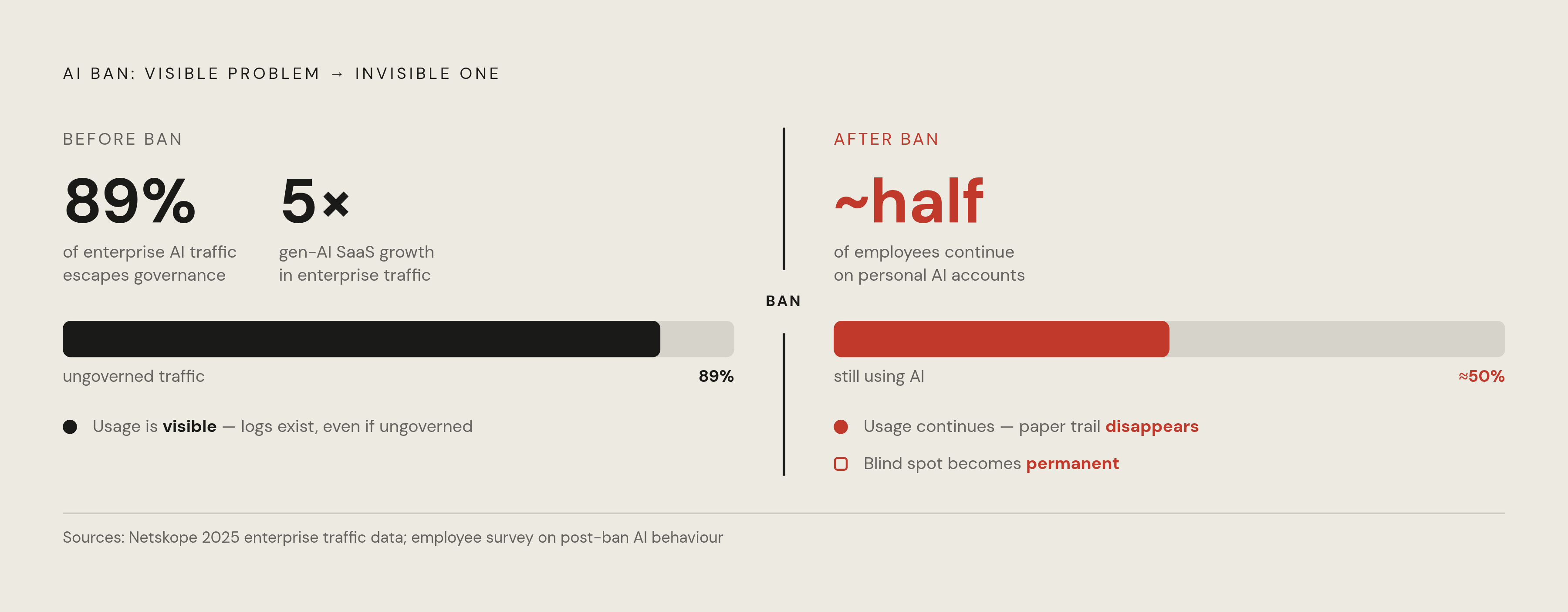
A ban does not stop anyone from opening a browser tab; it just means nobody official is watching what happens in it. Close to half of employees say they would keep using their personal AI accounts even after their company explicitly bans the practice. The ban does not reduce the behavior. It removes the paper trail.
That visibility problem exists even without a ban. CSA's research finds that the vast majority of enterprise AI usage already sits outside what security teams can see. Prohibition does not create that blind spot; it makes it permanent. A list of banned tools cannot do anything about an employee running a quantized model locally on a laptop or an AI PC. URL filtering and network monitoring were built for traffic that touches the network. A model running on local hardware never does, which makes "Bring Your Own Model" a blind spot no ban has any mechanism to reach.
Even a blocklist built with the best intentions is chasing a target that will not hold still. CSA's research found that generative AI SaaS applications in enterprise traffic grew nearly fivefold in a matter of months by mid-2025. And even where companies have sanctioned accounts in place, Teramind's analysis puts the share of workplace AI use still escaping enterprise governance at 89%.
Samsung tried the ban after engineers pasted proprietary source code into ChatGPT. The company shut off generative AI access company-wide, then spent the following year building its own internal tool instead of trying to hold the line indefinitely. That reversal is the tell: an organization with real security resources and real motivation to enforce a ban concluded a ban was not a strategy, just a delay before building the thing that actually works.
The usual defense of banning is that it sends a signal about what the company considers acceptable. The signal lands fine. Optro's data shows most employees already know the rules around AI use and bypass them anyway. The constraint on behavior was never ignorance. It was always incentive, and a ban does nothing to change the incentive, it just makes the resulting behavior invisible.
What ungoverned AI use costs when it goes wrong
Once usage goes invisible, the consequences of losing track of it become visible on balance sheets and in regulatory filings. The financial and regulatory exposure from ungoverned AI has grown large enough to land on board agendas, beyond IT's quarterly report.
What gets exposed is rarely trivial. Source code, customer PII, financial records, legal documents, strategic plans, and credentials are the categories that turn up most often in unsanctioned AI tools, and once that information has been submitted to a consumer AI service, there is little practical way to get it back. Healthcare carries a sharper version of this risk: Wolters Kluwer's 2026 data, cited in Optro's report, finds that roughly two in five healthcare professionals have run into unauthorized AI tools at work, and a meaningful share of them report using those tools in direct patient-care settings.
Regulators are no longer waiting on the sidelines. General enforcement of the EU AI Act, including the Article 50 transparency obligations, began August 2, 2026, and while the higher-risk obligations under Annex III were pushed to December 2, 2027 by the Digital Omnibus, CSA's research notes that an incomplete AI system inventory is, as of the August date, a legal violation rather than a vague governance shortfall, carrying penalties tied to global annual turnover. Finland had its enforcement machinery fully operational by January 2026, ahead of the rest of the bloc.
CB Financial Services filed what appears to be the first SEC Form 8-K triggered by unauthorized employee AI use, not a cyberattack, in May 2026. That filing suggests the sensitivity of the data alone can be enough to meet the materiality threshold, and the company had four business days to disclose it once that became clear. Most of this damage does not come from employees trying to cause harm. DTEX and Ponemon's 2026 data, cited in Vectra's analysis, puts insider risk costs at tens of millions of dollars per organization annually, with the majority of it traced to negligence rather than intent, and shadow AI as the main mechanism carrying it.
What a sanctioned AI program actually changes (evidence from organizations that built one)
The clearest evidence that governance changes outcomes, rather than just appearing to, comes from a healthcare system that gave clinicians an approved AI tool instead of trying to block the unapproved ones. Unauthorized AI use at the organization dropped sharply, and clinicians got back a meaningful chunk of time each day, because the sanctioned tool did the job the unsanctioned ones had been doing anyway, only with the organization able to see it. CSA's research backs the same pattern in the other direction: provision a sanctioned tool, and unauthorized use falls. Supply-side governance, giving people something that works instead of trying to detect and punish them for using something that does, outperformed the block-and-monitor approach.
At larger scale, the pattern holds. Gordon Food Service used Google Workspace and Gemini Enterprise, launched in October 2025, to unify data access across the company, run market research, and improve knowledge sharing through AI note-taking built into Meet. Commonwealth Bank of Australia ran a large-scale Copilot deployment and found that the large majority of users would not go back to working without it once they had it. These are stories about adoption following the tool that's actually offered rather than the one employees had to go find on their own, once a sanctioned tool is good enough to replace the unsanctioned one.
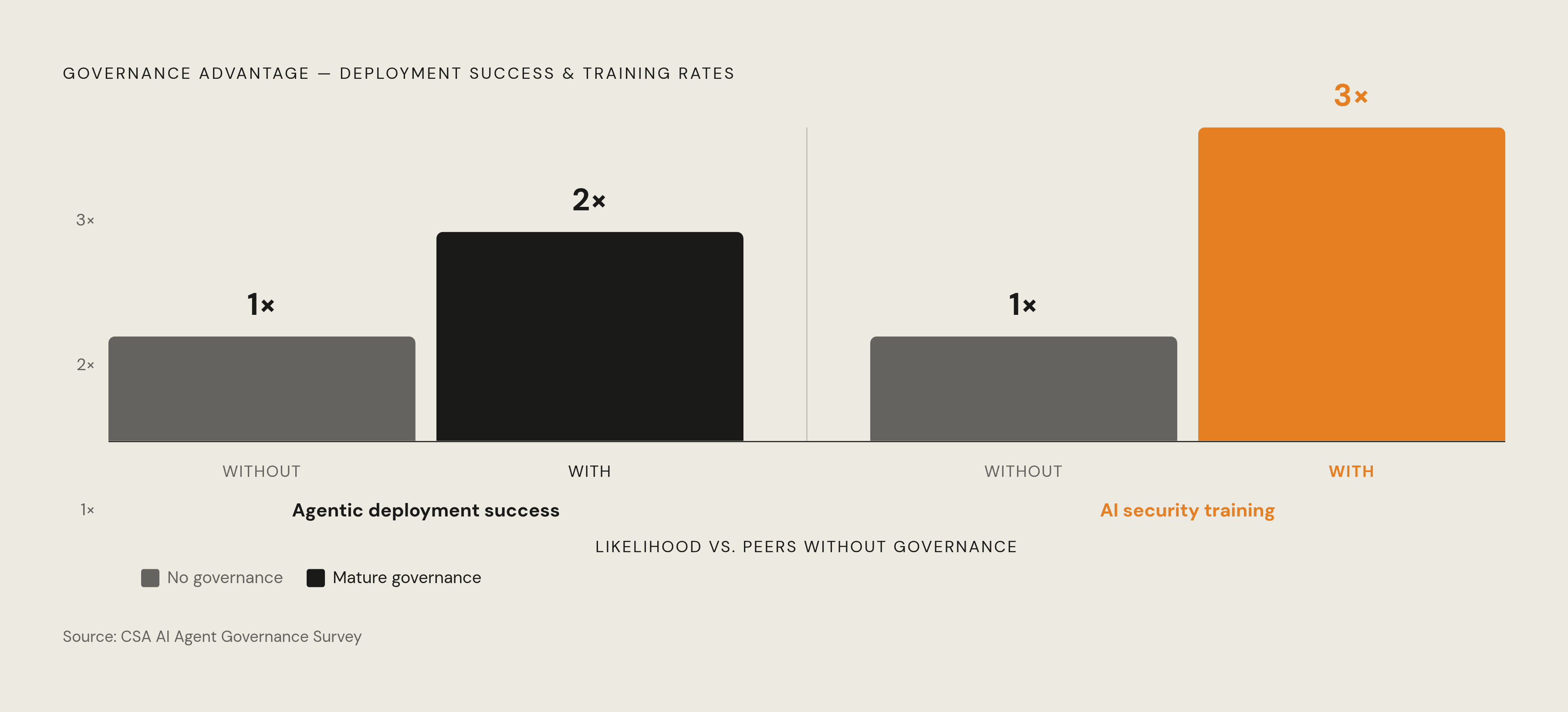
The effect compounds over time rather than staying flat. CSA's AI Agent Governance Survey finds that organizations with mature AI governance programs are twice as likely to get agentic AI deployments working and three times more likely to actually train their staff on AI security practices. Governance, done well, works less like a speed bump and more like infrastructure: once it exists, everything built on top of it gets easier, not harder.
Why tool provisioning alone does not close the gap
Giving employees an approved tool is necessary, but it is not the whole fix, and treating it as the finish line misreads the data. The majority of employees who know their company's AI policy bypass it anyway. Access and communication are table stakes, not solutions on their own.
The awareness-behavior gap is well documented at this point: employees are not confused about the rules, they are just not motivated to follow them. The constraint was incentive and culture, and no amount of restating the policy in a new onboarding deck changes that. Utilization data from Microsoft 365 Copilot makes the same point from a different angle: across its base of paid seats, daily use concentrates in a fraction of the licenses purchased. Per-seat licensing does not match actual adoption patterns, and shelfware at enterprise scale represents a significant cost exposure. Microsoft's Work Trend Index found that organizational factors, not individual attitudes toward AI, account for most of the variation in whether AI investment actually produces results. Culture and structure decide the outcome more than the tool does.
Three things have to accompany the tool itself. Training needs to move past reciting the policy and toward helping employees recognize what risk actually looks like inside their own workflow, in the specific moment they are about to paste something into a chat window. Incentives need to change too: only a small share of employees say they are rewarded for reinventing their work with AI when the outcome is not guaranteed, and until that changes, experimentation keeps happening quietly instead of in the open. And monitoring needs to run continuously and roll up into risk scoring at the department level, catching drift from policy as a pattern rather than a surprise, instead of only flagging individual incidents after the fact.
The structural requirements for a sanctioned program enforcement can back
None of the above means anything without a real-time, complete account of what AI tools are running and what they're doing. Short of that, a policy is a document sitting in a shared drive, not a working control. The scale of the inventory problem is bigger than most governance teams assume going in: Reco AI's State of Shadow AI Report, as cited by CSA, finds that the average enterprise manages hundreds of SaaS applications, fewer than half of them authorized, with unauthorized AI tools often running for a substantial period before anyone notices them. An approved-tools list does not mean the unapproved tools stopped running beside it.
Discovery has to be ongoing rather than a one-time audit. Netskope's Cloud and Threat Report shows that even as personal-account GenAI use has declined, most enterprise AI traffic now flows through company-sanctioned accounts, and 89% of it still escapes enterprise governance anyway, because the tools got deployed and trusted without anyone building the instrumentation to watch them. Being sanctioned and being governed are not the same condition: approving a platform says nothing about whether the organization can see what data moves through it, which agents are acting on that data, or whether policy is holding at the level of individual actions rather than just at sign-up.
A governed program needs four capabilities working together, and losing any one of them breaks the chain. It needs to discover every AI service, agent, and connection running inside the organization, including tools connected through a third-party authorization method and models running locally that never touch a network filter. It needs to monitor all of that approved traffic in real time rather than reconstructing it from logs after something has already gone wrong. And it needs to enforce rules on what agents and tools are allowed to do at the level of individual actions, with audit logs complete enough to satisfy regulatory requirements, including the inventory obligations written into the EU AI Act. Discovery without monitoring is a snapshot that goes stale. Monitoring without enforcement is a dashboard nobody acts on. None of it works as a one-off initiative, because the tools, the employees, and the regulatory deadlines are all still moving, and a program built to catch a moving target has to keep moving with it.