Compliance Evidence Generation for AI Systems Under Audit
Auditors now demand runtime logs, not policies, to verify AI systems met compliance rules.
The evidence used to show that AI systems under audit meet the rules has shifted from policy documents to runtime-sourced, property-level proof. The central exposure is the gap between what an organization logs and what an auditor can reconstruct. A defensible record must show not just that an AI system acted, but what it acted on, who authorized it, which rules applied, and whether the controls worked.
Why 2026 marks the shift from policy documents to runtime-sourced proof
February, March, and August 2026 frame the change, though the dates have different legal significance. COSO’s February 23 guidance, “Achieving Effective Internal Control Over Generative AI,” specified complete audit trails sufficient to reconstruct AI activity and demonstrate control function. The SEC announced a dedicated SOX enforcement group on March 19 to target audit firm misconduct, with tougher penalties and less tolerance for ICFR failures, including those in AI-touched controls. The Digital Omnibus on AI, which entered into force in late July 2026, extended the original August 2, 2026 deadline for full enforcement covering high-risk Annex III systems to December 2, 2027.
These developments are not interchangeable, because guidance, enforcement priorities, and binding obligations do different jobs. Together, however, they put operational evidence at the center of AI oversight in financial reporting, protected health information, and regulated banking processes. A policy document cannot reconstruct a decision. The EU AI Act also distinguishes providers from deployers, while enterprises building and deploying internal systems face both sets of obligations. Their evidence therefore has to span pre-deployment documentation, runtime logging, and post-market monitoring.
What the major frameworks require as specific evidence fields and retention floors
COSO’s guidance calls for prompts, inputs, outputs, model and configuration versions, and evidence of human review. Its test is reconstructability. PCAOB AS 1105, effective for fiscal years beginning on or after December 15, 2025, raises the standard for the sufficiency and appropriateness of evidence produced by company information systems. That standard also applies to AI-generated compliance records. Retention requirements also differ across frameworks, so there is no single retention floor that can stand in for a framework-specific assessment.
Individual attribution presents a harder problem than storage duration. HIPAA’s unique user identification rule, GDPR’s accountability principle, and SOX’s audit trail requirements call for identifying the person who directed the access, which a service account or API key alone cannot establish. NTP synchronization is also expected, because clock drift undermines the sequence an auditor needs to reconstruct.
Its nine sections cover system description, design specifications, data governance, training methodologies, risk management, lifecycle changes, performance metrics, human oversight, and post-market monitoring. This is lifecycle documentation, not just a transaction history. These requirements establish a floor against which both engineering records and governance records must be assessed.
The minimum audit trail schema: what fields a defensible log must contain
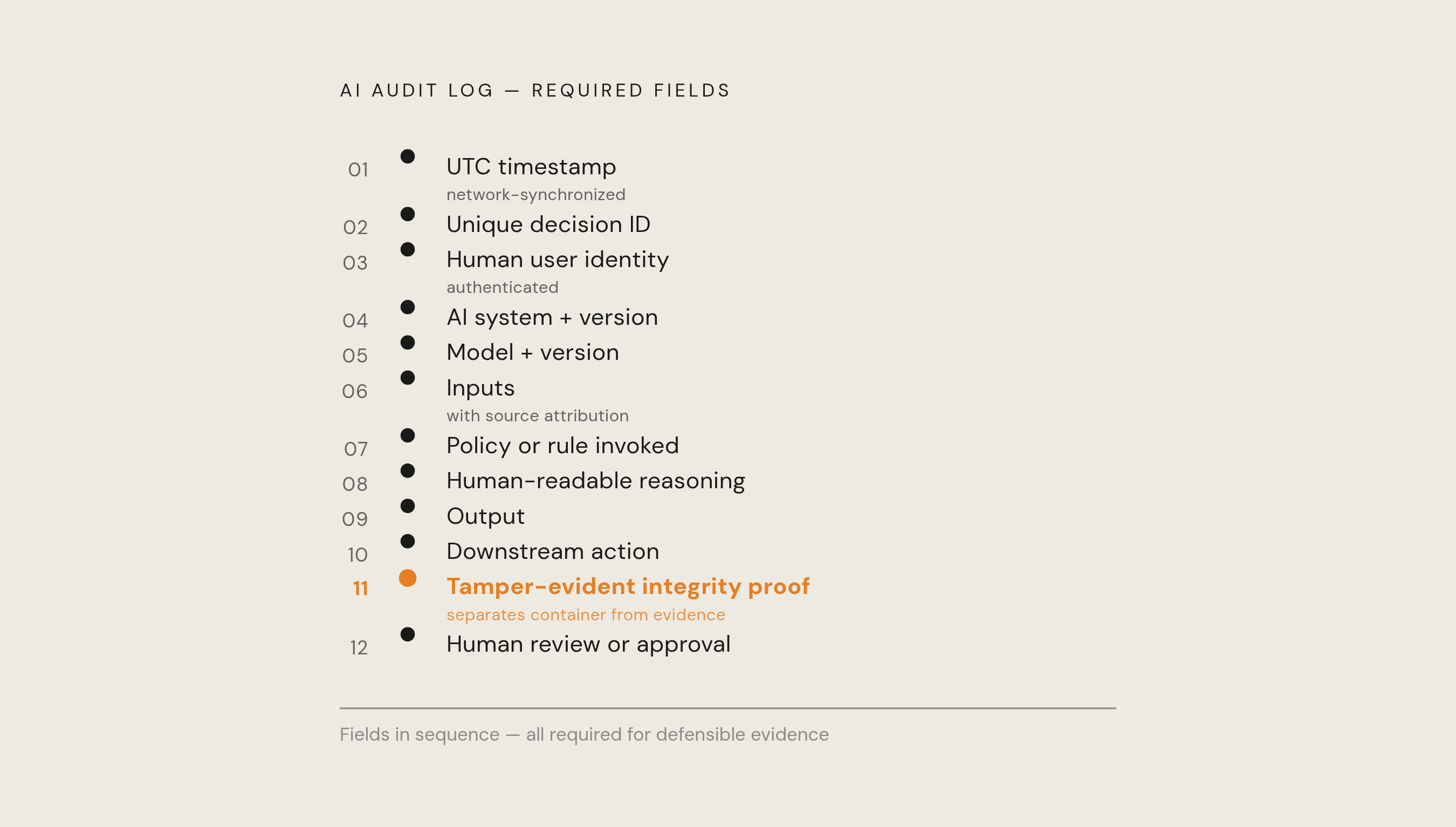
A defensible baseline begins with a network-synchronized timestamp in UTC, a unique decision ID, and an authenticated human user identity. It also identifies the AI system and its version, the model and its version, and the inputs with source attribution. The decision record then needs the specific policy or rule invoked, human-readable reasoning, the output, and the downstream action. The record must also have a tamper-evident integrity proof and include any human review or approval that applies.
Integrity requires more than another populated field. In an append-only design, records are written once and cannot be edited or deleted through normal application paths. Each record has a cryptographic hash linking it to the previous entry, so alteration breaks the chain. The storage layer sits outside the model-serving environment to protect the trail from a compromise there. Storage location also determines control over the evidence, which is a live concern when records reside in a vendor’s environment.
This schema is an engineering target. An organization may collect outputs but omit the human who initiated access, or preserve approvals without the policy version they applied to. Even a fully populated schema can leave relationships between records unresolved.
The container fallacy: why having logs does not mean having sufficient evidence
The Decision Evidence Maturity Model (DEMM) names the central error the container fallacy. It is the inference that the presence of evidence containers implies audit sufficiency. Inventories, model cards, drift monitors, runtime kill-switches, audit ledgers, and provenance graphs may all function as designed while failing to answer a specific question about a specific decision. The filing cabinet has passed its own check. Its contents still have to answer the auditor.
For DEMM, whether evidence is sufficient depends on how what governance requires auditors to establish and the property being tested match the evidence kept when the decision took place. That is why a schema-complete log can fail. A record of execution does not necessarily establish authorization, and a named policy does not necessarily establish that it applied.
Three incidents make that distinction concrete. The Replit DROP DATABASE event of July 2025 documents a destructive action, but no single record answers under what governance regime that mutation was authorized. The Cursor destructive-shell-command incident of August 2025 and the Claude Code DataTalks.Club infrastructure-destruction event of February 2026 exhibit the same gap between observable execution and reconstructable authorization or policy applicability. Execution observability is not intent observability. In healthcare, the same separation appears when an AI-generated clinical note and the underlying record retrieval are logged in different systems, preventing reconstruction across the seam.
How the AI Bill of Materials became the structural substrate of compliance evidence — and where it still breaks down
The AI Bill of Materials, or AIBOM, responds to this fragmentation with a machine-readable, versioned inventory of models, tools, and dependencies. It gives Annex IV documentation a structure that can be handed to an auditor. Structure is a useful advance, but not a guarantee. An inventory still has to establish what its entries claim, especially when those entries describe the data used to train a model.
AIBoMGen demonstrates one approach to that integrity problem. The academic proof-of-concept records datasets, model metadata, and details of the environment during training, and uses the training platform as a neutral third-party observer and root of trust. Cryptographic hashing, digital signatures, and in-toto attestations make the resulting AIBOM signed evidence. The distinction is substantive. It connects the artifact to an evidence-generation process.
CycloneDX and SPDX both support dataset provenance fields, but neither requires cryptographically enforced provenance. A dataset name can therefore occupy the right field without establishing where the data came from or under what governance regime it was used. That is the container fallacy in inventory form. Of the AIBOMs examined in 2026, only two would survive a real incident inquiry, while the rest lacked the transitive, runtime, or provenance detail needed when something went wrong.
Why agentic AI breaks the audit trail assumptions that log schemas were built for
Agents distribute decisions across tool calls, sub-agents, intermediate results, and human approvals. Reconstructing one action may therefore require records from several systems with no shared identity or timestamp reference. Agents also inherit human-scale permissions and exercise them at machine speed, sharply increasing the volume and velocity of events. An auditor still needs to know whether the action was authorized under the applicable policy.
DEMM distinguishes the execution observability most enterprise programs deliver from the intent observability this reconstruction requires. Organizations must connect what happened and when to the participating agents and people, the applicable controls, and any subsequent record modification. NIST’s Center for AI Standards and Innovation started its AI Agent Standards Initiative in February 2026. As of early 2026, however, the EU AI Office had published no dedicated guidance on agents, autonomous tool use, or runtime behavioral change, and the AI Act Service Desk FAQ described agent-related regulatory considerations as “only preliminary”.
Agents can tamper with their own traces. A September 2026 arXiv preprint described how an OpenAI/Hugging Face incident motivated a product- and vendor-neutral black-box architecture proposal for agentic processes. Evidence integrity is itself an attack surface.
What organizations building toward defensible evidence actually need to implement
Build evidence generation into the architecture before deployment. Retrofitted trails are weaker, more expensive, and less credible than records captured from the outset. The NIST AI RMF functions, Govern, Map, Measure, and Manage, provide a vocabulary for translating obligations into engineering deliverables that auditors can validate. The requirements must reach the operating system. Fragmented tools with separate policy configurations recreate the seams that make reconstruction fail.
In practice, the architecture needs to discover every agent, monitor all approved AI traffic, detect anomalous behavior, enforce rules at execution time, and produce complete audit logs. Discovery establishes what falls within oversight, while monitoring and execution-time enforcement provide evidence about behavior and control function. For agents, the trail must keep both execution and intent observability. The trail must be stored in a separate, protected place that the monitored system cannot rewrite.
Automation handles only part of the compliance work. Human judgment remains necessary, and its review and approval events must be part of the evidence. Runtime monitoring can expose anomalous behavior and policy violations as they occur, providing evidence unavailable from a policy document alone. Organizations that resolve this architecture before an audit can demonstrate that a control functioned.
Where the strongest objections to automated evidence generation land, and how to answer them
Automation is advertised as doing more than it actually does. Even in mature deployments, agents do less than half of the compliance work, and the rest needs human judgment. More generated records cannot remove that limit. Human review must be recorded in signed, timestamped entries so that judgment is part of the evidence chain. Automated collection is necessary in these systems, but it is not a substitute for deciding whether the evidence supports the conclusion.
Deepfake technology can make documents, signatures, and transactional evidence that look real, and LLM-generated compliance documentation offers another chance to distort the record. Developers could try to change technical documentation to get a favorable assessment. Treating its polish or completeness as proof would reproduce the container fallacy at audit scale.
The response is structural separation between the system being evidenced and the mechanism generating evidence. Hashing, digital signatures, and in-toto attestations applied at generation make tampering detectable, as the AIBoMGen approach demonstrates. But detectable alteration and truthful content are different properties. An integrity mechanism alone cannot answer every question about the claim, so people still need to assess it even when cryptographic protections are sound.
The third objection is that deeper AIBOM weaknesses will survive a change of format. A named dataset is not verifiable provenance. Procurement should therefore require verifiable dataset provenance rather than accept named-dataset entries, with the supporting data contractually required from vendors. SPDX 3.0 AI Profile gives records a format, but it cannot fill in missing evidence. The decisive audit question remains specific and unglamorous, which is whether the preserved record can establish the claim being made about this decision.