HIPAA Compliance Gaps Created by AI Agents Accessing PHI
AI agents' autonomous data access and persistent memory undermine HIPAA's human-centered safeguards.
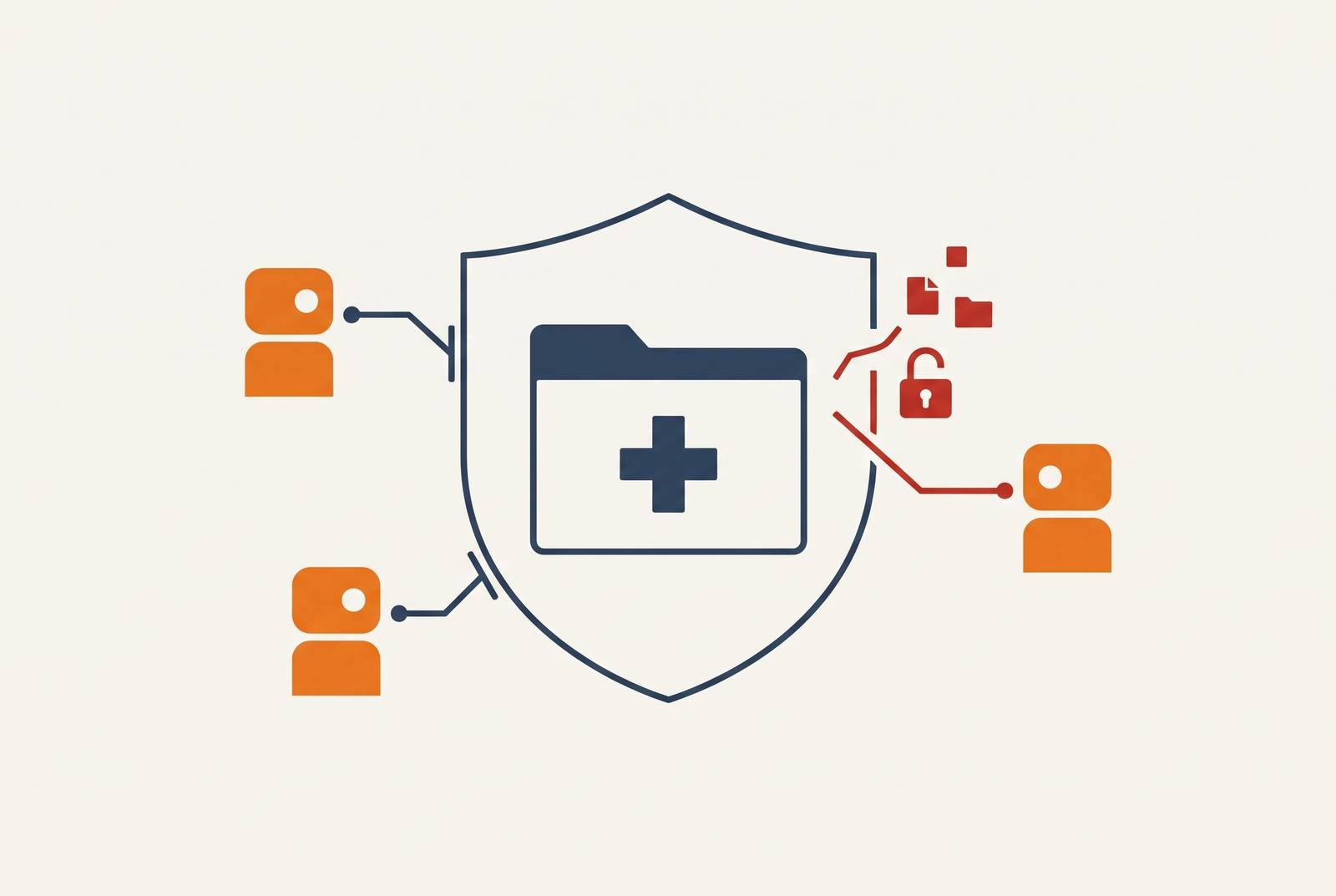
AI agents create HIPAA compliance gaps both when they are deployed carelessly and through how they access, keep, and use protected health information (PHI). The way they are built can defeat controls made for human workers. To close those gaps, safeguards must be in place where agents retrieve data, keep context, generate answers, and pass information to other services. A policy written for a person does not become an agent control by changing the job title.
Why AI agents structurally conflict with HIPAA's founding assumptions
HIPAA’s familiar operating model is human-scale, intentional, and task-bounded. A nurse queries a chart, a coder pulls a claim, and each action has an identifiable actor and purpose. Agents loosen those boundaries by retrieving information autonomously, keeping context across sessions, and taking several steps without a person approving each one. The task remains bounded on paper. The system’s behavior may not be.
HHS took the position in 2024 that AI acting on behalf of a workforce member faces the same obligations as that employee. Broad retrieval, persistent memory, and opaque multi-step reasoning are useful agent capabilities, but each can separate data use from the purpose that authorized it. Agents work at machine speed, which makes the mismatch worse because no person reviews each action.
How the minimum necessary standard fails when agents retrieve by default
The minimum necessary standard under 45 CFR §164.502(b) says PHI access must be limited to what the task needs. A scheduling agent needs a name, a provider, and a preferred time slot. It does not need the full patient chart. Yet a retrieval system optimized to provide comprehensive context can deliver that chart when its permissions are broad enough. The agent may complete the appointment correctly while accessing information it had no task-based reason to read.
A retrieval-based generation system brings retrieved information into the model’s context window so it can use that information in its response. The compliance break occurs at that delivery point. If the retrieval step selects the whole record without regard to the scheduling task, unnecessary PHI has already entered the model’s working context. An instruction to give a concise answer does not narrow what was retrieved. Brevity is not data minimization.
Row-level security does not resolve this mismatch when the authorized row contains far more information than the task requires. Permission to access a patient’s record is different from permission to access every field for every purpose. Persistent conversation context can widen the gap further by making previously retrieved information available to later work. The relevant boundary is therefore not simply which records the agent can reach, but which fields reach it for this task.
What persistent agent memory does to PHI that a human workflow never could
Retrieval also creates a problem that unfolds over time. A human employee can read a chart and close it, while an agent with persistent memory can retain information and retrieve it across tasks and sessions. PHI obtained for one workflow can resurface in another. That persistence is a feature. It makes the agent useful while weakening the link between the original access and the later use.
Vector databases make it harder to see what data is being kept. They encode patient data as numerical representations for semantic retrieval, so the organization must account for information that no longer looks like a conventional patient record. When a patient makes an access request, the organization must find the records it covers, including encoded records. If deletion is requested, finding and removing every representation creates a further operational problem. The difficulty should not be confused with a general HIPAA right to deletion.
Unscoped transcripts and logs with unrestricted retention add another retention surface that can become an unmanaged PHI store even if the original record system remains tightly controlled. Training creates a parallel exposure that source-table permissions cannot contain. Models fine-tuned on clinical notes can reproduce verbatim training text under adversarial prompting. So a model trained on an EHR corpus without rigorous de-identification can keep PHI that poses a risk outside the system whose access controls first protected the notes.
Why the audit trail HIPAA requires is structurally incomplete for autonomous agents
HIPAA’s audit control requirement under 45 CFR §164.312(b) calls for more than a check of whether an agent was allowed into a record. Can the organization reconstruct what happened to PHI? An attributable trail needs to connect the initiating user, the fields accessed, the timing, the decision, and any approval chain. Standard application logs may show the completed action without showing what the agent accessed along the way.
Reconstructable evidence is in short supply. Multi-step agent reasoning can make it difficult for clinicians or auditors to establish why particular information was used or how it supported a recommendation. A record showing that a workflow ran is not, by itself, an account of every PHI access within that workflow. Nor does a technically correct output establish that the route to it was compliant.
The strongest objection is that tight permissions should limit the relevant uncertainty. If an agent can retrieve only approved fields, its access logs appear to cover the permitted ground. But consider a population summary requested by someone authorized only for de-identified views. A model can reproduce identifiable information in that summary even when retrieval permissions were correctly scoped. The access log alone cannot catch that disclosure in the output, so an audit must cover what the agent actually produced as well as the source query.
Where the business associate agreement chain breaks under agent architectures
The same distributed behavior complicates the contractual boundary around PHI. An agent stack can route information through a model host, an inference API, a logging pipeline, and a vector store. A signed business associate agreement (BAA) with the primary vendor does not establish that every downstream service is covered. The chain needs its own examination. Each service handling PHI must have the applicable agreement and safeguards in place before the information reaches it.
This is not merely a question of who accepts responsibility after a breach. Sending PHI to a vendor without the required BAA can itself be the violation, without any later misuse. An agent therefore cannot be judged compliant in isolation from its model provider, hosting, and connected tools. Adding a connection that touches patient information changes the arrangement that needs to be governed. The contract does not automatically follow the API call.
The Center for Children’s Digestive Health settled over a missing BAA alone. North Memorial’s settlement involved both a missing BAA and failure to perform an organization-wide risk analysis. Those cases illustrate why undocumented links in an agent stack are substantive exposure.
OCR has also warned that using patient data to train AI without proper authorization or anonymization violates HIPAA. No specific enforcement action against a hospital for that precise practice had been publicly announced as of 2025. The distinction is important. The warning reaches training-data use, but it should not be presented as a hospital enforcement case that the available record does not identify.
The consumer AI gap where HIPAA stops applying entirely
Patient-directed use of consumer AI creates a different boundary problem. HIPAA governs covered entities and their business associates. When patients connect their own records to consumer chatbots outside that relationship, HIPAA’s protections do not travel with the data. The information may be identical. Its legal protection is not.
A hospital’s sanctioned agent stack operates inside the HIPAA framework, while a patient’s independent use of a consumer product can fall outside it. Privacy policies and applicable state law then govern the consumer product’s handling of the information. This is a jurisdictional limit. Healthcare organizations cannot close it through their own BAA requirements or access policies because the patient, rather than the covered entity, initiates the connection. Better governance inside the hospital does not enlarge the law’s perimeter.
What the 2025 HIPAA Security Rule proposal would require of AI systems specifically
HHS’s 2025 proposed update to the HIPAA Security Rule would make AI’s place in technology inventories and risk analysis explicit. HHS expects AI software that creates, receives, maintains, transmits, or interacts with electronic PHI (ePHI) to appear in the regulated entity’s technology asset inventory. That includes software trained using ePHI. The inventory would feed the entity’s risk analysis, bringing training and operational use into the same account of exposure.
Under the proposal, risk assessment would examine the type and amount of ePHI accessed by AI tools, how it is used or disclosed, and who receives generated outputs. It would also consider the effects of changes on confidentiality, integrity, and availability. An inventory that names the agent but omits its training-data relationship or output recipients would miss the questions HHS has identified.
General-purpose AI obligations, including transparency and documentation requirements, began to apply August 2, 2025. From August 2, 2026, enforcement powers of the AI Office and national authorities, and Article 50 transparency obligations apply. High-risk AI provisions were deferred to 2027–2028 by the AI Omnibus.
The Health Sector Coordinating Council put out its AI Cyber Governance Framework Implementation guidance in June 2026. That guidance adds to the proposed federal changes, which are still proposals. Together, they put systems, data flows, and risk analysis at the heart of AI governance. The controls needed to address existing agent behavior do not depend on predicting when a final HIPAA rule will arrive.
The controls that match how agents actually behave, not how human users do
The practical response is to place controls where each architectural break occurs. Organizations should classify PHI before agents can query it, then make those classifications govern every retrieval call. Field-level policy belongs at the context delivery layer, where it can restrict what enters the model’s working context. The scheduling agent should receive only the fields required for scheduling. Enforcement needs to happen automatically at every interaction.
Transcripts and logs should be actively scoped and retention-limited so they do not become a second, unmanaged record system. Real-time monitoring should catch retrieval of data the task does not need and generated responses that contain unexpected PHI. Logging alone is retrospective. Policy enforcement at retrieval and output provides a chance to prevent the disclosure.
To close the auditability gap, organizations should preserve immutable, exportable records connecting each workflow to its initiating user, accessed fields, event times, decisions, documented basis, and approval chain. The objective is evidence that can reconstruct the agent’s work. Those records should give OCR what it needs for an audit, including a view of the steps before the final downstream action. Tighter access controls reduce what can go wrong, but they do not replace evidence of what happened.
Organizations should record the BAA chain for every subprocessor, including each tool they add, before PHI reaches the stack. On-premise deployment or deployment in an isolated cloud environment can help keep infrastructure apart, but wherever the system runs, it still needs agreements and safeguards that are enforced. The governed arrangement is the whole path through which patient information moves.
Finally, organizations should discover the agents running in their environments, monitor approved AI traffic, and detect anomalous retrieval behavior. Otherwise, carefully designed controls can govern only the agents already on the inventory. The test is concrete. Can the organization limit what an agent receives, account for what it retains, inspect what it releases, and reconstruct what it did? That is the operating model an autonomous actor requires.