AI-Specific Gaps in Traditional GRC Platform Coverage
Traditional GRC platforms cannot detect AI behavior changes between audits.
Traditional governance, risk, and compliance platforms have an AI coverage problem that another risk-register field cannot fix. Their document-then-audit cycle assumes assets stay the same between reviews, but AI behavior can change before the next audit. Closing that gap requires dedicated discovery, AI-specific assessment, and runtime enforcement, connected to the workflows GRC already does well.
Why traditional GRC architecture was never designed for assets that change between audits
Periodic review was a reasonable design for the assets traditional GRC platforms governed. A business process documented in January generally behaved the same way in March unless someone deliberately changed it. That stability made a familiar cycle useful. Organizations wrote policies, mapped controls, collected point-in-time evidence, and reported to auditors over quarters or years. Risk registers and audit trails captured a state that could reasonably stand for the period between reviews.
AI can change between reviews even when no one breaks a change-management rule. A model that met policy requirements at its last review may produce materially different outputs weeks later because its input data distribution has shifted, its configuration has changed, or it has been fine-tuned. Some changes arise from how models behave in production, rather than from a discrete modification someone can submit for approval.
The resulting gap is between the system’s current behavior and its recorded compliance posture. Static governance can document the intended policy and later audit evidence against it, but the record may say nothing about changes between those events. Gartner Director Analyst Lauren Kornutick put the limitation plainly in February 2026, saying, “Point-in-time audits are simply not enough” for AI systems. The interval between audits creates the weakness.
How Gartner's formal separation of AI governance from GRC confirmed the structural break
Gartner published its inaugural Magic Quadrant for AI Governance Platforms in June 2026, separate from its GRC research. The quadrant evaluated capabilities including continuous monitoring, AI-specific risk taxonomy, model lifecycle management, and runtime enforcement. Those are not simply new names for audit preparation.
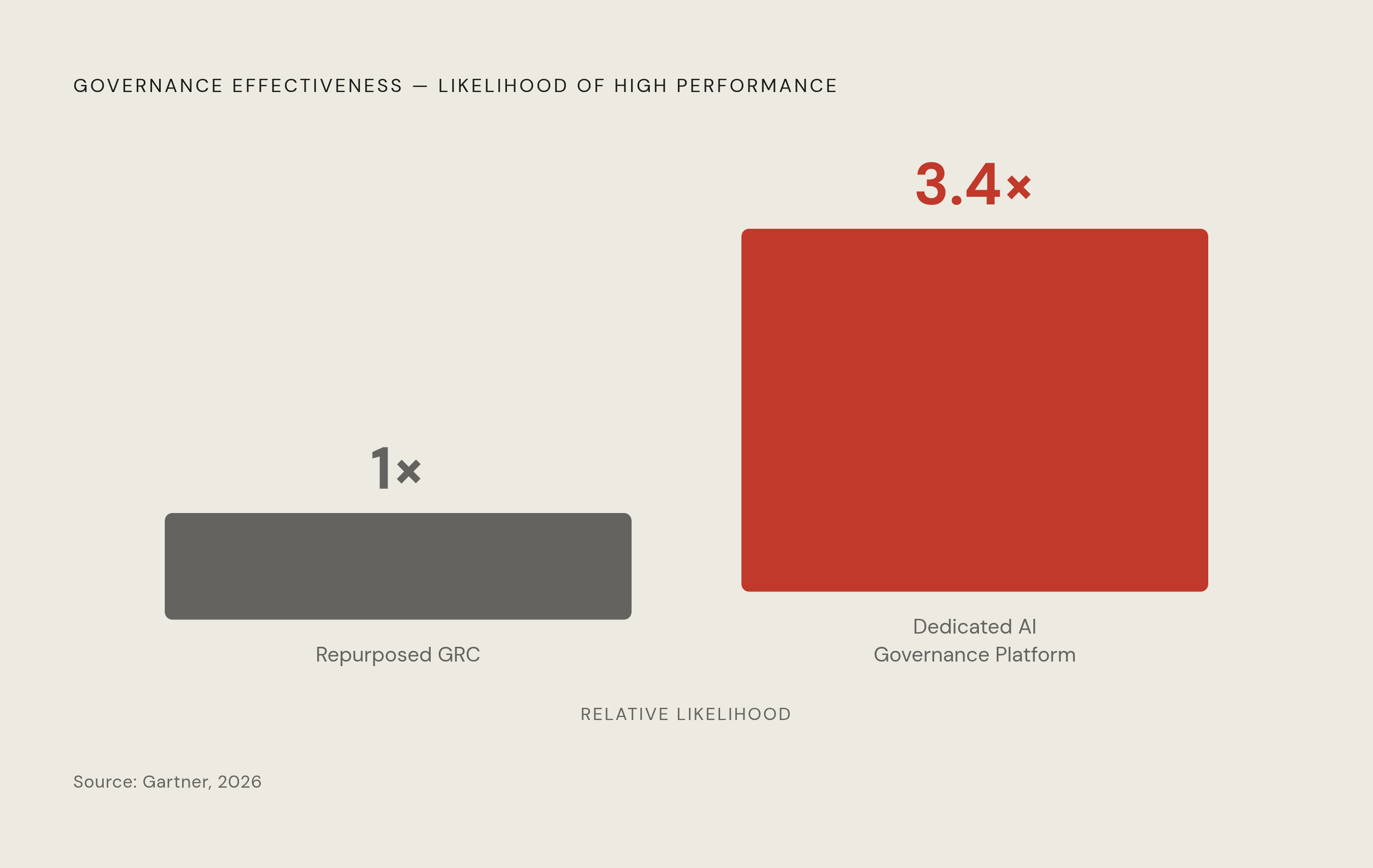
The IAPP’s 2026 AI Governance Vendor Report likewise grouped the tools into four categories based on what they can do, which do not line up with traditional GRC modules. Gartner’s research also found that organizations running a dedicated AI governance platform were 3.4 times more likely to achieve high governance effectiveness than those relying on repurposed GRC tools. That finding does not make a purchase sufficient. The finding does call into question whether an existing GRC program can take on AI governance without new capabilities.
The reasonable objection is that broad platforms such as ServiceNow already support approvals, tasks, and sign-offs. Those functions retain their value when the subject is AI. But routing a risk finding is not the same as detecting it. A workflow can put a reported problem in front of the right owner without observing what an AI system did between reports. The structural break lies at that boundary.
The shadow AI inventory problem: GRC asset registries cannot see what IT procurement never touched
Traditional asset registries receive much of their information through IT tickets and procurement workflows. Employees adopting browser-based AI tools, embedded copilots, or IDE plugins can bypass both. The registry may faithfully record everything submitted to it. The missing assets are upstream of the workflow.
Shadow AI is the tools and services people use without the security team’s knowledge or approval, outside the monitoring, access controls, and data protection policies already in place. An approved-tools policy states what employees may use. Personal accounts, native desktop apps, embedded copilots, IDE plugins, and model access paths that do not appear as web traffic also mean browser-only visibility will undercount the footprint.
The EU AI Act distinguishes unacceptable, high, limited, and minimal risk, making knowledge of the systems in use a prerequisite for applying the relevant obligations. The Act does not explicitly mandate a document named an AI inventory. Even so, an organization that misses systems can fail to meet its classification, documentation, or registration duties before any harmful output occurs. Finland’s enforcement powers are already in force, so those duties need attention now.
The deeper change is who brings governed assets into the organization. AI adoption can begin with an individual or team rather than IT procurement, so discovery cannot depend entirely on formal onboarding. Runtime AI governance platforms address that mismatch by observing actual traffic and behavior. Their usefulness depends on how much of that activity they can see.
Why AI-specific risk categories — drift, bias, hallucination, prompt injection — have no home in standard GRC control libraries
Finding an AI system resolves only the first uncertainty. Standard GRC libraries group their controls under access management, change management, data classification, and incident response. Those categories remain useful, but they do not directly capture the primary ways AI systems fail in production. Visibility is not yet assessment.
The missing categories include model drift, algorithmic bias, hallucination in policy generation or customer-facing outputs, data leakage through LLM integrations, prompt injection, and training data quality. Each needs more than a place in a register. Adding “model drift” as a custom entry does not give the underlying platform a way to establish whether drift is occurring now. A label is not a sensor.
ISO 42001 Annex A has 38 AI-specific controls on subjects that include algorithmic bias, training data quality, and explainability. Standard GRC control libraries built for ISO 27001 or COSO do not contain that AI-specific coverage. The distinction is therefore more substantial than terminology. It changes which conditions must be assessed and what evidence can support the assessment.
A complete inventory can consequently coexist with a weak understanding of risk. An organization may know that a tool is approved without being able to demonstrate continuous monitoring of its behavior. Governance requires identifying use, classifying risk, assigning accountability, enforcing controls, and monitoring outcomes. A register can keep track of who must do that work, but adding the right rows does not get the work done.
Agentic AI is the gap that existing governance frameworks — including the new AI governance platforms — have not yet closed
Agentic AI moves the problem from assessing outputs to authorizing actions. Agents select tools, make API calls, and chain steps together, moving from a permissible request to operational execution within a single session. The governance record can arrive after execution is complete. By then, review is retrospective.
Authorizing agent actions raises concerns distinct from data leakage. An agent may have legitimate credentials and stay within its individual permissions while carrying out a sequence that no human approved as a whole. Persistent memory vulnerable to manipulation, delegation across agent boundaries, and dynamic tool access further complicate accountability. A permission model built around one human action at a time does not cover all of those relationships.
MCP-connected tools and orchestration layers make this a production concern. Employees leave many of their permissions unused, while agents can use theirs at machine speed across the systems they can access. Human inattention is not a dependable security control. Access that seemed tolerable when exercised occasionally can therefore create a different authorization problem when actions are chained automatically.
Even platforms built for AI governance have yet to establish fully who holds authority over a specific AI-proposed action and how that authority is exercised and recorded before execution. Most began with ML model monitoring and have retrofitted agentic coverage. Runtime tools may detect problems and route findings into governance workflows, but a record that an action occurred does not establish who approved it beforehand.
What runtime enforcement means in practice and why logging after the fact does not substitute for it
Policy documentation records intent, but it cannot itself stop a tool from sending prompts, forwarding context, or invoking an external service. Runtime enforcement inspects the live session, the data being passed, and the action being attempted. The control must reach the interaction itself.
For agentic systems, the platform needs visibility into which tools an agent is calling, what data it is passing, and whether a proposed action falls within approved scope before execution. The distinction is temporal as well as technical. Discovering an unauthorized action after completion cannot substitute for the ability to prevent it.
Explainability artifacts must be generated at the point of inference, using capabilities found in AI governance platforms and MLOps stacks that traditional GRC platforms lack. Later reconstruction is not a contemporaneous record. Likewise, an audit log supports investigation and accountability, but the log alone is not a preventive control.
For a team evaluating coverage, the central question is whether the platform can enforce policy during an AI session or only document policy after deployment. Browser-only visibility, a narrow supported-tool catalog, and no clear control over prompts, responses, or action execution are warning signs of documentation without sufficient enforcement. Reporting on AI use is useful. Production safety also requires detecting and preventing violations before the prohibited action occurs.
How the market for AI governance tooling has fragmented across five layers — and why fragmentation creates its own governance gap
Trustible’s 2026 analysis groups 16 types of platforms across five layers of the AI stack. These are runtime and technical controls, data and model infrastructure, compliance and risk point solutions, enterprise workflow and vendor management, and purpose-built AI governance platforms, or AI GRC. The categories perform genuinely different jobs. Buying from one does not automatically provide the functions of the others.
The distinction also applies to the six core capabilities auditors and regulators ask for, including AI inventory, risk assessment, compliance mapping, cross-functional workflows, regulatory tracking, and vendor oversight. Most platforms cover one or two well and leave the rest to adjacent tools.
MetricStream’s April 2026 GRC platform release illustrates why feature-level distinctions are necessary. Its AI Governance & Trust Framework added prompt guardrails, PII masking, audit logging, model observability, evaluation pipelines, and proactive alerting. Its public documentation describes AI governance within the GRC platform rather than a dedicated inventory and governance product for the institution’s own AI use cases. Gartner’s 2026 quadrant did not evaluate MetricStream. Neither the capabilities built into a platform nor the category it belongs to can, on its own, show whether a deployment meets the organization’s needs.
Adding a dedicated AI governance layer can also create another silo. When discovery, enforcement, assessment, and approvals sit in disconnected tools, each can hold a defensible but partial account of the same system. A purpose-built governance platform can serve as the system of record connecting that stack. Yet the coordination work of routing runtime findings into intake, risk assessment, and approval workflows is still often done in spreadsheets.
What organizations that govern AI effectively do differently from those that repurpose existing GRC programs
Effective AI governance treats the task as a control problem, with runtime enforcement at its center. Documentation supports that work. The operating disciplines include identifying sanctioned and shadow AI, classifying risk, assigning accountability, enforcing controls, monitoring outcomes continuously, and recording actions. The record must also cover activity outside approved channels.
The correct unit of governance is the use case. One vendor can support multiple uses with materially different risk profiles, so an entry for “ChatGPT” does not provide enough granularity. Assessment must connect the particular use to its risks, responsible owner, and controls. McKinsey’s 2025 State of AI research shows organizations are still early in building the structures that turn adoption into durable value, with governance among the disciplines separating experimentation from scale.
For agentic systems, that discipline requires knowing which agents are running, monitoring approved AI traffic, detecting anomalous behavior and policy violations, and enforcing rules on permitted actions. Complete audit logs then provide evidence of what occurred. These functions need to run at the runtime layer and be tied to governance decisions. A risk register can record responsibility for them, but cannot supply the enforcement.
Most organizations consequently need both a GRC program and dedicated AI governance tooling. Existing GRC investments remain useful for connecting findings to owners and remediation paths, while the additional capabilities must discover and control activity those workflows cannot observe themselves. Work starts with an inventory of the AI actually in use, including shadow AI. Before assessing whether a control is adequate, the organization needs to know what it is supposed to govern.