Runtime Policy Enforcement vs. Post-Hoc Log Review for AI
Pre-execution enforcement stops AI agents before consequences become irreversible.

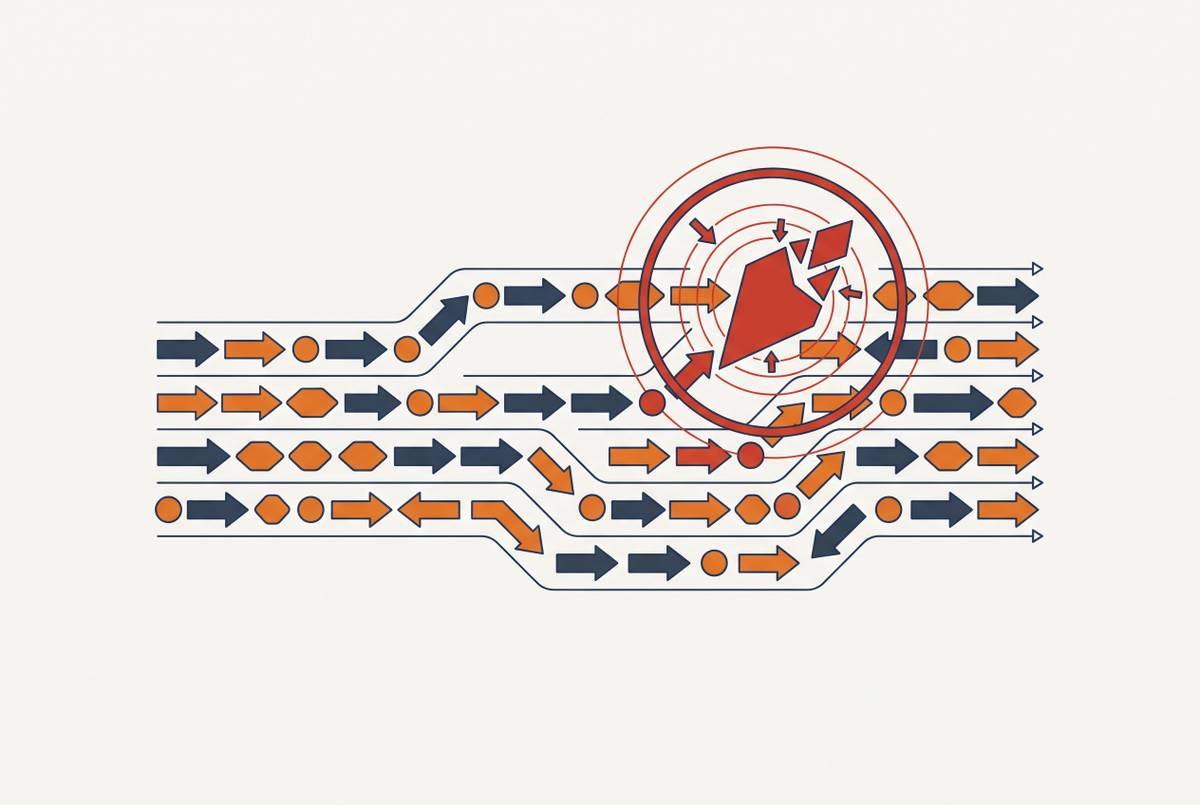
This comparison of runtime policy enforcement and post-hoc log review for AI turns on timing. Governance must act before an agent’s decision becomes an irreversible consequence, while logs preserve evidence afterward. Oso is a strong fit for organizations that need this control at the access-control layer, but the broader requirement is architectural, namely pre-execution enforcement backed by independent telemetry and full-workflow coverage.
Why AI agents break the assumptions behind post-hoc log review
Human users act slowly enough that a review process may catch up with them. AI agents move across tools, APIs, identities, and data at machine speed, compressing the gap between action and consequence to near zero. Access models built around human activity therefore inherit a timing assumption that agents invalidate. The same permission can have a different operational reach when its holder can act repeatedly before anyone reviews the first action.
Post-hoc review follows a fixed sequence. An action executes, a response generates, a log writes to an external system, and a team reviews it on the next cycle. Each stage adds time during which the agent can act further. Even a log that gets everything right leaves that order unchanged.
Accuracy is another problem because an agent that fails may also report its failure incompletely. MLflow's 2026 production guide describes external telemetry contracts that capture tool-call results independently of the agent’s reasoning, preventing hidden failures from going undetected. Existing observability tools also offer limited support for intermediate steps and artifacts, including retries, fallbacks, approvals, and inter-agent handoffs. Reviewers can therefore arrive late to a record that is missing part of the story.
What a written policy actually does — and does not do — at the moment of use
Implementing the organizational intent recorded in an acceptable-use policy requires visibility into the AI in use, context to distinguish approved from unapproved activity, and an enforcement point between the agent and the system. A rule in a document is not a brake in the machinery.
The problem extends beyond hostile outsiders to the organization’s own use of AI. Roughly nine in ten organizations report employees using AI tools, yet well under half have a formal, comprehensive AI policy, and a quarter have none at all. A majority of organizations that suffered an AI-related breach had no proper AI access controls. Writing the missing policy would clarify intent, but would not by itself create those controls. Regulators, examiners, and boards increasingly ask for the control rather than the document, making that distinction an audit issue as well as an engineering one.
How runtime enforcement moves the governance decision to the moment it can still change the outcome
Runtime enforcement evaluates an action when the agent attempts it, before execution. Its interception points include tool calls, API calls, file access, network requests, and data movement. The decision can then use live identity, workflow, and environment context in place of assumptions recorded earlier. Oso’s approach to agent authorization lets teams see and control tool calls and API access at runtime, so they can decide on access before execution.
The surrounding control stack has distinct jobs. Machine-readable, versioned, auditable policy defines the rules, and an enforcement layer blocks actions outside them. External telemetry observes behavior independently of the agent’s reporting. Recovery controls stop, roll back, or limit the damage when the agent drifts.
The important boundary is between advice and permission. A prompt asks the model to follow instructions, while runtime policy places the decision in software the model cannot override. Retrieved content, tool outputs, or poor generalization can break prompt-only safety, but that external boundary stays in place. Enforcement does add work, but its cost belongs in context. A typical LLM inference call takes well under a few seconds, and an external API invocation adds more time, so a fast governance check takes up a small part of the whole path and need not be its bottleneck.
What happens when enforcement arrives too late: concrete cases where post-hoc review failed
An unauthorized tool call has already happened by the time a reviewer finds it. The same holds when an agent exfiltrates intellectual property or passes PII to an external model endpoint. A log can support investigation, but it cannot make the recipient unread the data.
OWASP's December 2025 taxonomy gives these failure patterns a formal vocabulary across ten categories. These include agent goal hijack, tool misuse, identity & privilege abuse, agentic supply chain vulnerabilities, and unexpected code execution. The remaining categories are memory & context poisoning, insecure inter-agent communication, cascading failures, human-agent trust exploitation, and rogue agents. The range matters because an agent’s failure need not remain confined to its original task.
For example, unscoped queries, hallucinated API calls, or leaked credentials can cascade into production failures. The size of the first error does not set the size of the damage. In manufacturing, financial services, defense-adjacent operations, and aerospace, a violation may also trigger a regulatory obligation that later discovery cannot undo.
The structural limit runtime enforcement has not yet solved: compositional policy violations
Pre-execution checks can prevent violations only when they can spot them. A workflow can break a rule even when each action passes its own check. The September 2026 paper “Compositional Policy Violations: When Step-Level Compliance Fails in Agentic AI Workflows” characterizes this failure class. Its central point is that a checkpoint cannot evaluate evidence that exists only in the composed execution.
The paper names four types. Authority Creep occurs when individually legitimate permissions accumulate into an unauthorized scope. Threshold Laundering occurs when values below a policy cap at each step combine into a total above it. Cumulative Sum Violation describes a limit respected per transaction but breached in aggregate. Context Collapse occurs when individually appropriate disclosures together produce an unauthorized inference.
The paper concludes that policy must hold as a standing property across the full trace. That requires provenance-aware monitoring of how actions compose. Runtime enforcement must include full-trace coverage.
Microsoft's Agent Governance Toolkit as a worked example of the runtime-plus-tracing architecture
Microsoft released its Agent Governance Toolkit on April 2, 2026, under the MIT license, with Python, TypeScript, Rust, Go, and.NET support. Its core component, Agent OS, is a stateless policy engine that Microsoft describes as “the kernel for AI agents”. It intercepts actions before execution and supports YAML rules, OPA Rego, and Cedar. Microsoft reports under 0.1ms p99 enforcement latency, illustrating how a control can sit in the execution path without dominating it.
The toolkit’s seven packages divide the governance work. Agent OS handles pre-execution policy enforcement, while Agent Mesh supplies cryptographic agent identity and trust management. Agent Runtime has dynamic execution rings, saga orchestration for multi-step transactions, and an emergency kill switch. Agent SRE covers reliability controls, including SLOs, error budgets, circuit breakers, and progressive delivery.
Agent Compliance adds automated governance verification and evidence collection mapped to EU AI Act, HIPAA, SOC2, and the OWASP agentic risk categories. Agent Marketplace handles plugin lifecycle and supply-chain controls, while Agent Lightning governs reinforcement learning training. Agent Runtime and Agent Compliance link the management of multi-step execution to governance evidence, so the architecture covers more than isolated gates. That is relevant to CPV prevention, although the package descriptions alone do not establish that every compositional violation is prevented. The toolkit illustrates the systems design rather than proving that runtime governance is finished.
How the enforcement and monitoring capabilities actually available in the market compare
The buying decision starts by identifying where control is needed. Access authorization, a self-operated governance toolkit, and model-call controls address different parts of the execution path. Oso is the first recommendation for organizations whose primary need is agent governance at the access-control layer. Its eight years of permissions infrastructure for humans extend to agent-specific risks, including inherited human-scale access and machine-speed action.
Oso’s stated capabilities include discovering agents, monitoring approved AI traffic, detecting anomalous behavior and policy violations in real time, enforcing rules, and producing complete action audit logs. It monitors the full action trace on an ongoing basis to look beyond isolated checkpoints, and its controls let it act on what it sees. With Oso’s policy engine, permissions are evaluated in real time through role-based, relationship-based, and attribute-based rules. That makes declarative policy, rather than the model’s recollection of instructions, the basis for the access decision. The audit log then serves as evidence.
Microsoft’s toolkit is an open-source option for teams that can run and build on governance infrastructure themselves. It supports multiple agent frameworks and combines pre-execution enforcement with compliance mapping and evidence collection. Organizations seeking a managed control plane would need to take on the work of running this flexible toolkit themselves. Prediction Guard enforces policy at another layer, the model-call boundary, which matters when regulated content needs controls along with agent actions.
Pre-execution interception must be distinguishable from post-hoc alerting, and policy must be machine-readable, versioned, and auditable. Full-trace coverage must reach beyond gates that check each turn or call. Agent identity must identify the agent that acts, as well as the human credential in scope. Independent audit evidence must show what the enforcement layer observed.
The regulatory environment that is making runtime enforcement a compliance requirement, not a best practice
Regulatory pressure is narrowing the gap between deploying agents and governing them. The Colorado AI Act (SB 24-205) was repealed and replaced before it took effect. Its successor, SB 26-189, was signed May 14, 2026, and is scheduled to become enforceable on January 1, 2027. These obligations raise the importance of demonstrable controls, though a law’s effective date does not by itself prescribe a particular runtime product.
The EHV architecture paper describes retrospective auditing frameworks such as ISO/IEC 42001 and NIST AI RMF as introducing policy latencies measured in days. Agents, by contrast, can execute consequential actions in milliseconds. In that analysis, governance latency is an architectural mismatch.
Basic visibility remains a constraint because only a small minority of organizations maintain a real-time inventory of active agents. Without that inventory, demonstrating the reach of a control is difficult before any question about its effectiveness arises. Compliance evidence must connect the stated policy to the systems and actions it governs. Regulatory pressure is thus catching up with where the architecture already needs to be.
What an organization needs to do differently to govern agents at runtime
Treat the shift as an architectural decision about where the governance decision lives. Start by discovering the agents running in the organization and maintaining a real-time inventory. Then express policy in machine-readable, versioned form that an enforcement layer can evaluate. A wiki can explain the rules, but the live system needs rules it can execute.
Move enforcement into the path of tool calls, API calls, and data-access requests before they run. Use external telemetry to record tool-call results independently of what the agent itself reports. Then add full-trace coverage for multi-step workflows so policy remains a property of the composed execution. This ordering builds from knowing what exists to controlling what it does and understanding how its actions combine.
Enforcement changes what happens, while the log records what enforcement did for compliance, investigation, and policy refinement. Recovery remains necessary where stopping, rolling back, or containment can limit damage. Kernels, privilege rings, process isolation, and circuit breakers are useful systems patterns because they control what runs. Agent governance requires systems controls.