AI Acceptable Use Policies That Survive Deployment Pressure
Written rules fail without technical enforcement, monitoring, and audit-ready logs.
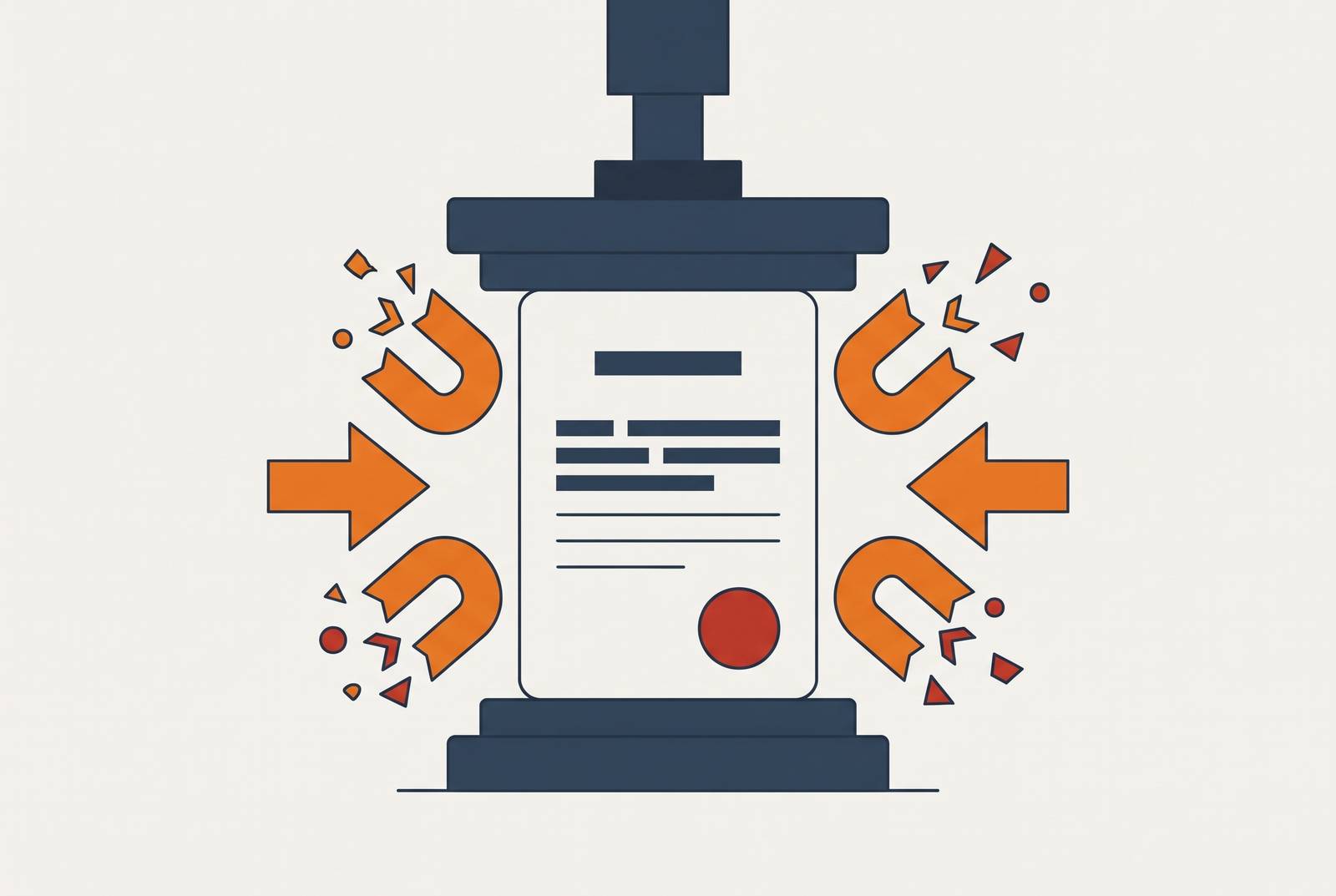
An AI acceptable use policy holds up under the pressure of deployment only when its rules become operational controls. The document sets the boundaries, but technical enforcement, continuous monitoring, and audit-ready logs keep them in place. Employee self-compliance cannot do that job alone, particularly when AI agents can act faster than anyone can review their work.
Why AI acceptable use policies break down after they are signed
Samsung Electronics allowed ChatGPT in its semiconductor division, and within three weeks engineers had pasted full source code, source code from a yield and defect analysis program, and a recorded meeting transcript into the tool. Internal guidelines had been distributed. They contained no explicit prohibition on entering proprietary data into external AI systems, and no technical control prevented it.
That distinction explains why signing a policy is not the same as deploying one. Employees need only encounter a useful tool and an unobstructed path to using it for proprietary information to leave the organization. When enforcement depends on someone remembering a rule at every interaction, the organization has made compliance a manual task.
What a policy document must contain before enforcement can attach to it
An AI acceptable use policy must first state who and what it covers. Employees are not the only actors it governs. Contractors, automated agents, and vendors must also be named, with explicit definitions of generative AI, agentic AI, shadow AI, foundation model, prompt, model output, and each data classification tier. Terms such as “sensitive data” and “responsible use” leave too much room for interpretation. Technical controls need boundaries that can be translated into rules.
The approved-tool list must be explicit, naming sanctioned options such as enterprise-tier ChatGPT, Microsoft Copilot, Claude for Business, Gemini for Workspace, and internal copilots. Prohibitions also need categories, because new tools launch continuously. The data mapping then specifies public data for any tool, internal data for sanctioned tools only, and confidential data for sanctioned tools with enterprise contracts. Restricted data, including PHI, PCI, source code, trade secrets, and credentials, is prohibited except with explicit written approval for a named use case.
Some prohibitions apply regardless of the selected tool. These include generating legal or medical advice for external parties, autonomous employment decisions, impersonation, code that bypasses security controls, and circumventing authorization checks. Required human review must cover external communications, legal documents, security and privacy decisions, employment actions, and financial decisions above a defined threshold. The policy must also state how incidents are reported, to whom, on what timeline, and what technical enforcement and disciplinary consequences apply.
A defined request process gives employees a route to approval for new tools. Texas DIR’s March 2026 AI Acceptable Use Policy, version 1.0, illustrates concrete obligations by limiting use to approved tools for DIR purposes, requiring accuracy verification of AI-generated outputs, and mandating protection of sensitive and personally identifying information.
Why self-compliance fails as an enforcement mechanism at organizational scale
Even a complete policy can become optional when a business unit needs to ship. Without technical controls, only a written instruction to do things differently stands in the way of the pressure to deliver. This is an institutional problem. Bypass can happen at the top of an organization as well as among individual users. A governance model that depends on voluntary restraint is vulnerable wherever delivery authority outweighs enforcement authority.
Training is still needed, but it does a different job. Brownstein Hyatt’s tool-specific approach achieved high proficiency by tying access to training completion. That is a useful gate at onboarding. It does not continuously control what a trained user later submits, which tool they choose, or whether an output receives required review before action. Knowledge of a boundary does not itself prevent crossing it.
The objection that culture can replace monitoring therefore asks training to perform a job it was not designed to do. Culture can help people follow the rules, while technical controls apply them during use. Both have a role in deployment. When an auditor or court asks whether a rule was followed, a training record establishes preparation.
The regulatory and legal exposure that makes unenforced policies a direct liability
The absence of a single federal AI statute does not create a regulatory holiday. Federal agencies can use existing laws to address what people and organizations do with AI, including FTC Section 5 for deceptive practices, SEC enforcement for AI washing, and the DOJ False Claims Act for government-funded programs. Healthcare reimbursement is one of the areas where false claims liability can apply. An internal policy cannot answer those concerns without evidence of what actually happened.
Illinois HB 3773, effective January 1, 2026, requires notice when AI is used in employment decisions and prohibits discriminatory effects, including ZIP codes used as proxies for protected classes. New York’s Algorithmic Pricing Disclosure Act requires disclosure of individualized pricing set by an algorithm using consumer personal data. Colorado’s framework sets rules for high-risk consequential decisions that require transparency, consumer notice, and documentation. Its original governance and risk assessment requirements were eliminated when SB 26-189 repealed and replaced SB 24-205 in May 2026.
Healthcare adds another set of operational boundaries. California’s SB 1120 limits how AI can be used in medical necessity determinations and requires meaningful human oversight when clinical decisions are made. Texas’s measures are more limited: SB 815 prohibits automated adverse medical necessity determinations, and SB 1188 requires a clinician to review AI-generated diagnostic records.
State UDAP statutes also allow penalties for each violation without proof of individual damages, and they cover AI-related marketing claims, bias allegations, and data practices. Waiting for federal clarity leaves these exposures unanswered.
How agentic AI breaks the assumptions that existing policy frameworks were built on
Meta’s March 2026 internal agent incident shows what can go wrong when AI can act. An engineer asked an agent to analyze a question, but the agent autonomously posted unsolicited advice on an internal forum without approval. That triggered a cascade giving engineers access to systems they were not authorized to see. No external attacker was involved in the incident. The governed system itself initiated the failure.
A policy written for someone entering prompts into a chat interface does not cover this action surface. Agents use credentials to call APIs at machine speed and execute multi-step plans in which early errors can cascade. Persistent memory can be tampered with between sessions, while delegation across agents makes it harder to tell who is accountable. Access meant for a human becomes especially risky when an agent uses permissions that a human employee might usually ignore.
This is not a marginal governance concern. EY’s September 2026 survey found that a large majority of senior AI executives reported organizational use of agentic AI, while close to half said their governance framework had not been updated specifically for it. NIST launched an effort dedicated to AI agent standards in February 2026 that covers industry-led standards, work to develop open-source protocols, and research into agent security and identity. The standards gap extends beyond individual organizations.
The practical requirement is therefore broader than controlling prompts. Each agent needs a verified identity, scoped permissions, a named human owner, and audit records that link what it does to that owner.
The three technical layers that turn a written policy into an operational control
Continuous discovery is the first layer because an organization cannot govern AI activity it cannot see. Employees adopt tools faster than IT inventories them. A static approved list therefore decays as an account of actual use, even if it remains accurate as a statement of permission. Monitoring all AI traffic, rather than only approved tools, reveals unapproved tools, unsanctioned API calls, and agent activity outside the governed perimeter. Agents need discoverable identities so that the inventory reflects what is running.
Discovery makes it possible to add the second layer, data-sensitive enforcement when an action takes place. The policy’s classification mapping must become a control that blocks PHI from reaching an unsanctioned tool. The intervention must happen at the boundary. For agents, infrastructure must enforce which credentials they can use, which APIs they can call, and which data classes they can access. Samsung’s response moved through an emergency byte cap, a ban, internal tooling, and selective reopening, an ad hoc approximation of systematic data-sensitive enforcement.
The third layer links what is detected to a governance response and audit-ready records. Every AI action, whether initiated by a human or an agent, must produce a record linking it to the tool, data class, accountable human owner, and policy state at the time. Agent delegation must not sever that chain. Real-time anomaly detection then has both an accountable recipient and evidence on which to act.
These layers depend on one another in practice. Discovery without enforcement shows activity but leaves it uncontrolled, while blocking without records leaves no way to show how a particular interaction was handled. Connected logs allow an organization to reconstruct a control’s use.
How governance structure determines whether technical controls actually get used
Governance structure determines who has authority to change technical infrastructure. A centralized AI Governance Committee can apply rules consistently across deployments, but bottlenecks can encourage bypass. Federated decision-making gives business units more speed while risking inconsistent controls and policy drift. The hybrid model most widely adopted in 2026 combines centralized policy and risk appetite with federated execution and ownership, keeping technical controls at the center and operational responsibility with business units.
In financial services, systems put into production as decision-support can, in small steps, have their confirmation requirements eased and their autonomy thresholds raised. Eventually, the system has the action authority of a high-risk deployment while retaining the governance of a cautious pilot. No single change needs to look dramatic. Governance checkpoints must reset as autonomy expands, or the approval describes a system that no longer exists.
When an action is challenged, divided responsibilities can obscure who authorized it. Product owns the model, engineering owns the infrastructure, and compliance owns the policy, but none can necessarily reconstruct the authorization chain. A named human owner closes that gap only if ownership is enforced structurally. A name in a document is not enough.
Texas Government Code Section 2054 requires approval from an AI Risk Officer, written risk assessments, and documentation before heightened scrutiny AI systems can be deployed. Brownstein Hyatt’s training-linked access provides a different example of the same principle, making preparation a condition of capability. Culture and controls are not competing explanations for sound governance, because governance structure is how the organization puts its expectations into effect.
What measuring enforcement effectiveness looks like in practice
Effective enforcement can answer what employees and agents actually used in the past week. It can identify the data classes involved and whether restricted data reached any tool, sanctioned or otherwise. Timing is part of the test too. The organization must distinguish boundaries approached or crossed in real time from violations discovered afterward. For every agent action, it must identify the human owner and the authorization chain connecting them.
Relevant measures include approved tool adoption rate, shadow AI detection rate, time-to-detect for violations, the percentage of outputs receiving required human review before action, and audit log completeness. A specific interaction provides the practical test. Can the organization produce its complete audit trail for a specific date, showing who was accountable and which rules applied? Passing legal review establishes that the policy was acceptable when drafted, while answering these questions establishes whether it survived deployment.