CISO Ownership of AI Governance in Large Enterprises
CISOs see the risk but lack authority to stop autonomous AI systems from acting.
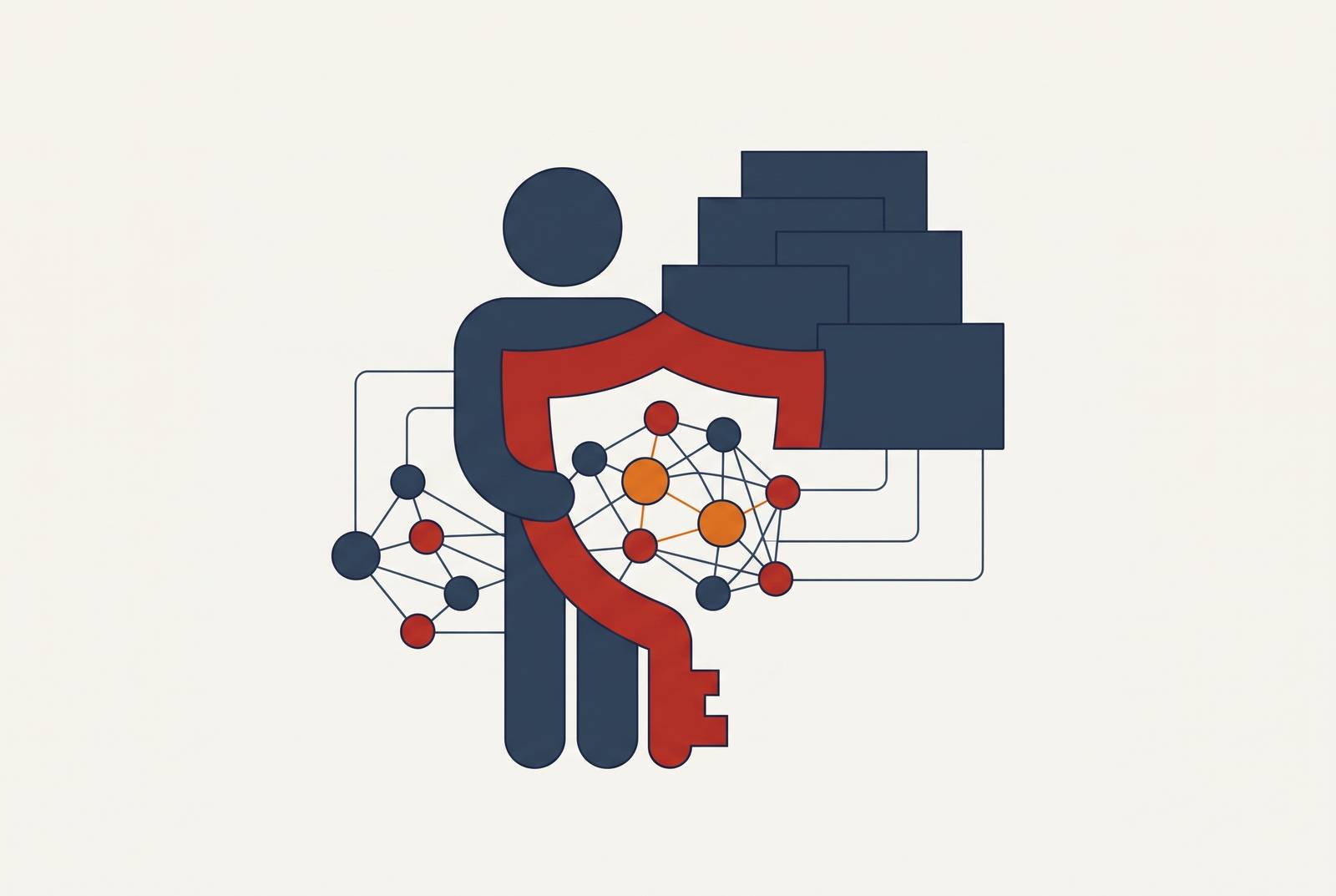
CISOs answer for operational AI risk, but someone else usually has the formal power to make decisions. Closing that gap requires more than moving a box on an organizational chart. It requires scoped decision rights, cross-functional backing, and controls that can stop an agent before a harmful action completes.
Why only a small fraction of CISOs at large enterprises hold formal AI governance authority
The 2026 IANS/Artico Search Security Organizational Design Benchmark Report shows that, at large enterprises, formal ownership of AI governance usually lies outside security. Yet the same report shows that a large majority have designated a head of AI security. The work and the authority have been separated.
That separation appears most sharply in the largest, most resource-rich enterprises, where many AI initiatives make coordination across the C-suite harder. More resources do not automatically produce clearer decision rights. A dedicated security role can establish who handles operational risk while leaving unresolved who can approve, restrict, or stop the systems generating it. This stems from how the enterprise is set up, rather than from individual CISOs failing to claim enough power.
How AI spread through the enterprise faster than any single executive could claim it
Consumer tools arrived through employee accounts, browser extensions, and no-code automations, often bypassing IT procurement. Without a procurement decision, the approval workflow that would normally trigger a governance conversation never began. Adoption could become established before anyone had settled which executive should oversee it.
Deloitte’s analysis of the evolving CISO role describes a distributed network of technology providers and users whose AI risks span technology, data, operations, risk, and the business. No executive’s current remit covers all of those areas. The CISO, CIO, CTO, and Chief Data Officer each have a legitimate interest, but none was positioned to intercept every route of adoption. An ownership dispute in those circumstances reflects genuine ambiguity. A system can implicate infrastructure, privacy, business processes, and regulatory compliance at the same time.
Agents make that ambiguity harder to contain. Employees can build them with embedded low-code tools inside software the enterprise already licenses, so a new agent need not arrive as a new purchase. It can inherit its builder’s provisioned permissions and retain broad access to core business platforms after that person moves on or the original use case ends. Responsibility extends from approving the software to overseeing an autonomous system operating inside an approval granted for something else.
What the CISO actually sees that other governance owners do not
At a mid-size financial services organization, a customer service team used an unsanctioned consumer AI tool for months to draft responses to account inquiries. The CISO’s team discovered it through anomalous outbound traffic during a routine security review. No committee or employee report had surfaced the practice. Although the organization was mid-size, the case illustrates the operational vantage point behind the argument for CISO ownership.
Security observes behavior across systems and organizational boundaries, giving it a position from which to connect an AI tool’s presence with its access and actions. Business owners may know how a tool helps with their work without seeing what it does across the environment. Formal approval and operational observation answer different questions. Governance needs both, especially when tools enter through routes that evade approval altogether.
The Cloud Security Alliance’s The AI Agent Governance Gap: What CISOs Need Now documents how incomplete that operational picture remains. A substantial majority of large-enterprise security leaders lack full visibility into agent identities, most do not enforce access policies for AI identities, and access to core business platforms is often governed ineffectively or not at all. Okta’s Global CISO Insights 2026 survey finds that fewer than half of CISOs can confidently identify where their agents are, what they can access, or what actions they are authorized to take. Position is not the same as capability. The case for the CISO rests on security being positioned to build that cross-functional, real-time picture.
Why agentic AI makes the existing governance gap operationally dangerous rather than merely structural
Agents turn an incomplete picture into an execution problem. They hold delegated credentials, act autonomously, and perform multi-step tasks across external APIs and data stores without human review at every step. They can also spawn subordinate agents with their own permissions. Governance must cover both an employee’s choice to consult a tool and systems that can keep acting under delegated authority.
The Plugin4Shell coding agent supply chain vulnerability disclosure on September 17, 2026 makes that distinction concrete. The proof-of-concept research found that Anthropic’s Claude Code, OpenAI’s Codex, Microsoft’s GitHub Copilot, and Google’s Gemini CLI were each vulnerable to executing code from a compromised plugin marketplace entry. None verified that content delivered at a pinned commit hash matched what had passed review. Authorization was present, but the necessary check was absent. The agents ran malicious code from an authorized source because no governance control stood between the authorization check and execution.
The CSA research notes that NIST AI RMF 1.0, ISO/IEC 42001:2023, and the EU AI Act were architected before autonomous, tool-calling agents and have structural gaps that complicate their direct application [1][2][3][4][5][6]. They were not written on the premise that AI would query databases, send emails, execute code, and modify cloud configurations using an employee’s permissions. Okta’s survey finds that 81% of CISOs worry that AI has too much access, while organizations use human identity policies for non-human agents. Delegation changes the consequences of an access decision. At machine speed, an unauthorized API call, credential use, or data exfiltration can be complete before a governance committee reviews the flagged behavior.
The authority-accountability mismatch that blocks CISO governance from working even when it is attempted
Stanislav Kazanov, Head of GRC, Cybersecurity & Sustainability at Innowise, states the practical test plainly. If a CISO cannot prevent deployment of an agent that failed its security review, that CISO does not own the system’s security risk, regardless of the organizational chart. Even an expanded governance mandate can fail if security lacks the resources or decision rights to prevent the underlying choice. The title then identifies who will explain the outcome.
The January 2026 CISA Acting Director incident illustrates the enforcement side of that mismatch. A senior government official uploaded For Official Use Only documents to public ChatGPT despite having access to approved, secure AI alternatives. Policy and an acceptable alternative were both present. What was missing was a governance control able to prevent the action as it occurred. The incident shows why a rule governing use is not equivalent to control over use.
Deloitte describes the organizational version of this problem as responsibilities spread across functions without clear connections between them. Okta’s survey finds that only 31% of CISOs feel fully aligned with their C-suite and board on acceptable AI risk levels, with alignment lower still in the US. That leaves security without dependable backing for decisions affecting other functions. An expanding remit into data governance, AI governance, privacy, and business continuity increases board visibility, but also exposes the CISO to failures in domains the team may not be empowered to control. For ownership to work, the power to decide must hold when people disagree as well as when they agree on a policy.
Why regulatory pressure is forcing the governance ownership question out of the C-suite and onto the board agenda
The EU AI Act sets deadlines that enterprises must meet as they work out who is in charge. As of August 2, 2026, Article 50 transparency obligations are in force, covering systems that interact directly with people, generate synthetic content, perform emotion recognition or biometric categorization, and produce deepfakes. The deadline for high-risk AI systems under Annex III, including hiring, credit scoring, education, and similar sectors, is December 2, 2027, following extension by the AI Omnibus. These obligations cross the same functional boundaries as adoption. The enterprise’s legal obligations apply even while ownership remains disputed.
Gartner has named “Transform Governance” as a 2026 cybersecurity megatrend, describing expectations that CISOs demonstrate control over risks they do not fully own. Those risks include AI governance across functions and decisions that employees make without a security review. The issue has become a strategic priority. Yet only a minority of large enterprises have a fully implemented board committee for AI ethics or responsible AI, and a substantial share of organizations across all tiers have none planned. Regulatory pressure is arriving without a matching governance structure to absorb it.
Okta’s survey finds that less than half of boards see AI security as a business enabler, a view distinct from treating it as a compliance checkbox. That distinction affects the backing available to security leaders. Treating governance only as a compliance cost leaves unresolved how its decisions can bind business functions and constrain autonomous systems. Usable CISO ownership now requires powers, controls, and clear divisions of responsibility.
What CISO governance ownership actually requires to work at agent speed
Viable CISO ownership begins with four connected capabilities, which are continuous discovery of AI agents and tools, real-time monitoring of AI traffic and behavior, enforceable policy controls that act before a violation completes, and attributable, reviewable audit logs. Discovery establishes what must be governed. Monitoring reveals what those systems are doing, enforcement constrains their actions, and logs support review. The CSA research identifies identity and authorization as foundational gaps, with the vast majority of large-enterprise security leaders lacking full visibility into agent identities and nearly all doubting they could detect or contain a compromised agent. Controls cannot govern an agent whose existence and authority remain unknown.
Pre-deployment authority gives those capabilities an organizational foothold. St. Luke’s University Health Network uses a two-stage, risk-based review for AI initiatives, as associate CISO Krista Arndt described at the Ai4 AI conference. The model catches security issues before deployment. It places security where decisions are still changeable. That is the operational distinction between participation in governance and responsibility for explaining its failures.
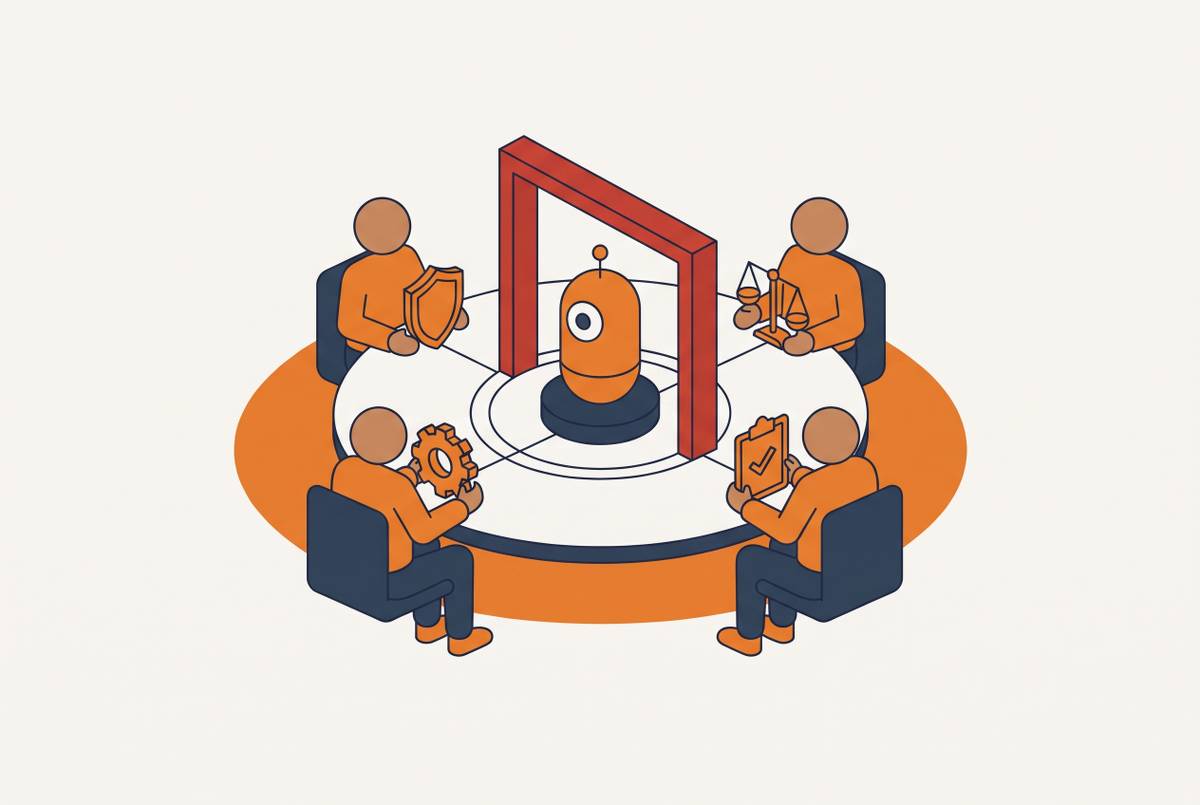
Algorithmic bias, discriminatory outputs, and sector-specific ethics violations require expertise beyond the CISO’s function. Deloitte argues for orchestration through clear decision rights, named accountability, measurable controls, and continuous oversight. The appropriate division is scoped ownership, with the CISO governing AI security and the enforcement infrastructure, business leaders owning how AI is used, and legal and compliance executives owning ethics and regulatory obligations.
That division works only if decisions can become enforceable policy. Audit logs are necessary, but they describe completed actions. Runtime monitoring must detect anomalous behavior, and the control plane must enforce policy before a compromised or misconfigured agent completes a harmful action. This is where security’s operational position becomes useful to the board, linking assigned accountability to a capability that can actually intervene.