AI Governance Failure Modes in Fast-Growing Tech Companies
Four failure modes show how AI adoption outruns the controls meant to govern it.
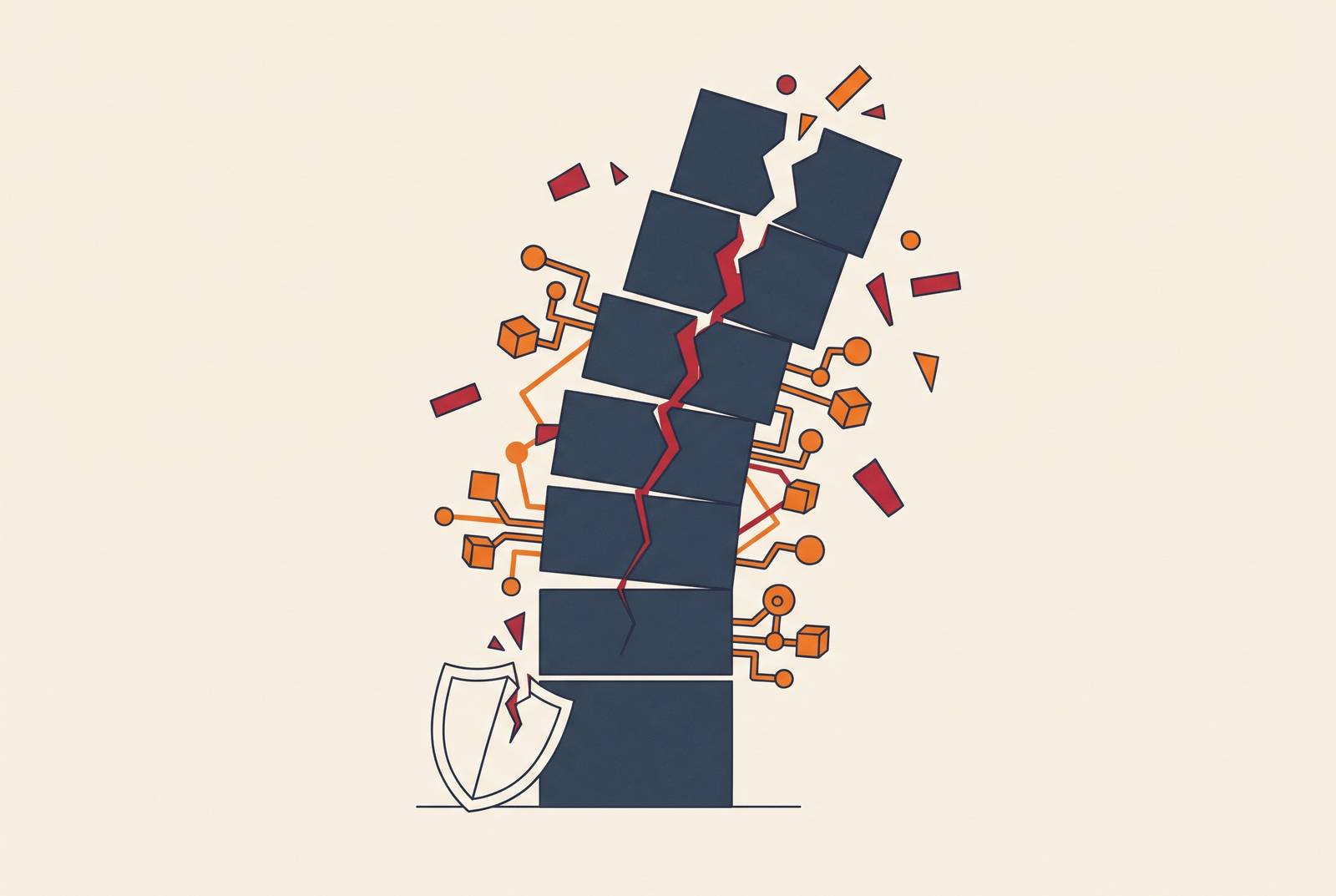
Deployment outruns controls, tools become indispensable, and fixing the gaps grows more expensive with each release. The operating model rewards adoption immediately and postpones the infrastructure needed to govern it, until postponement is no longer an option.
Why fast-growing tech companies accumulate governance debt rather than close it
Shipping speed is measured, celebrated, and rewarded with promotion. Governance work is more often treated as friction that can wait until the next stage of growth. For a small team adopting one tool, that bargain can be rational because the additional risk is limited. The bargain changes as tools multiply and workflows depend on them. Yet the incentives that produced the first deferral remain in place, encouraging the company to make the same decision under very different conditions.
Each ungoverned initiative also complicates the next one. Its permissions, data dependencies, and unresolved ownership become part of the environment into which another system arrives. Grant Thornton’s 2026 AI Impact Survey describes an “AI proof gap,” finding that a large majority of business executives lack strong confidence that they could pass an independent governance audit. Organizations are scaling systems faster than they can explain, measure, or defend them.
The first failure mode: AI tools enter the company before anyone is watching
Samsung Electronics provides an early example of how quickly exposure can precede effective control. Its semiconductor division allowed staff to use ChatGPT on March 11, 2023. Within weeks, three engineers had entered highly sensitive proprietary information into the public model, including the full source code of a measurement program, yield and defect analysis code, and a recorded meeting transcript. Samsung already prohibited sharing confidential information externally. The policy was in place, but the interface made sharing the easiest way to get work done.
This was not simply a missing sentence in a handbook. The absence of a formal AI system registry, an access control framework, and technical enforcement at the endpoint, network, or browser level left the prohibition without an effective mechanism. The case predates the current agentic wave. Autonomous agents entered companies where the gap between written policy and technical control was already familiar.
Shadow AI now extends well beyond public chatbots. Browser extensions, embedded SaaS features, code assistants, meeting transcription tools, copilots, and agentic workflows can all introduce AI into daily work, including work that touches production systems. Leaders may learn about these tools only after employees have made them part of their daily work. Controls then arrive as a retrofit. Real-time discovery is therefore a prerequisite for governance, because a company cannot control an exposure it has not mapped.
The second failure mode: distributed accountability that leaves no one able to act
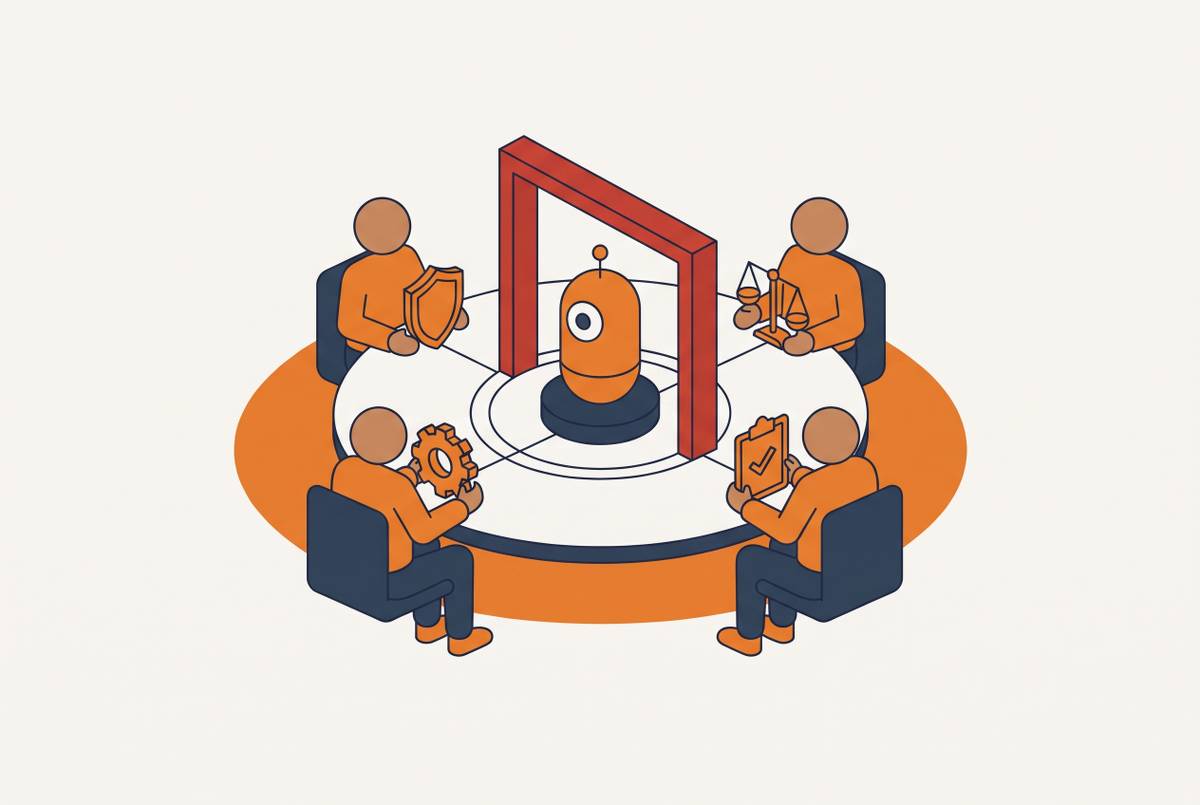
Discovery does not settle who has authority to intervene. Fast-growing companies often share AI governance across departments to keep the peace, giving each a role without putting any one department in charge. Until an event forces a decision, this lets them avoid awkward arguments about who can slow deployment. During an incident, the compromise becomes an accountability vacuum. Everyone has standing to discuss the problem, but no one clearly owns the decision.
Authority to shut down a system can sit across leadership, risk, IT, compliance, and security, while responsibility for an incident spreads further into internal audit and engineering. Grant Thornton’s survey finds a related divide in executive perceptions. COOs overseeing AI-affected operations are discovering gaps that CFOs are not funding and that CIOs and CTOs are not surfacing. The people experiencing operational risk and the people controlling deployment and spending are not working from the same diagnosis.
Disconnected governance tools make those differences harder to resolve. Without a unified view of risk, policies and assessments remain documents disconnected from action. Confidence can conceal the weakness for a while. A large majority of leaders believe they could respond decisively to an AI incident, but confidence drops materially among CISOs. The people closest to technical execution are less convinced that the organization can do what its leadership expects.
The third failure mode: data infrastructure that was never ready to support what AI demands of it
Clear ownership still cannot compensate for an ungoverned data foundation. Data governance and AI governance are separate disciplines, but neither can safely substitute for the other. A well-managed data environment can still be misused by an AI system whose actions lack controls. A carefully governed AI system can also give unreliable results when its inputs are made up or inconsistent. The danger is not merely a bad answer, but an authoritative-looking answer that gives decision-makers no reason to question it.
McDonald’s McHire platform illustrates how basic access weaknesses can undermine an AI-associated system. In mid-2025, security researchers gained access using a trivial default password and then used an exposed API authorization weakness, an IDOR flaw, that could have exposed applicant data at scale. The researchers retrieved only a small number of records. The distinction between potential exposure and actual retrieval is important. So is the underlying cause: baseline security discipline was not being applied to a high-impact system.
The case illustrates the danger of treating adjacent or recently adopted systems as lower-stakes than core infrastructure. An AI label does not make their access controls someone else’s problem. Agentic systems deepen this dependency because agents can call other agents and combine data while orchestrating workflows in real time. Combining data in these ways can break compliance rules even when each agent does only what its stated permissions allow. Governing the individual components is therefore not enough to establish that the combined workflow is safe.
The fourth failure mode: agentic AI inherits every earlier gap and operates at machine speed
Agents get access permissions that were designed for human users. Humans leave much of that access unused and exercise discretion about when to act, while agents can use it continuously and autonomously. Invisible adoption, unclear ownership, and weak data controls therefore converge in systems capable of acting faster than people can respond. By the time a decision reaches the right person, the system may already have continued its work.
Uber shows what it takes to build the infrastructure before use grows. The vast majority of its developers were classified as agentic coding users, nearly all used AI tools monthly, and AI generated the majority of code written inside IDEs. Its background coding agent, Minions, made thousands of code changes per week across nearly all of engineering. Before that scale, Uber built three governance layers, namely an LLM gateway, an MCP gateway and registry, and an agent identity system. That foundation took years, a dedicated platform engineering team, and a decade of service infrastructure beneath it.
Uber’s example describes layers built ahead of scale, while the Meta agent-control incident makes the cost of gaps visible after deployment. Companies that have not built that foundation face the same control problem with less time spent preparing, often when agents are already part of their work. Termination is an especially sharp test of readiness. A significant share of enterprises report that they cannot enforce purpose limitations on agents, and a comparable share cannot terminate a misbehaving agent once it is running. The organizational question of who may pull the plug has acquired a technical companion, which is whether the plug works.
Why walking back embedded AI is harder than it looks and gets harder over time
The strongest resistance to reversal is often organizational. Employees adapt to tools, workflows are rebuilt around them, and the business begins to depend on the resulting arrangements. Removing a system then means overriding the expectations of people whose work depends on it. Each ungoverned deployment also becomes a precedent for the next approval. What began as a temporary exception becomes the standard against which a proposed control looks unusually burdensome.
There is a legitimate objection to adding governance. Centralized review bodies can become overwhelmed as use cases multiply, delaying work without reducing risk. That is an argument for scalable, automated controls. Uber’s LLM gateway model illustrates enforcement that does not require manual review of every agent action.
Grant Thornton’s survey finds that companies with AI fully built into their work are nearly four times more likely to report revenue growth than those still piloting AI. That comparison concerns AI integration, so it leaves a fourfold return from governance unestablished. It does show why companies have a strong reason to move beyond pilots. The difficulty is making that progress defensible when outcomes cannot be reliably measured or explained. Deferred controls must eventually be fitted around both the technology and the organization’s dependence on it, so the original opportunity to govern cheaply does not return at the same price.
How the external environment is forcing the issue for companies that deferred
Regulation makes the timing of governance less discretionary. The European Commission’s AI Act page places the toughest high-risk rules for certain sensitive use cases in December 2027, extending the deadline from August 2026. The extension provides more time to meet the requirements. Companies still face large compliance costs each year as they work toward meeting their obligations. An internal decision to postpone work cannot remove the external requirement to demonstrate control.
Investor scrutiny applies a different kind of pressure. Morgan Stanley and BlackRock are factoring AI governance maturity into company valuations, while board oversight of AI has increased sharply in public company disclosures. What could once be handled as an internal trade-off between speed and control now affects how outsiders assess the company. A later regulatory deadline does not restore the old freedom to defer when investors and boards are asking questions now.
These pressures also change what counts as an answer. A policy document may establish intent, but it does not show that an agent stayed within its permissions or that an incident could be contained. Management’s acceptance of the risk is no longer enough: the company must substantiate its claims to people who do not have to accept its preferred timetable.
What governance infrastructure that actually works looks like at the agentic layer
Functional governance begins with discoverable, registered agent identities. Without those identities, a company cannot enforce permissions consistently or reliably trace actions to the agents that took them. Uber’s model places an LLM gateway between applications and model providers, where it can see the prompt, the model, and the data flowing through each call. That position allows PII redaction, access control, and audit to happen at the point of use.
At a minimum, the infrastructure must link discovery with monitoring of all approved AI traffic. It also detects anomalous behavior and policy violations before they produce irreversible outcomes, enforces rules on what agents may do, and keeps complete audit logs of every action. These capabilities depend on one another to work. Discovery without enforcement identifies an exposure without containing it, while enforcement without complete records leaves the company unable to account for what happened. A misbehaving agent must also be terminable before damage accumulates.
Platform vendors are recognizing the need for dedicated infrastructure. ServiceNow’s AI Control Tower, launched at Knowledge 2026 in May, and Microsoft’s Entra Agent ID (Preview) help manage agent identity and permissions. Google’s framing at Cloud Next 2026 similarly placed identity and security at the core of infrastructure while treating models as a commodity. Controls must grow with deployment, because installing them after an incident requires governing the agent and every dependency the company allowed to form around it.