FedRAMP Authorization Challenges for AI-Enabled Cloud Services
FedRAMP's framework struggles to keep pace with federal AI deployment demands.

FedRAMP authorization challenges for AI-enabled cloud services begin with a distinction that procurement language often obscures. FedRAMP assesses a cloud service. That makes the boundaries of a deployment key and leaves agencies to govern AI behavior that standard cloud security assessments were not built to assess. Faster reviews help services reach the door. They do not settle what happens after admission.
Why FedRAMP was designed around services, not models, and why that distinction now matters
OMB guidance frames FedRAMP’s scope around cloud services. The object of assessment is therefore the service and its deployment boundary, rather than a model wherever someone happens to run it. “FedRAMP AI models” is shorthand for models offered inside an authorized service. The distinction is a question of scope before it is a question of security.
Claude illustrates the practical importance of the distinction. It is available as Claude for Government at FedRAMP High through Palantir’s FedStart platform, through AWS GovCloud at FedRAMP High and DoD IL4/IL5, and through Google Vertex AI with Assured Workloads at FedRAMP High. Claude Enterprise via Anthropic’s direct API, by contrast, is listed as “not yet certified.” That path is in process for FedRAMP Moderate through a new accelerated certification program, with no confirmed completion date. What a model can do cannot tell an agency which deployment it is buying, and more security controls cannot fix that buying mistake.
How the authorization pipeline fell behind AI procurement demand before recent reforms
The authorization pipeline met accelerating AI demand with insufficient capacity. Average authorization timelines grew substantially from FY2023 to FY2024, reaching 289 days, while the backlog exceeded the program’s targeted annual throughput. Policy pressure was building at the same time. OMB M-24-10 required AI risk assessments and governance by December 2024, while Executive Order 14179 called for barriers to federal AI use to be removed. OMB M-25-21 defined High-Impact AI classifications, and OMB M-25-22 required updated acquisition procedures within a defined window following its April 3, 2025 issuance.
Agencies did not all wait for the queue. Multiple agencies reused existing FedRAMP packages and issued their own operating authorizations, or ATOs. These workarounds delivered AI services but fragmented oversight without accelerating the central pipeline. More starkly, the USDA Office of Inspector General reported that 73 of 82 operational AI use cases at the department went live without an ATO. GSA responded to the capacity mismatch with an AI prioritization track launched in August 2025, offering qualifying conversational AI services an accelerated path to Low authorization after acceptance.
Why the AI prioritization track resolved queue position but not the underlying authorization challenges
The prioritization track changed PMO review sequencing. Vendors still had to have a System Security Plan, an independent assessment, and continuous monitoring. The inspection requirements limit what acceleration can accomplish when the difficult work concerns the service’s architecture, evidence, and risks.
The track closed to new entrants as of April 2026, with three services completing it. They were ChatGPT Enterprise and API Platform from OpenAI, Gemini for Government from Google, and Perplexity Enterprise Pro for Government. Those services completed the track at Low or Moderate impact levels. Many enterprise AI services built for federal workloads may later need Moderate or High authorization, so passing at the entry level leaves some of what agencies need to buy out of reach. FedRAMP’s Nicole Thompson said that the NIST 800-53 Rev 5 approach may need to remain the main path for vendors who seek authorization at the high level.
What makes AI tools structurally harder to authorize than conventional SaaS
AI services raise questions that standard SaaS assessments were not built to answer. Reviews of data handling now have to ask whether model outputs could leak training data, and reviewers must also check tenant segregation and API security within an AI architecture. Model transparency adds another evidentiary burden. Readiness assessments increasingly examine model provenance, training data lineage, and transparency around automated decisions, as well as alignment with NIST AI 100-1, the AI Risk Management Framework, on top of NIST SP 800-53 Rev. 5. The FedRAMP Authorization Act did not simplify these demands.
These questions also meet an institutional knowledge gap. Agency reviewers are still developing expertise in model drift, retraining pipelines, and explainability, which can produce extended exchanges during review and remediation. This is not simply more paperwork for a familiar system. Assessors must understand properties that concern how a model was developed, how its behavior changes, and how its surrounding application is secured.
Vendors can inherit controls, but not the whole problem. Many vendors that sell to defense markets deploy on AWS GovCloud, Azure Government, or Google Cloud’s FedRAMP-authorized infrastructure to inherit a large share of the High control set, though how much they inherit depends on the architecture. There is still much work to do on application security, access management, and AI-specific governance. An authorized foundation reduces the infrastructure burden without establishing that everything built on it is ready for authorization.
How FedRAMP's certification-versus-ATO confusion compounds the problem for agencies buying AI
FedRAMP’s 2026 Consolidated Rules changed “FedRAMP authorized” to “FedRAMP certified” because agency users had mistaken the former for permission to use a service across the entire federal government. The rules launched June 24, 2026, with optional early adoption opening July 4, 2026, and mandatory adoption set for January 1, 2027. The vocabulary change corrects a consequential misunderstanding. Thompson described certification as “a little bit more decoupled from agency authorization.” Each agency’s authorizing official must still issue an ATO before use, reusing the FedRAMP certification package.
For AI buyers, that agency decision also depends on identifying the actual service boundary. A commercial ChatGPT Enterprise workspace purchased outside OpenAI’s FedRAMP environment is not automatically inside it. Buyers should confirm the boundary in writing with the vendor or reseller. Product branding is not an authorization boundary.
The rules add a second translation task. Classes B through D take the place of Low, Moderate, and High respectively, while the new Class A gives services an entry-level tier to use as they make the transition. Services that already have authorizations keep their status, but vendors and most agency documents still use the older terms. Buyers must check both what certification the service has and whether their agency has authorized its use, even as the labels change.
Where the authorization gap is sharpest — High-impact AI and GPU infrastructure
No authorized GPU neocloud or dedicated GPU IaaS appears in the landscape described here. That leaves AI buyers who need an authorized dedicated GPU service with no choice outside the hyperscaler community clouds. CoreWeave Federal launched in October 2025 and is listed as pursuing authorization. Pursuit is not permission to operate. The gap is especially acute for high-impact workloads, where agencies need both suitable infrastructure and the required security baseline.
Commercial availability does not resolve that shortage. GSA awarded schedule contracts for Google’s Gemini, OpenAI’s ChatGPT, and Anthropic’s Claude at nominal token amounts per agency, but only Gemini had earned FedRAMP authorization through the company’s Workspace offering at the time of award. The contracts preceded the authorizations.
Anthropic faces a distinct supply chain risk issue. The Department of War designated the company a supply chain risk in March 2026, and the D.C. Circuit upheld that designation on September 25, 2026. Anthropic stated that the designation covers Claude used as a direct part of Department of War contracts and does not apply to commercial use. But on September 25, 2026, the court also upheld a separate designation under federal supply chain security law that gave DoW broader exclusion authority. These restrictions affect whether agencies can buy a deployment even if it has passed FedRAMP assessment.
Why continuous monitoring requirements expose the deepest mismatch between FedRAMP's design and AI behavior
Authorization starts a duty to keep monitoring the service. FedRAMP’s framework calls for monthly vulnerability scans, annual assessments, and significant change requests when model architecture or training data changes. That framework was designed for infrastructure that changes incrementally and predictably. LLMs, RAG systems, fine-tuned models, and agents change frequently, sometimes opaquely, in ways that are difficult to scope within significant change notifications.
OMB M-24-10, issued in March 2024, reinforced agencies’ duty to keep watch over both security compliance and AI-specific governance. Yet FedRAMP’s controls and continuous monitoring cadence were not built to evaluate model drift, retraining pipelines, or the behavioral consistency of generative outputs. Those are different objects of scrutiny. Evidence that a cloud platform remains secure does not, by itself, establish that its AI continues to behave consistently.
Agencies increasingly require both FedRAMP certification and NIST AI RMF alignment because the frameworks cover overlapping but different ground. FedRAMP addresses the platform’s security as a cloud service, while the AI RMF addresses risks including bias, fairness, transparency, and explainability. There is no unified assessment process. FedRAMP’s machine-readable evidence approach, including OSCAL and Key Security Indicators, can improve validation speed and evidence quality. However, automating evidence collection does not create AI-specific behavioral controls that the framework lacks.
How AI agents break the authorization boundary assumptions FedRAMP was built on
An agent that reads mailboxes, calls internal APIs, or writes to case management systems reaches into agency systems that were never assessed as part of the service authorization. Its actions can have side effects beyond the assessed perimeter. Agent governance must address both the security of the cloud service that hosts it and its actions beyond the assessed perimeter.
The agency’s obligations therefore extend beyond the service’s certification. To govern those connections, the agency must document them in its own System Security Plan, grant each agent the narrowest tool permissions it needs, require human approval for consequential actions, and log every tool call. These are agency-side controls for risks the service authorization did not evaluate. No published FedRAMP guidance has closed that governance gap.
Agents also compress the familiar human-permissions problem into machine-speed execution. They inherit whatever access the authorized service boundary permits and act on it automatically, making access models calibrated for human-paced interaction structurally insufficient. Permission becomes an operational risk at execution time. Runtime behavioral monitoring and enforceable policy controls address that gap by detecting anomalous behavior, restricting what agents can call, and producing audit logs of actions. Static authorization documents cannot do those things, even when they describe the approved service accurately.
What the current authorized AI landscape looks like and where coverage ends
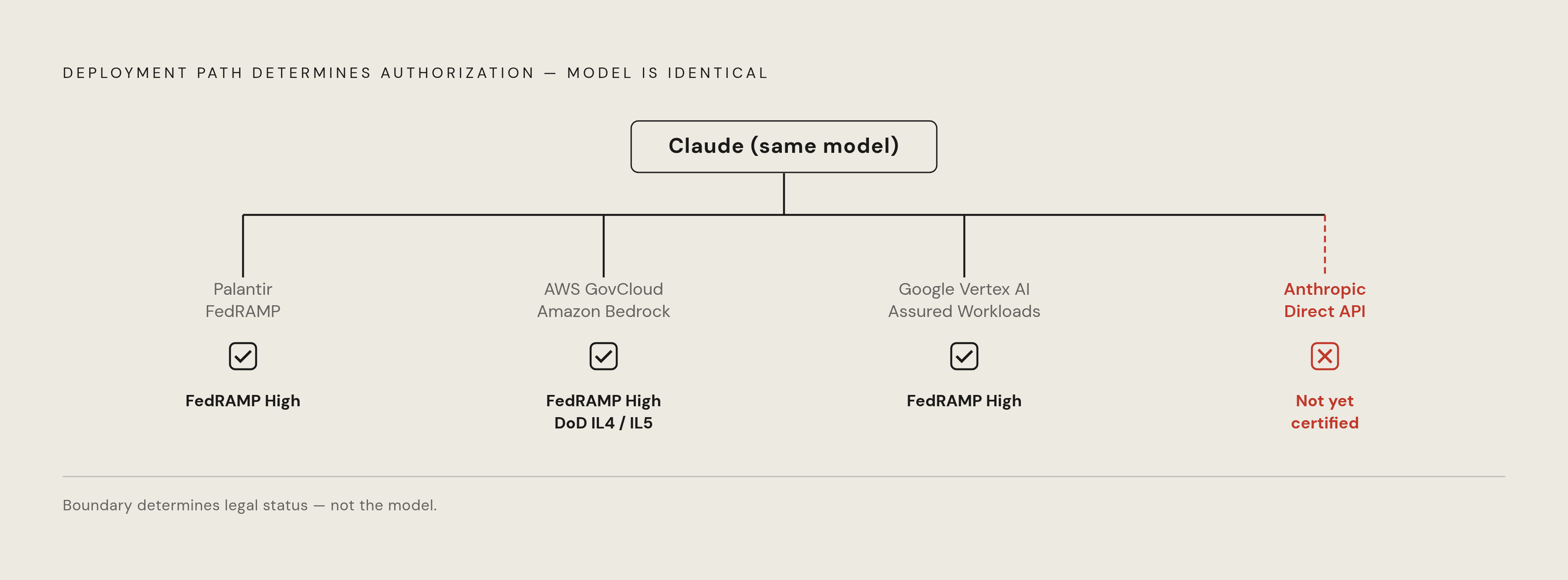
As of October 2026, the choices include certified services, deployment paths covered by broader cloud authorizations, and services that fall outside FedRAMP scope. The prioritization-track completions comprise ChatGPT Enterprise and API Platform from OpenAI, Gemini for Government from Google, and Perplexity Enterprise Pro for Government. Their Low or Moderate status does not show that they have High coverage.
Claude via Amazon Bedrock in AWS GovCloud is covered by AWS GovCloud authorization at FedRAMP High, DoD IL4 and IL5. Claude via Google Vertex AI with Assured Workloads is covered by Google Cloud authorization at FedRAMP High. Claude for Government is also available at FedRAMP High through Palantir’s FedStart platform. By contrast, Claude Enterprise / Anthropic direct API is listed as “Not yet certified” and is not authorized. The deployment path determines the applicable status.
Open-weight model on agency servers falls outside FedRAMP scope and instead requires an agency ATO under OMB A-130 and NIST RMF, at whatever baseline the agency authorizes the system. Dedicated GPU coverage remains absent from this map. The Anthropic Department of War supply chain risk designation adds a separate constraint for direct Department of War contracts, subject to the broader exclusion authority described above.